


The quiet loneliness of a mind shaped by books
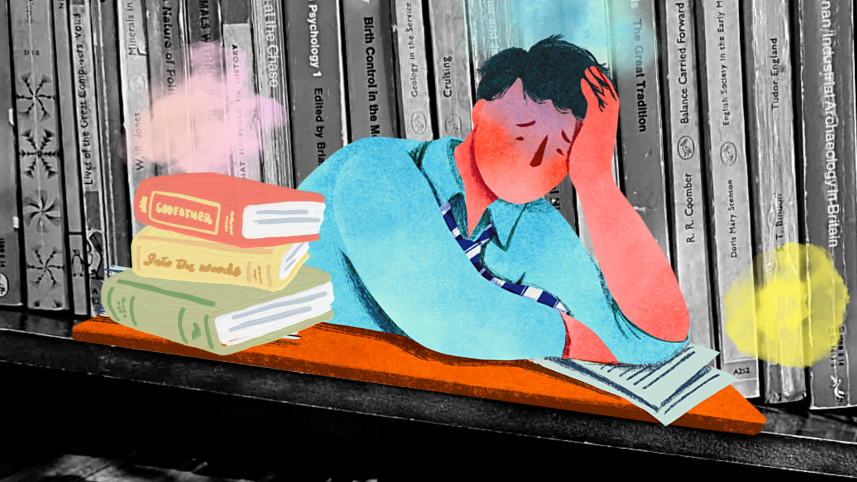
Those who grow up immersed in books often find themselves standing alone at a certain point in life, feeling a profound sense of isolation, much like the Bangladeshi poet Abul Hasan once poetically promulgated when he wrote that immortal Bengali line “Obosheshe jenechi manush boro eka (In the end one learns a difficult truth that a human being is all alone).”
It is not necessarily a tragic realisation, but it is a profound one. It arrives slowly, often after years of quiet observation, after countless evenings spent with novels, poetry, essays, and ideas that expand the mind in ways ordinary social life rarely does.

Reading deeply and engaging with art for long stretches of life changes the rhythm of a person’s inner world. Books expose a person to centuries of thought, to lives lived in distant cultures, to philosophies formed under very different skies. A reader might sit in a small room but travel mentally across continents and eras -- through the moral struggles of Dostoevsky’s characters, the quiet existential reflections of Camus, or the fragile beauty of a Humayun Ahmed novel.
When such experiences accumulate, they shape a mind that begins to see life through layers of complexity. The reader becomes sensitive to contradictions, nuance, irony, and emotional depth.
This often creates an invisible gap between that person and their immediate surroundings.
Avid readers and thinkers tend to mature mentally ahead of their peers, not necessarily in intelligence but in perspective. They begin to recognise the subtle motives behind human behaviour. They develop patience with ambiguity and scepticism toward easy answers. Over time, their tastes evolve into something different from the mainstream rhythms of everyday life.
They may seek quiet conversations about ideas while their peers are satisfied with lighter distractions. They may find themselves lingering over poetry or short stories while others are comfortable with noise and immediacy.
Gradually, their sensibilities shift.
They develop a kind of moderation -- a resistance to extremes that comes from encountering many viewpoints through literature and non-fictions. At the same time, they acquire a sensitivity toward beauty, narrative, and emotional complexity that others may never consciously cultivate. This does not make them superior to others, but it does make them different. And difference, even when subtle, can create distance.
Eventually the reader realises that the conversations around them no longer resonate in the same way. The interests that once seemed shared begin to diverge. Where friends might seek entertainment, the reader might seek meaning. Where others pursue quick certainties, the reader may feel compelled to question and reflect.
This divergence can quietly reshape relationships.
It is often said that when someone realises they are losing friends, it can be a sign of maturation. The phrase sounds harsh, but the idea behind it is essentially transformation. As people grow intellectually and emotionally, their priorities change. Friendships formed during earlier stages of life may no longer sustain the same depth of connection.
For those shaped deeply by books this process can feel particularly acute. They sometimes experience the unsettling sensation of having been born in the wrong era. Surrounded by people who seem uninterested in the ideas that excite them, they may feel temporally displaced -- as if their sensibilities belong to another generation or another cultural moment.
The result is a quiet frustration.
They look at long-time companions and wonder why certain questions never arise in conversation. Why do others not pause to think about the moral dilemmas of the world, the beauty of a line of poetry, or the emotional architecture of a great novel? Why do some people appear comfortable with shallow explanations or impulsive decisions? These questions do not always come from arrogance. Often they come from genuine bewilderment.
Yet frustration can easily slip into irritation.
The reader begins to notice habits and attitudes that once seemed harmless but now appear careless or irrational. A sense of distance emerges. Conversations feel repetitive, predictable, sometimes even exhausting. The intellectual and emotional curiosity that books cultivate begins to seek a different kind of companionship -- one that is often difficult to find in everyday surroundings.
Gradually, such individuals may appear “unsocial” to others.
But this unsociability is rarely hostility. More often it is retreat. The reader withdraws not because they despise the world but because they are constructing another one within themselves. It is a quiet interior landscape shaped by the ideas, characters, emotions and philosophies encountered over years of reading and watching.
Inside that inner world, conversations continue endlessly. A novel read years ago may still whisper questions about morality and freedom. A visceral description of a scene from a short story may linger as a meditation on human vulnerability. A line of poetry may echo like a private truth that no casual conversation can capture.
 For all latest news, follow The Daily Star's Google News channel.
 This world becomes a refuge.
Friends, relatives, colleagues and acquaintances still exist in outer life, but not everyone is invited into the inner space. Entry requires a shared sensitivity -- a willingness to engage with subtle art, image, reflection, and complexity. Since such connections are rare, the inner world often remains sparsely populated.
And so, eventually, the reader confronts the paradox that poet Abul Hasan hinted at -- the deeper one travels into thought and imagination, the more solitary the journey can become.
Yet this solitude is not necessarily emptiness.
It is a form of intellectual independence. It is the freedom to observe the world without constantly conforming to it. Within that solitude lives a conversation with centuries of writers, thinkers, philosophers, and poets who have wrestled with the same questions.
In that sense, the reader is never entirely alone.
But in the ordinary social world -- the world of everyday noise, fleeting trends, casual banters and endless talks -- the reader often stands quietly apart, carrying within them a universe that few others can fully see.
Faisal Mahmud is a Dhaka-based journalist
Comments