


A silent warning against the modern life
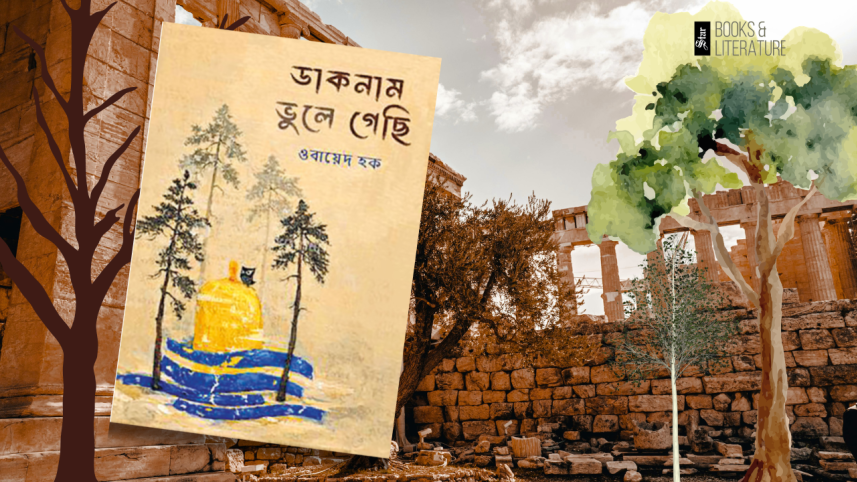
Obayed Haq’s Daknaam Bhule Gechi (Upokotha Prokashon, 2026) is a story about a lot of things—but in between it all is a story of a man who is observing a slowly modernising society while quietly sitting in its margins.
The story is set in an unspecified timeline, but all we can gather is that it is set somewhere in the early 2000s. The scene is set where a family with a rich Zamindari background is forced to move to a remote village in Mohimganj, close to the Indian border—by forgoing their house in the capital Dhaka. The protagonist’s father is immensely proud of his heritage and wistfully boasts while relocating his family to the Zamindari house, after financial constraints force them out of Dhaka. This is our first glimpse of the move away from tradition toward modernity—even though the father is proud of his heritage, his wife recognises it as a long-lost broken birthright. The story reaches a point of interest when they arrive at this Zamindari house, only to find it completely abandoned, in the middle of nowhere, and (to their great surprise) shrouded in superstition. There is a lore around the village of Mohimganj that people observed a pregnant apparition within the boundaries of this great Zamindari house, and whoever lays their eyes on this apparition is to be cursed for life. With nowhere to go but this accursed house, the family move in, and try to make it their home. However, trouble lies within the ancient corners of the house as strange incidents begin to unfold. As events unfold further, our protagonist grows up and is forced to dwell alone within the boundaries of the accursed house. No villagers dare to trespass within the boundaries of the home and the protagonist grows up slowly—completely alienated from society. He spends his time fishing in the ponds in the vicinity and talking to a variety of plants, flowers, and wildlife in his backyard. He leads an almost mystical life—detached from civilisation, within the periphery of rich flora and fauna.

And then, electricity touches the lives of the village dwellers. The dark nights of the village became brightly lit by 100-watt bulbs. People stopped gathering around the tea-stalls to gossip and instead gathered around the brightly lit screens of the television. All of the light and sound pollution confused the birds of the area—they mistook electricity poles for trees, only to get electrocuted. But our protagonist remains in the comforts of his hurricane-lit Zamindari house, away from the modern touch of it all.
The story introduces a few other characters but always centres around our out-of-touch protagonist. The strong suit of the story is the narration of the natural landscapes of the Zamindari house. Our protagonist is forced to create a unique ecosystem within the boundaries of the house—and it is here that he interacts with the wildlife. Obayed Haq excels at introducing a host of plants, each distinguished by name, colour, feel—almost as if the trees and flowers have their very own existence. One concern with the story is the representation of the female characters. The female characters suffer from the problem of flatness—all of them follow the same feminine tropes. The female characters felt uninteresting, and not nearly as dynamic as the male ones.
The story marks a quiet departure from Obayed Haq’s recent releases, while also hinting at the pitfalls of modernity. In today’s fast-paced world, amid the noise and light pollution of everyday life, Obayed Haq’s protagonist reminds readers to slow down, or at least to take a long, hard look at our easy enmeshment with the “modern” life. A striking point in the narration is when the protagonist has to travel to Dhaka and is genuinely stunned by the sheer number of bright lights around him—as if, paradoxically, so much brightness had blinded him. It is worth thinking about in a day and time when technology is so readily a companion of ours.
Tasnim Naz is a Lecturer in the Department of English, Bangladesh University of Professionals. Reach her at tasnimnaz46@gmail.com
 For all latest news, follow The Daily Star's Google News channel.
Comments