


Walking Abbey Road with Joy Shahriar
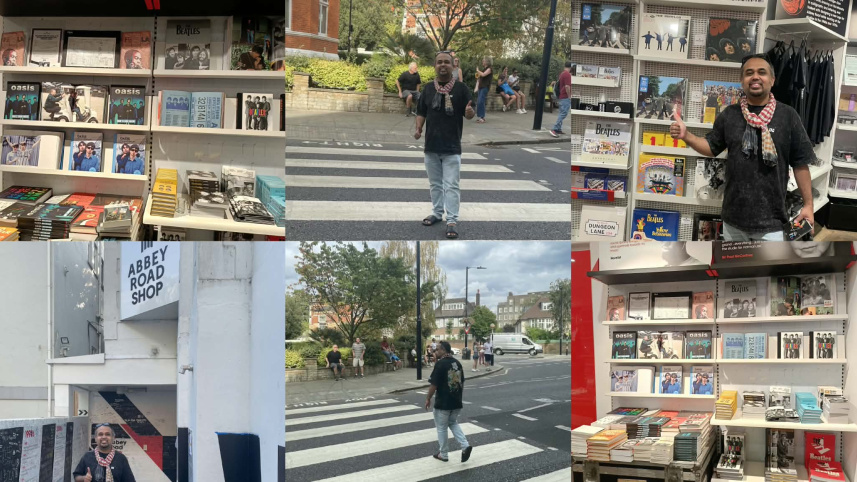
For singer-songwriter Joy Shahriar, his first trip to the UK was not simply about performing at a concert alongside the legendary Nachiketa. A lifelong music lover and ardent fan of the Beatles and Pink Floyd, he had long dreamed of visiting places that shaped music history.
At the top of his list were London’s legendary Abbey Road crossing and Abbey Road Studios. What he did not expect was to stumble upon the filming of a new Beatles movie — and even come face-to-face with the actor playing a young John Lennon.

Here, Joy recounts his memorable journey to Abbey Road in his own words.
A journey to Abbey Road
I left Dhaka for London on a Qatar Airways flight at 4am on August 14, 2026, to perform at a mega concert organised by iON TV at London’s Royal Regency on August 23. Whenever I travel somewhere to perform, I see it as an opportunity to explore as well — one I never want to let pass me by.
Even before leaving, I had made a list of places I wanted to visit in London and elsewhere in the UK. At the very top were the Abbey Road crossing and Abbey Road Studios, places deeply intertwined with the history of the Beatles. For a fan like me, visiting Abbey Road was nothing short of a pilgrimage.
I reached London around noon on August 14. It took nearly two and a half hours to cover 26 miles through traffic that could give Dhaka a run for its money. At 37C, even the heat felt familiar.
So, on my first day in London, I somehow felt as though I had never really left home.
The following morning was bright and sunny, and I set out to explore the city. My childhood elder brother, Khalid Ehsan Micky, picked me up around 11am. We visited Tower Bridge, where musician Pritom Ahmed joined us, followed by Big Ben, the London Eye and 221B Baker Street.
Then came the destination I had been waiting for: Abbey Road.
Pritom bhai left for a meeting, while Micky bhai and I continued towards the crossing. Because of a diversion, however, we had to get off the bus some distance away. The detour came with an unexpected bonus — we passed Lord’s and quickly stopped for a few photographs outside its gates.
As we approached Abbey Road, we noticed people being turned away. We were told the famous crossing was inaccessible because work was underway.
I asked whether we could at least visit the Abbey Road shop and studio. We could, they said, but only by taking another route.
A five-minute walk turned into almost 20 minutes. When we finally reached a junction near the Abbey Road shop, there was another barrier. The road was closed.
Understandably frustrated, Micky bhai asked, “We walked for 20 minutes because of your misinformation. Now are we supposed to walk all the way back without seeing anything?”
By then, however, we had discovered why the road was closed.
The entire stretch had been taken over by a film shoot.
Yes, a new film about the Beatles was being filmed at Abbey Road.
One of the young volunteers took pity on us and told us to wait. When filming paused, he would get us through so we would not have to retrace the entire route.
The opportunity came, and we hurried after him. Then, midway through, came the call: “Lights, camera, action!”
We stopped and stood in an empty space directly opposite Abbey Road Studios. We were told to remain silent.
So there we were — mouths shut, eyes wide open — watching a new Beatles film being shot.
That is what I call luck.
 For all latest news, follow The Daily Star's Google News channel.
 The Abbey Road crossing is there every day. I could have seen it at any time. But stumbling upon a Beatles film shoot there entirely by chance was something else.
Once the shot ended, we walked past Abbey Road Studios and across the famous crossing. The only thing we could not do was take photographs.
Then, at the end of the road, I came face-to-face with John Lennon.
Not the real John Lennon, of course, but the young actor portraying him in the film. Our eyes met and we exchanged smiles as we passed each other on Abbey Road.
I remember thinking, “If only I could have taken a photograph.”
Later, I realised perhaps the memory itself was worth more than any photograph could have been.
Returning to Abbey Road

My Abbey Road story did not end there.
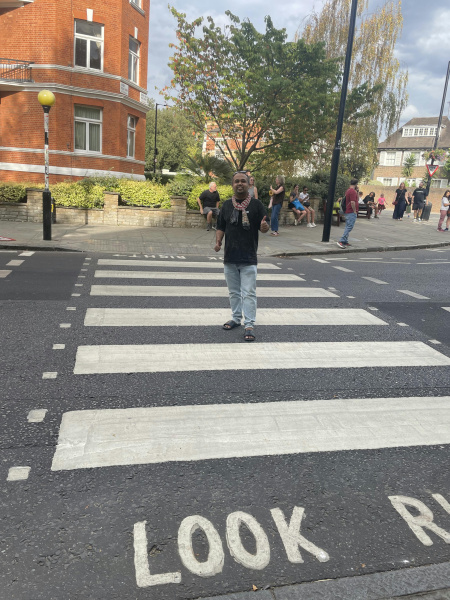
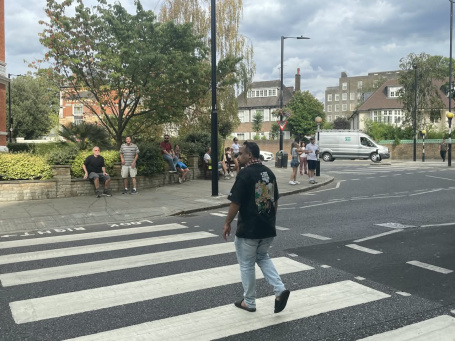
After another event on August 16, I returned on August 17, this time with my elder sister, Salma Alam. Finally, I could take as many photographs as I wanted at the crossing immortalised on the cover of the Beatles’ “Abbey Road”.
Released on September 26, 1969, the album features one of the most recognisable covers in music history. Photographer Iain Macmillan captured John Lennon, George Harrison, Paul McCartney and Ringo Starr walking across the road on August 8 that year.
The shoot lasted only around 10 minutes. More than half a century later, people from around the world still come to Abbey Road to recreate that image.
Where music history lives
The Beatles began recording at what was then EMI Recording Studios in 1962. Opened in 1931, it later became known as Abbey Road Studios and remains inseparable from the band’s history.
But the studio’s legacy extends far beyond the Beatles. Pink Floyd, Oasis and Radiohead have recorded there, alongside contemporary artistes such as Adele and Ed Sheeran.
As a huge Pink Floyd fan, simply being there carried another layer of meaning. Their landmark “The Dark Side of the Moon” was recorded there, as was “Wish You Were Here”.
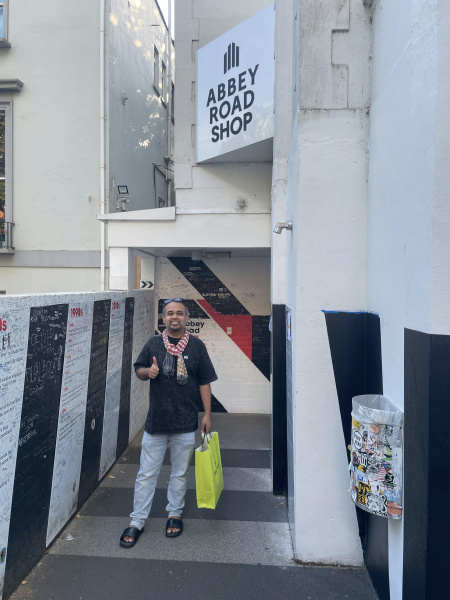
I could not enter the studios, which are not generally open to the public, but I certainly did not miss the Abbey Road Shop.
The moment I entered, I almost lost my mind.
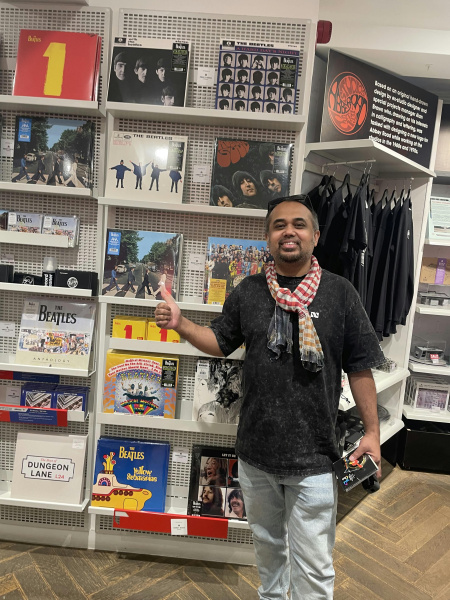
There were Beatles and Pink Floyd CDs and vinyl records, mugs, T-shirts, fridge magnets, caps, customised guitar picks, guitar straps and seemingly endless memorabilia. Then there were the books — on lyrics, chords, concerts, photographs, biographies and almost every imaginable aspect of the Beatles.
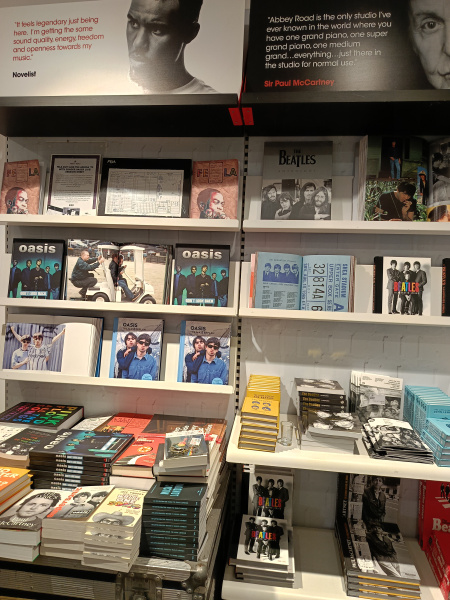
I had to stop myself from buying everything.
Eventually, I bought a book about the stories behind the Beatles’ songs and another on the history of Abbey Road Studios. I already owned “Abbey Road” on CD, so I picked up Pink Floyd’s “The Dark Side of the Moon” instead, along with a guitar strap featuring the artwork from the Beatles’ “Revolver”.
After nearly an hour, I finally convinced myself to leave.
Could we do the same?
Whenever I encounter places like Abbey Road, I cannot help thinking about Bangladesh.
Could we not have created something similar around Azam Khan, Ayub Bachchu, Sanjeeb Choudhury or Shafin Ahmed? And is it too late to begin celebrating living legends such as Kumar Bishwajit, James or Prince Mahmud in such a way?
Perhaps not.
I left Abbey Road with memories that will stay with me for the rest of my life. A few days later, while visiting Manchester, I even drove for nearly an hour and a half to Liverpool to visit a Beatles museum.
Throughout my UK trip, I kept noticing how carefully the British preserve their cultural history. They honour it, keep it alive and find ways to turn that legacy into something new generations can experience. At the same time, they have built a powerful cultural brand around it that continues to draw visitors from around the world.
Abbey Road made that particularly clear to me. A few musicians crossing a street for a photograph in 1969 created an image that people are still travelling across the world to recreate more than half a century later.
Whenever I encounter something like that elsewhere, I find myself returning to the same thought:
Perhaps, one day, we can do it too.
Comments