


‘Into My Lungs’: Unseen cost of breath in the cotton industry
If you live in Dhaka long enough, you learn how the city runs on things you do not see: back-end labour, silent trades, invisible costs politely filed under the word industry. “Into My Lungs”, a multimedia exhibition by artists Ayman Alazraq and Emanuel Svedin, walks straight into that blind spot and refuses to look away. Running from January 23 to February 7, 2026, at Alliance Française de Dhaka, Gulshan, the exhibition takes a subject most people never talk about and places it directly in front of you, impossible to ignore.
The premise begins with a thread; cotton thread as a physical object and as a connector: worker to machine, machine to fabric, fabric to store, store to you. Very quickly, it becomes clear that this exhibition is not interested in aestheticising suffering. Instead, it maps a system, one we have knowingly or unknowingly accepted, where suffering has been made to feel routine, almost normal.

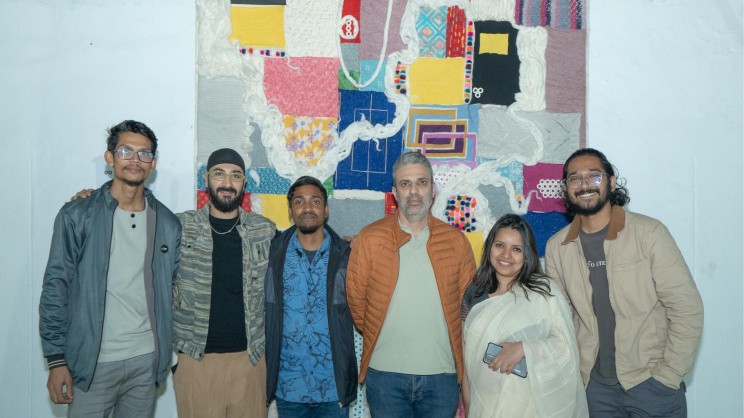
Svedin could not travel to Bangladesh for the opening, but on the first night, we met Ayman Alazraq, exhibition designer Liam Alzafri, and curator-producer Fouzia Mahin Chowdhury. Alzafri and Alazraq share Palestinian heritage, a detail that informs the sensitivity with which displacement, labour and survival are treated throughout the work. Chowdhury, who conducted the fieldwork and research after being approached by the artists, spoke about what it meant to bring the exhibition to life responsibly.
“They are separating themselves from the horrors they are witnessing to make the world aware of our sufferings,” she said. “So it is very important for me to do justice to that. It is the least I can do.”
“Into My Lungs” does not overwhelm with quantity. There are few installations, but each carries weight. The exhibition is laid out deliberately, like a guided walk into the lungs of workers in the spinning industry. At its core is byssinosis, an occupational lung disease caused by prolonged exposure to cotton dust, particularly in spinning mills. It is a disease rarely discussed outside medical circles and remains underdiagnosed even there.
For workers living hand to mouth, the early symptoms sound too ordinary to raise alarm: persistent coughing, chest tightness, breathlessness, fatigue. These are brushed off as exhaustion, part of the job. Even when medical help is sought, the condition is often misdiagnosed as asthma or tuberculosis due to limited awareness. This reality is terrifying because, up to a certain point, byssinosis is curable. Since its primary cause is environmental, changing jobs, moving away from cotton exposure can reverse the damage. Yet countless lives are lost to this slow poison simply because it goes unrecognised and untreated for too long.
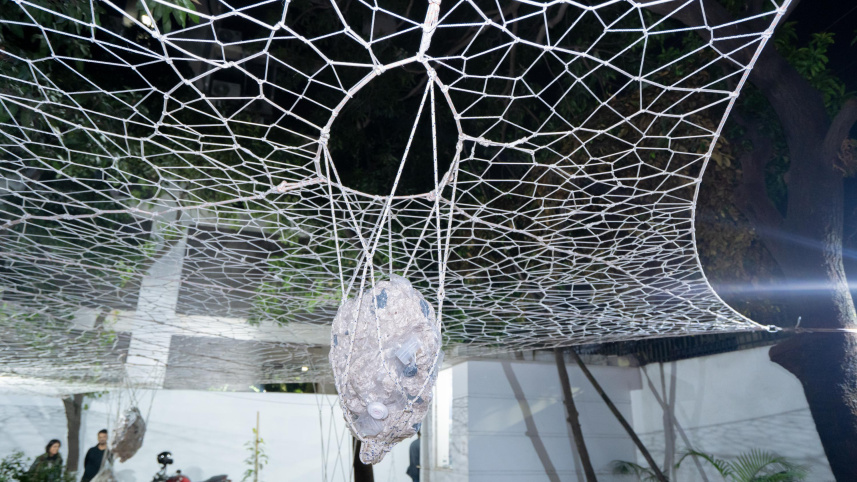
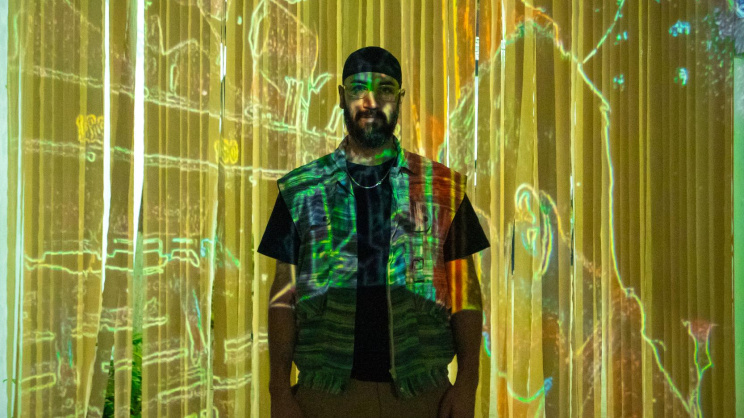
At Alliance Française Gulshan, the first installation is a net-like structure made of rope, designed to resemble the alveoli of the lungs. Packets of cotton dust hang within it, slowly weighing the structure down. This is byssinosis made visible. Moving into the corridor, a psychedelic video is projected onto curtains, documenting the everyday lives of spinning-mill workers. The routine, repetitive nature of the work is hypnotic, and quietly lethal.
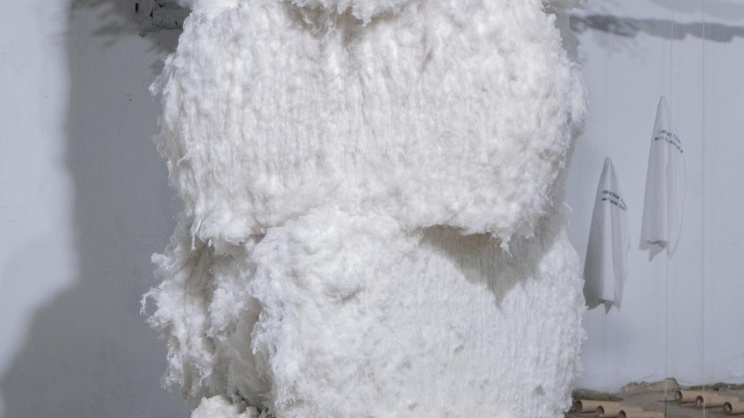
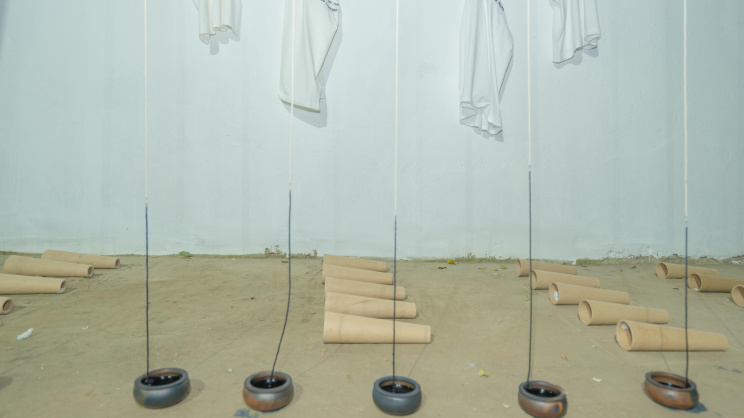
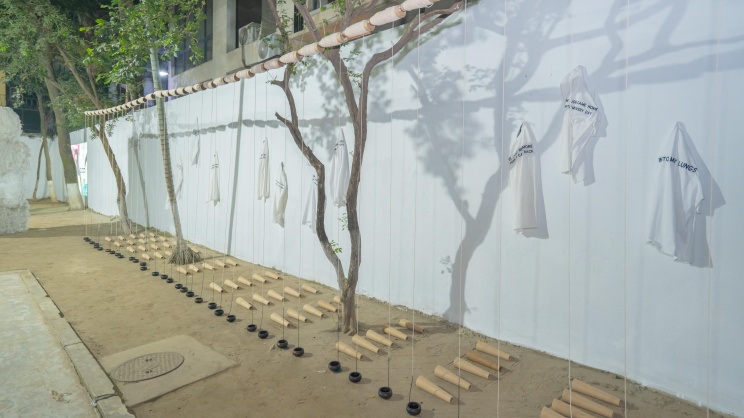
The most haunting section, titled “After the Cotton Has Settled”, uses tar slowly seeping into thread to visualise how prolonged exposure gradually consumes the lungs. The image is stark and unadorned, tracing the disease’s slow, inescapable progression from breath to body, and ultimately to life itself. Nearby, bobbins lie on the ground, framed by rectangular structures resembling coffins, arranged to point towards the Kaaba; an image of mourning that acknowledges loss without spectacle.
One of the exhibition’s strongest choices is its refusal to chase shock value. There is no disaster porn here, no loud moralising. What unsettles is precisely how plausible everything feels. This is everyday harm. Routine damage. And that is the point.
The project exists somewhere between research, documentary and public conversation. Drawing from fieldwork and interviews across industrial zones, it traces cotton’s journey from factories to hospitals to homes shaped by loss. In the final section, the exhibition circles back to where it all begins: cotton itself. Vibrant clothing, the kind we wear every day is projected beautifully, while white cotton residue slowly creeps across the surface like a parasite. The piece, created by Anamika Paul, is visually striking and deeply uncomfortable.
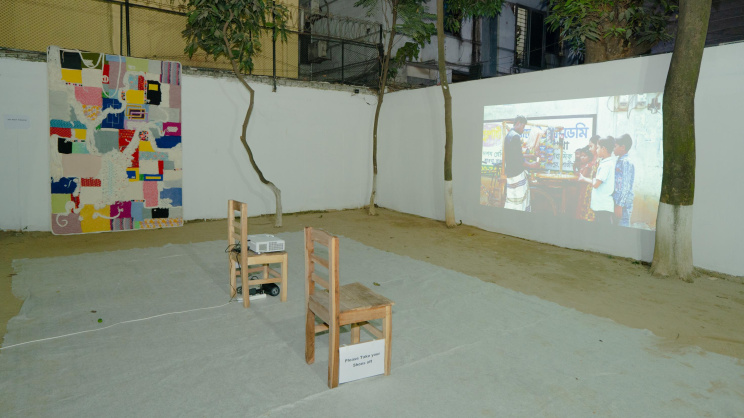
At the centre of the room sit two chairs facing a screen. Here, the cost of our clothing is made explicit through a feature-length documentary that lays the truth bare.
“Into My Lungs” lands in Dhaka with uncomfortable clarity. The cotton economy is not a distant factory problem. It is local, national and global, and it sits in our closets. The exhibition keeps returning to one central truth: the global fashion supply chain makes it dangerously easy to forget the person at the beginning of the thread. This project attempts to reverse that forgetting, without preaching or reducing people to symbols.
You leave aware of your own breathing, how easily it is taken for granted. “Cheap” clothing stops feeling cheap. Someone always pays, just not at the cash register.
 For all latest news, follow The Daily Star's Google News channel.
Comments