


Inside Dhaka’s competitive hierarchy of misery

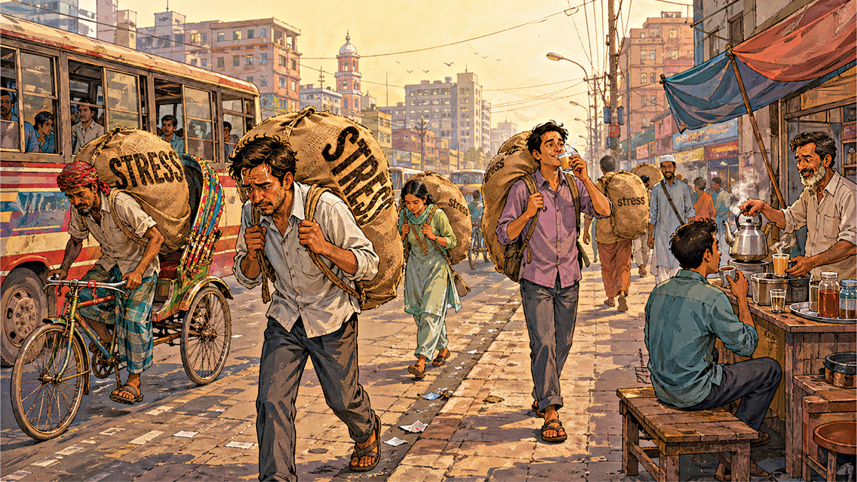
Before I start, let me acknowledge something our beloved Dhaka does with unsettling efficiency: it turns almost anything into a competition.
Be it overtaking in traffic lanes, gently ignoring the concept of queues at elevators, or using the horn as a full-fledged communication system -- nothing here is too small, too trivial, or too unnecessary to be turned into a contest.

And, inevitably, our daily hardship did not escape this civic enthusiasm. If anything, it may be the only category where we are truly world-class -- with our informal storytelling!
Confused so far? Let me elaborate!
We all know how Dhaka is a city where even a “short trip” requires emotional preparation. And by preparation, I mean serious preparation -- with a water bottle, sunglasses or umbrella, and at least one existential crisis. Time here is not measured in minutes, but in traffic signals survived.
However, we have adapted!
No… not by fixing anything structural, but by developing a response that is far more immediate and, frankly, far more satisfying: complaining!
Not officially, of course, there are no forms to fill… but verbally, often generously and, if needed, aggressively!
I realised this the other day when I made an avoidable mistake by saying, “I’m exhausted” to one of my colleagues.
My reasoning, I believed, was sound. A 90-minute commute from Dhanmondi to Banani. Ninety. Minutes. Ninety minutes is a full movie, with a lot of character development.
But my colleague, however, was unimpressed.
“Ninety minutes?” she scoffed. “I left Uttara at 7:00 AM. I’ve finished an entire podcast series on the fall of the Roman Empire. At one point, I reached self-actualisation. At another, I considered starting my office in the back of my car. So, you my dear, were practically teleported by comparison.”
And just like that, my suffering was downgraded from a “valid complaint” to just an “anecdote.”
Why?
Because this is Dhaka. Here, hardship is not something you simply experience and mention -- it is something you must substantiate. Preferably with evidence, duration, and a supporting anecdote.
You say you have a headache; someone else has already endured a full-blown migraine, a power fluctuation, or a traffic jam long enough to develop a quiet, complicated bond with the driver.
So, your bad day is never quite bad enough here -- because there is always someone, almost clinically prepared, to counter it with a composed little verdict: “I had it worse.” Not as empathy. Not as solidarity. More like a gentle correction to your version of reality.
There is, of course, a strange kind of comfort in it. If everyone is suffering, no one is uniquely singled out.
You say your day was long; someone else says theirs started yesterday and is still buffering.
And somewhere in that exchange, the complaint stops being just a complaint -- it becomes participation. A way of saying: I am here. I endured this too. Let me add my version to the pile.
 For all latest news, follow The Daily Star's Google News channel.
 So maybe that’s the answer. We don’t just complain because things are hard here in Dhaka. That would be far too simple.
We complain because, in a city where very little is predictable and even less is fixable on demand, hardship has quietly become one of the few languages we all speak fluently, confidently, and often, with unnecessary elaboration.
It is how we relate. It is how we compete. It is how we make sense of days that refuse to go as planned.
And perhaps, more tellingly, it is how we reassure ourselves that whatever we went through today, however inefficient, inconvenient, or mildly absurd -- it counted for something. Anything!
Comments