


More lanes or trains? Rethinking the Dhaka-Chattogram corridor

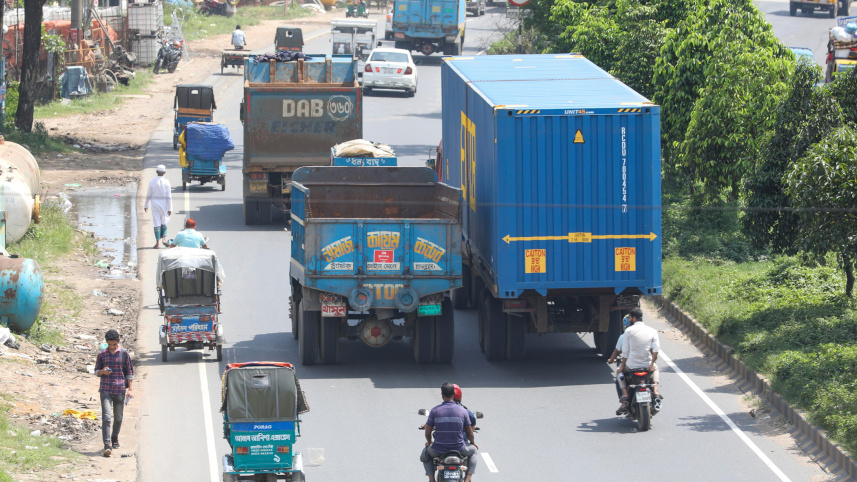
Every day, thousands of trucks carry containers, raw materials, and export goods along the Dhaka-Chattogram highway, alongside rising passenger traffic. This corridor also connects the capital with Chattogram Port, the gateway for most of Bangladesh’s international trade. As economic activity expands, pressure on the corridor and dependence on imported fuel also rise. This route is already one of the most fuel-intensive segments of the transport network. Despite expansion to four lanes, congestion persists.
Proposals to widen the highway into a 10-lane corridor or elevated expressway reflect the scale of the problem. But expanding roads alone risks locking Bangladesh into a fossil fuel–dependent transport model. The real question is not how to accommodate more vehicles, but how to reduce reliance on them. That shift requires a decisive move toward rail. Without a shift in the transport mix, more road capacity may lead to higher fuel use and greater exposure to energy shocks. Heavy trucks remain the backbone of this corridor, but they also create the greatest energy burden by accelerating road deterioration, increasing maintenance costs, and consuming large volumes of diesel. In a global environment marked by volatile energy prices, this dependence exposes Bangladesh to recurring economic vulnerability. In this scenario, rail offers a strategic alternative.

Rail transport is significantly more energy-efficient, especially for freight. One freight train can replace roughly 40–60 heavy trucks, while moving a container using about one-fifth the fuel and emitting one-fifth as much carbon as trucks. This reduces dependence on imported diesel while easing pressure on infrastructure and foreign exchange reserves. For Bangladesh, the long-discussed Dhaka–Chattogram chord line presents a practical opportunity to make this transition. By creating a more direct alignment between the two cities, the chord line would shorten travel distance, enable faster passenger services, and expand capacity for freight movement. This does not require ultra-high-speed systems like Japan’s Shinkansen. A modern medium-speed railway operating at 140–160 kilometres per hour would be sufficient.
This could reduce passenger travel times to around two hours, but the greater impact would be on freight movement. Shifting even a portion of container movement from trucks to rail would reduce congestion, lower fuel consumption, and improve logistics reliability, thus creating a more balanced system where rail and road share the load.
Nevertheless, this shift must be supported by a broader reconfiguration of inland logistics. Expanding inland container depot capacity closer to industrial clusters—particularly around Narayanganj—can significantly reduce long-haul trucking. Fast-tracking projects such as Dhirasram Inland Container Depot (ICD) or the proposed Pubail ICD would allow cargo to be consolidated and moved in bulk by rail, rather than dispersed across thousands of truck trips. Together with a chord line, these facilities could form the backbone of a more energy-efficient multimodal system.
However, infrastructure alone will not deliver these benefits unless institutional constraints within the railway sector are addressed. One persistent challenge is the shortage of locomotives and trained loco-masters, which limits effective use of existing rail capacity. As long as freight depends on spare locomotives from passenger services, a reliable rail logistics system will remain difficult.
There is, therefore, a strong case for revisiting the Railways Act, 1890, to allow regulated participation of private operators on designated corridors. Opening railway tracks to private freight operators is a practical response to capacity constraints. It would enable additional locomotive investment, improve service reliability, and introduce operational flexibility. Without such reform, even well-planned infrastructure investments—including a Dhaka–Chattogram chord line—risk delivering only partial results. With it, Bangladesh could unlock the full potential of its rail network.
A practical way forward would be to translate this vision into a phased railway roadmap. Priority should be given to developing a Dhaka–Narayanganj–Chattogram chord line as a modern broad-gauge corridor, creating a more direct and high-capacity rail link between Dhaka and Chattogram. Meanwhile, institutional reform by opening access for private operators under a regulated framework should be put in place and railway-based inland logistics should be strengthened through the development of ICDs in strategic locations under public–private partnership models. Together, these steps would create an integrated rail-led system capable of shifting a substantial share of cargo away from roads, reducing fuel consumption, and strengthening long-term resilience.
Recent discussions on the proposed Teknaf–Tetulia economic corridor highlight the need for a more integrated approach to transport planning in Bangladesh. The initiative reflects a shift toward viewing corridors not merely as roads, but as systems linking logistics, industry, and regional connectivity, while emphasising sustainability. This reinforces a central point: how connectivity is designed, particularly in energy use and transport mode, will determine long-term sustainability.
Linking Matarbari deep-sea port with the Mirsarai economic zone and extending rail-based ICD development toward the northwest, such as Nilphamari, could help translate this vision into a more balanced, rail-led national logistics corridor. Globally, countries facing similar challenges are already moving in this direction. China has expanded rail corridors linking ports with inland industrial regions. India is developing its Dedicated Freight Corridor to reduce logistics costs and energy use. Across Europe, rail plays a central role in reducing transport-related emissions. These are not just transport investments; they are energy strategies.
Bangladesh now faces a similar choice. Continuing to expand highways without strengthening rail will deepen long-term dependence on fossil fuels. In contrast, investing in rail, supported by institutional reform and inland logistics development, offers a pathway toward a more resilient and energy-efficient transport system. The choice we are facing is not between a 10-lane highway or an elevated expressway; it is between more lanes or less fuel.
Ahamedul Karim Chowdhury, adjunct faculty at Bangladesh Maritime University, is a maritime, logistics, and supply chain policy analyst.
Views expressed in this article are the author's own.
Follow The Daily Star Opinion on Facebook for the latest opinions, commentaries, and analyses by experts and professionals. To contribute your article or letter to The Daily Star Opinion, see our guidelines for submission.
 For all latest news, follow The Daily Star's Google News channel.
Comments