


Voices of Remorse: A New Perspective

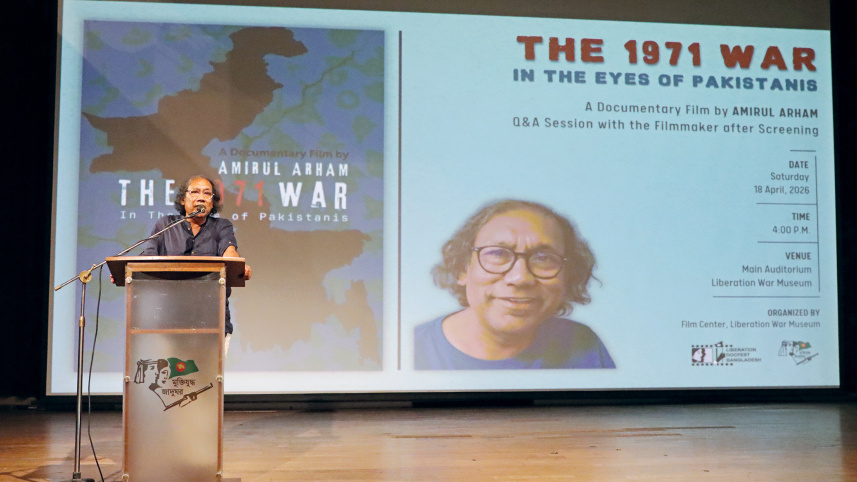
The Liberation War Museum has recently hosted a special screening of the documentary “The 1971 War: In the Eyes of Pakistanis”, an emotional exploration of the 1971 genocide through the realisations and reactions of the Pakistani people.
The film serves as a bridge across a painful past, attempting to analyse the modern understanding of the cruelty and massacres that marked the path to Independence. It brings to light the harrowing humanitarian disaster that resulted in the loss of millions of lives and the systematic torture of women, framing these events as a dark chapter the world must never forget.

The visionary behind this project is Amirul Arham, an internationally acclaimed Bangladeshi filmmaker who has lived in Paris since 1985.
Arham began his cinematic journey at the Dhaka Film Archive before training under world-renowned filmmaker Jean Rouch, eventually gaining global recognition for works such as his documentary on “Social Business”. The film was selected for the “Cinema Positive” category at a major international festival and garnered widespread acclaim.
Reflecting on his work, Arham notes that his journey into this subject is an attempt to understand the tragedy from a fresh perspective, analysing the realisations and reactions of the Pakistani people toward the cruelty and genocide of 1971. Millions of lives were extinguished, and the systematic abuse of women left scars that remain unhealed in Bangladesh’s collective memory.
The film asks what ordinary people in Pakistan saw, what they were told, and how today’s youth evaluate these events.
In this latest work, he captures perspectives from a wide array of individuals, from Pakistani labourers and businessmen who were present in then-East Pakistan to today’s politicians and youth re-evaluating their history.
Perhaps the most poignant moment features the late Rowedad Khan (1923–2024), a former influential bureaucrat and politician. In a rare and deeply moving interview, Khan offers a heavy-hearted testimony and a formal apology on behalf of the people of Pakistan for the atrocities committed during the 1971 war.
Arham’s connection to the subject dates back decades. In 1996, he worked on a film on the Bihari population, titled “Lost Souls of Bangladesh”, which was broadcast on French National Television in 2000.
Witnessing their lost dreams of a stable life in Pakistan sparked his curiosity about civilians who remained there, including those who witnessed the horrors of 1971. This led to a clandestine journey of research and archival work to reach the right voices without drawing the attention of authorities.
Reflecting on a process that began in 2022, Arham notes the immense challenges of documenting a history five decades later, as many witnesses have passed away or are affected by ailments such as Alzheimer’s. Yet, he found that many Pakistani civilians today admit they remain poorly informed about the genocide committed by their army in then-East Pakistan.
The Film Center is a division of the Liberation War Museum, where activities related to the Liberation War are conducted. Under the supervision of founding trustee Mofidul Hoque, the division organises film screenings, workshops, and research activities.
As part of this effort, the Film Center arranged the screening to provide a new perspective on the country’s history. Naasehun Ameen, CEO of the museum, said the screening was organised as part of its continued commitment to preserving and promoting the history, values, and sacrifices of 1971.
Such initiatives help engage wider audiences, especially younger generations, and encourage deeper reflection on the significance of the Liberation War and its enduring impact.
 For all latest news, follow The Daily Star's Google News channel.
Comments