


Rediscovering Rahat Ara Begum: A legacy revived through dance and literature

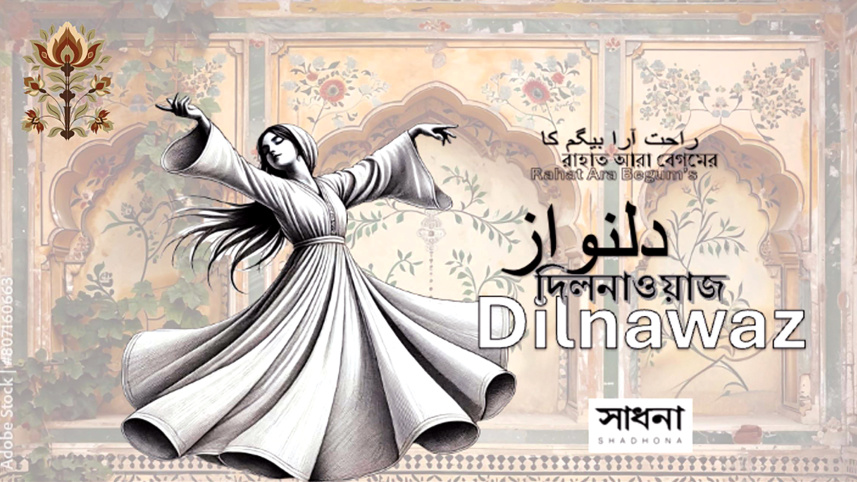
For Lubna Marium, acclaimed dancer and choreographer, reviving her grandmother Rahat Ara Begum’s literary legacy has been a pilgrimage. The Urdu short story “Dilnawaz” -- a dance-drama inspired by Begum’s forgotten script -- is her ultimate tribute.
Blending Sufi philosophy with classical and contemporary dance, the production explores love, longing, and transcendence. Recently staged at the Bangladesh Shilpakala Academy in Dhaka, it reintroduces Begum’s allegorical tale to modern audiences.

Both a love story and a philosophical meditation, Dilnawaz is not just a romantic tragedy. The dance-drama adaptation has turned the tale into a living cultural experience, entrancing Dhaka’s audiences with its courtly world and mystical atmosphere of transcendence.
“She existed in our family consciousness almost as an ‘absent presence,’” Lubna recalls. “Her name was spoken with reverence, but her books had disappeared from circulation, and the literary world that once celebrated her had long faded from public memory.”
Dilnawaz became the centrepiece of Lubna’s choreographic vision. “Dance, like Sufi poetry, can express longing, surrender, and transcendence without words. The greatest challenge was doing justice to both the literary and spiritual dimensions of the story. But when the dancers began to inhabit its emotional landscape, the choreography stopped being interpretation and became embodiment.”
Collaborating with Canadian Iranian dancer Sashar Zarif and choreographer Shabbur Ahmed Khan, Lubna nurtured the project for over a decade. Music by Raatul Shankar Ghosh, inspired by maestro Uday Shankar, and poetry by Imran ibn Niaz were woven into the production, creating a layered performance that merged literature, spirituality, and movement.
Today, Rahat Ara Begum’s works are accessible once again, primarily through an anthology published in Dhaka, with original editions preserved in archives, and through Shadhona -- a Centre for the Advancement of South Asian Culture, where Lubna continues to weave her grandmother’s legacy into performance.
Rahat Ara Begum, widely regarded as the first woman Urdu fiction writer of Bengal, lived a brief but luminous life in 1940s Calcutta. A prolific contributor to Urdu literary magazines, she wrote with a voice that was “tender, intellectually alert, and spiritually searching.”
Her stories explored love, longing, poverty, and the emotional lives of women with remarkable clarity. “Her writing can best be described as quietly radical,” Lubna explains. “She illuminated social injustices and gender inequality without overt didacticism. In that sense, her feminism was subtle but powerful.”
Beyond her literary achievements, Rahat Ara Begum was deeply rooted in Sufi practice, particularly the Naqshbandi-Mujaddidi tradition. Family memories portray her as austere yet luminous, someone who undertook solitary retreats and infused her writing with mystical sensibilities.
One family story captures the depth of her spiritual presence even after her passing. Lubna recalls how her grandfather, Sirajul Islam, visited Rahat’s grave every day for decades, bringing flowers and sitting in silent contemplation. “When one of us once asked him what he was doing there, he quietly replied that he was ‘talking to Rahat.’ That moment captures something essential about their lives: love, devotion, and spiritual companionship were inseparable.”
The rediscovery of Rahat’s works was itself a journey across archives in Lahore, Hyderabad, Kolkata, and Dhaka. The eventual publication of “Lost Tales from a Bygone Era” marked a turning point.
“It felt deeply emotional. The book was not simply a literary publication; it was a restoration of memory. To hold it was to reconnect with a voice that had been silent for decades and to bring her back into conversation with contemporary readers.” Looking ahead, Lubna envisions further translations, scholarly discussions, and creative adaptations of Rahat’s stories.
I believe Lubna Marium, carrying the artistic inheritance of her grandmother, has planted a seed of spiritual reawakening among Dhaka’s audiences. Amid the rush of our hurried lives, she offers a poised invitation to pause, reflect, and reconnect. For younger generations especially, her work opens a contemplative space to engage with the seven stages of Sufi devotion, leaving behind a profound resonance.
 For all latest news, follow The Daily Star's Google News channel.
Comments