


When theatre speaks in letters
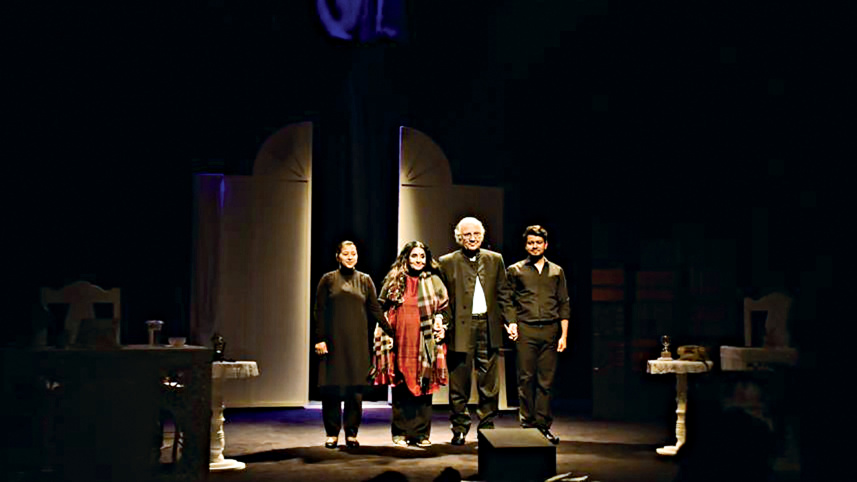
I found myself back on Bailey Road with my friends last weekend, after what felt like ages. Joining us was Anisul Haque, a friend’s better half and the celebrated writer who makes pop culture look effortlessly stylish.
But the real significance lay not in our presence, but in the rare chance to witness theatre royalty -- Ramendu and Ferdousi Majumdar -- in action.

Love Letters, the 48th production of Group Theatre, was staged at the Nilima Ibrahim Auditorium of Bangladesh Mohila Samity. Directed by Tropa Majumdar and performed by her parents, it felt like the most heartfelt gift a child could ever give to their performer parents: a fully booked show.
Adapted from AR Gurney’s Pulitzer‑nominated drama and translated into Bengali by Abdus Selim, the play wove six decades of love and longing into the fabric of Bangladesh’s Liberation War.
Exactly at this point, I made the mistake of mixing up the Indian rendition of the same play, Tumhari Amrita. For some odd reason, the name Amrita and the motif of letters made me think of Amrita Pritam and Sahir Ludhianvi. In reality, Javed Siddiqui’s Hindi/Urdu adaptation -- directed by Feroz Abbas Khan and performed by Shabana Azmi and Farooq Sheikh -- was inspired by painter Amrita Sher‑Gil. That performance, too, has a cult following.
In Dhaka, however, Love Letters became an intimate Bengali adaptation. Minimalist in form yet rich in emotion, it was both a tribute to enduring love and to the Majumdar family’s extraordinary legacy.
By sheer luck, I’ve seen both versions. Each reflects its own cultural fabric: Love Letters, rooted in Bangladesh’s liberation narrative; Tumhari Amrita, in India’s evolving social landscape. Both remind us that theatre’s magic lies not in elaborate sets but in the raw intimacy of human voices carrying stories of love, separation, and history.
With only two actors, letters, and emotions, Love Letters unfolded as a timeless experience. Ramendu as Ananta and Ferdousi as Maisha embodied two lifelong correspondents whose dreams, disappointments, and ambitions spanned sixty years.
Rather than dialogue, the story emerged through notes and cards, creating an atmosphere of intimacy, love and separation, victories and defeats, memory and history. It was both a romantic drama and a reflection of Bangladesh’s socio‑cultural journey. It was the Theatre’s commitment to blending global classics with local narratives.
The evening reminded me why Bailey Road remains the beating heart of Dhaka’s theatre scene. I can still picture the old Mohila Samity theatre from my childhood, waiting for Dewan Gazi’s Kicha to begin. The hall was dimly lit, wooden chairs creaked under eager audiences, and the thrill of anticipation hung in the air. For a child, the stage felt enormous. When the play began, the actors’ voices filled the room with raw intensity, larger than life. That first encounter was more than just watching a performance, more like an initiation into the magic of theatre.
Mohila Samity, with its humble charm and buzzing atmosphere, became a symbol of Dhaka’s cultural awakening. Legends like Ramendu and Ferdousi Majumdar built their reputations here, and countless young theatre lovers discovered the power of live performance.
Even today, memories of that old hall glow with nostalgia -- a reminder of a time when theatre was less about spectacle and more about soul. Dhaka people who missed this show, keep an eye out for the next. It is simple, yet it holds you in a lingering trance of unrequited love and longing.
 For all latest news, follow The Daily Star's Google News channel.
Comments