


Heartless, hateful against Hindus
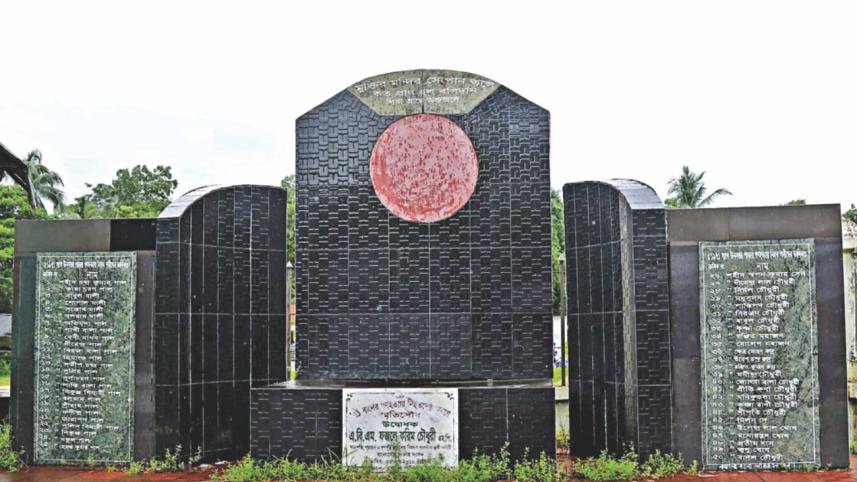
Salauddin Quader Chowdhury was an embodiment of the hatred and brutality the country suffered during the Liberation War.
He devised synchronised plans and executed those with "highest ruthlessness" to exterminate innocent people, especially the Hindus and political opponents in his locality.

Along with his accomplices and the Pakistan army, Salauddin unleashed a bloodcurdling terror on five Raozan villages in Chittagong on a fateful summer day in 1971, turning the villages into valleys of death. One hundred and 11 unarmed people were massacred in the 10-and-a-half-hours raid.
They killed widely respected philanthropist Natun Chandra Sinha when he was offering morning prayers. They abducted Sheikh Mozaffar Ahmed, founder of the Awami League in Chittagong, and his son Sheikh Alamgir from road and killed them in a Pak army camp.
Forty-four years later, justice finally caught up with the self-declared brigadier of Chittagong as he walked the gallows early today.
He was executed three days after the Supreme Court dismissed his petition to review his death sentences, handed down by a special tribunal in 2013.
Narrating Salauddin's brutality in its judgment on July 29, the SC said: "Accused Salauddin Quader Chowdhury has committed crimes with highest ruthlessness and extreme atrocity. He persecuted civilian and unarmed people, tortured them to death, caused disappearance of innocent people and helped in disappearing people in collaboration with the occupier Pakistani Army."
The accused also rampantly looted and assisted in plundering people's property, it said in the judgment written in English.
"The offences were not the one envisaged in the penal laws of any country, the accused in committing those crimes in the synchronised plan and design that were developed and put into execution with cool blood.
"Salauddin Quader Chowdhury persecuted, killed and caused disappearance of civilian people solely on religious and political grounds. He had direct involvement in the killing of innocent people.
"The prosecution has been able to establish clearly that he had thoroughly designed plan and common objectives to commit those crimes, especially he had done all these brutal offences with specific intention to exterminate the Hindu religious community and his political opponents from that locality," added the SC bench headed by Chief Justice Surendra Kumar Sinha.
Investigators and witnesses said Salauddin carried out all those atrocities largely because of the high-voltage 1970 general election in which his father Fazlul Quader Chowdhury, a top politician of the then East Pakistan, lost his Raozan constituency to an Awami League candidate.
They blamed the defeat on the Hindu community.
Also, his families conviction for Pakistan's unity drove them to join hands with the Pak army to execute the latter's plan to annihilate the Hindu population or to forcefully convert them to Islam or drive them from the country, according to the prosecution.
On April 13, 1971, Salauddin along with his accomplices and the Pak army raided five villages -- Maddhya Gohira Hindupara, Gohira, Jagotmallopara, Sultanpur Banikpara and Unasattarpara -- with the intent to destroy the Hindu community in whole or in part.
All these villages were located around Gohira Chowdhurypara, Salauddin's ancestral home.
The attacks took place between 6:30am and 5:00pm.
Salauddin's men called the people out of their homes on the pretext of holding a meeting and assembled them in a place. They then lined the people up before the Pakistan army opened fire.
Once done with killing people, they also looted and torched homes and destroyed the neighbourhoods.
 For all latest news, follow The Daily Star's Google News channel.
 The terror of the raids forced thousands of survivors of the villages to flee to India as refugees.
The marauders, guided by Salauddin, first attacked Maddhya Gohira Hindupara around 6:30am and killed five of a Hindu family, including a woman.
They then went to the house of Natun Chandra in Gohira village between 9:30am and 10:00am. The army men stormed the house and found septuagenarian Natun, owner of herbal medicine manufacturer Kundeshwari Owshadhaloy, offering his morning prayers at a temple inside the compound.
They had a brief conversation with him and left. Natun resumed his prayers.
But Salauddin and the Pak soldiers returned there in a while. They dragged Natun out of the temple.
He cried out in protest but in vain.
"I have an order from my father to kill you," shouted Salauddin, whose father Fazlul Quader was the chief of Convention Muslim League that actively opposed the Bangalee's struggle for independence.
The soldiers then opened fire on Natun. But he was not dead yet.
As Natun was groaning in excruciating pain, Salauddin shot him two to three times to make sure his death.
The raid on Jagotmallopara village began between 10:30am and 11:00am. Thirty-two villagers were massacred and their houses torched.
Salauddin, his men and Pak soldiers swooped on Sultanpur Banikpara around 1:00pm. They looted and destroyed houses there.
The last place Salauddin and his gang attacked was Unasattarpara. They reached the village between 4:00pm and 5:00pm and killed 70 people there.
On April 17, 1971, Salauddin with some Pakistan army personnel stopped the car of Sheikh Mozaffar Ahmed when he along with his family was returning from Raozan to his home in Rahamatganj.
They picked up the AL leader and his son from there.
Later, the family members came to know that the two were taken to a nearby army camp and killed.
The family did not even get the bodies back for burial despite repeated requests.
Comments