


Palmyra temple destroyed by IS
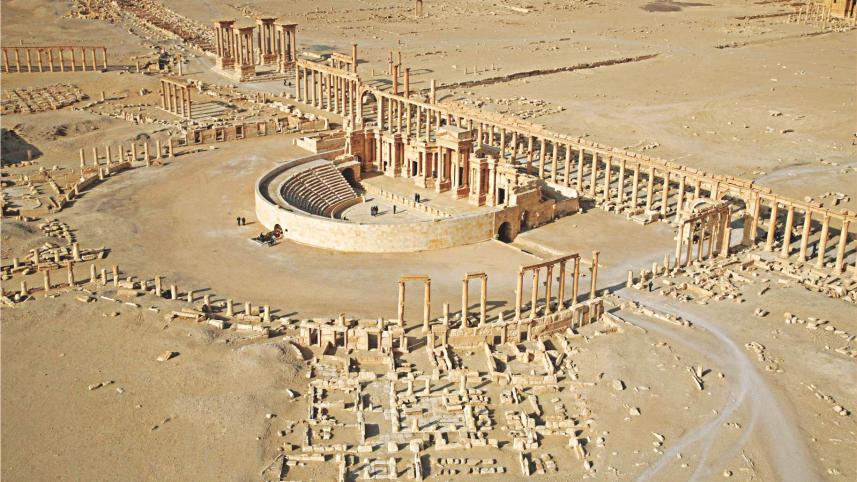
The Islamic State group has blown up a famed temple in Syria's ancient Palmyra, in an act the UN condemned as a war crime and an "immense loss" for humanity.
The destruction of the Baal Shamin temple, considered the second-most significant in ancient Palmyra, raised concerns for the rest of the Unesco World Heritage sites.
 For all latest news, follow The Daily Star's Google News channel.
 It comes only days after ISIS beheaded the 82-year-old retired chief archaeologist of Palmyra, sparking widespread condemnation.
"This destruction is a new war crime and an immense loss for the Syrian people and for humanity," said Irina Bokova, the head of the UN cultural watchdog Unesco, calling for the perpetrators to be held accountable.
"Daesh (ISIS) is killing people and destroying sites, but cannot silence history and will ultimately fail to erase this great culture from the memory of the world," Bokova said in a statement.
Syria's antiquities chief Maamoun Abdulkarim told AFP the temple was destroyed on Sunday.
"Our worst fears are sadly being realised," Abdulkarim said.
Famed for its well-preserved Greco-Roman ruins, Palmyra was seized from government forces in May, prompting concerns ISIS might destroy it as it has heritage sites in parts of Syria and Iraq under its control.
Initially most of Palmyra's best-known sites were left intact, though there were reports ISIS had mined them and the group reportedly destroyed a well-known statue of a lion outside the city's museum.
"Daesh placed a large quantity of explosives in the temple of Baal Shamin today and then blew it up," Abdulkarim said on Sunday.
"The cella (inner area of the temple) was destroyed and the columns around collapsed," he said.
Prior to the outbreak of the Syrian conflict in March 2011, more than 150,000 tourists visited Palmyra every year.
ISIS mined the ancient site in June before destroying the Lion Statue of Athena outside the Palmyra museum.
Most of the pieces in the museum were evacuated by antiquities staff before ISIS arrived, though the group has blown up several historic Muslim graves.
ISIS' harsh version of Islam considers statues and grave markers to be idolatrous and the group has destroyed antiquities and heritage sites in territory under its control in Syria and Iraq.
ISIS has also executed hundreds of people in the city and surrounding area, many of them government employees, and infamously used children to shoot dead 25 Syrian government soldiers in Palmyra's ancient amphitheatre.
Among those it has killed was Khaled al-Assaad, Palmyra's antiquities chief for 50 years, who was beheaded last week after refusing to leave the city following the ISIS takeover.
In neighbouring Iraq, the jihadist group has razed some relics of ancient Mesopotamia and looted others to sell on the black market.
Syria's war, which began with anti-regime protests, has spiralled into a multi-front conflict that has killed more than 240,000 people.
On Sunday, at least 31 people including eight children were killed in government air strikes on rebel-held Eastern Ghouta outside Damascus, the Observatory said.
Comments