


UN: Myanmar must address 'root causes'
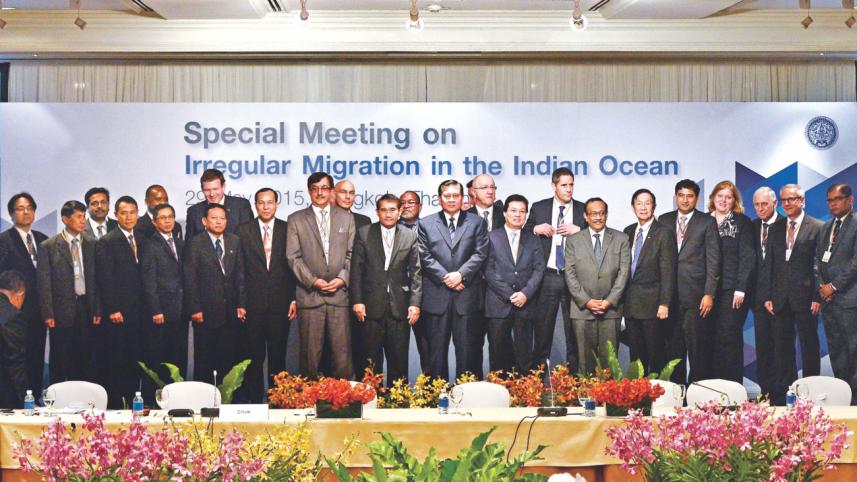
Myanmar must address the root causes of why people are leaving its shores, a top United Nations official said yesterday at a summit to find a solution to a crisis that has seen thousands of migrants and refugees stranded at sea in Southeast Asia.
Volker Turk, assistant high commissioner for protection, at the UNHCR, the UN Refugee Agency, said that Myanmar has a responsibility to its people, and that the granting of citizenship to stateless people in the country is the key.

In response, Myanmar's delegate, Htin Lynn, Special Representative of the Ministry of Foreign Affairs, suggested that Turk was "politicising" the issue by singling out Myanmar as a major cause of the crisis that has dragged on for weeks.
Describing the talks as "very constructive", Norachit Sinhaseni, permanent secretary to the Thai Ministry of Foreign Affairs, said all 17 countries at the table had agreed to a document that includes a commitment "to address factors in the areas of (migrants') origin."
Myanmar and Bangladesh, the departure points for thousands of boat people, agreed yesterday to address the "root causes" of a migration crisis at an international meeting in Bangkok, claimed Thailand's foreign ministry.
But critics pilloried a deal that failed to mention the Rohingya minority at the heart of the crisis.
The majority of the migrants are Rohinyga Muslims, who are pariahs in Myanmar's Buddhist-majority western Rakhine State, and poor people from neighbouring Bangladesh.
The Thai hosts described the day-long talks as "very constructive", saying all 17 countries at the meeting agreed on a statement to provide humanitarian help to 2,500 migrants believed to still be adrift at sea, as well as to the 3,500 who have already made it to Thai, Malaysian and Indonesian shores since May 1.
The statement also drew a commitment to address the "root causes" and "factors in areas of (migrants') origin", including improving the economy, human rights and security in the source countries.
But the document did not mention the Rohingya -- who Myanmar refuses to recognise as an official minority.
Myanmar denies citizenship to the majority of its 1.3 million Rohingya and calls them "Bengalis" -- shorthand for foreigners from neighbouring Bangladesh.
The publication yesterday of Myanmar's first census in three decades also failed to include the Rohingya in its tally, after authorities refused to count them if they self-identified.
Communal violence in 2012 between Rohingya and the Buddhist majority in Rakhine State brought their plight to the fore.
Bangladesh recognises some 30,000 Rohingya as refugees but tens of thousands more are treated as illegal migrants from Myanmar.
Welcoming the outcome of the meeting, Shahidul Haque, head of the Bangladeshi delegation, told reporters "we had a very productive discussion today."
But he rejected the notion that Bangladeshis were heading toward Indonesia and Malaysia because of a lack of economic opportunities at home.
He said Bangladesh had been achieving sustained economic growth and hundreds of thousands of people have been lifted out of poverty.
Bangladeshis had left because of the false promises of traffickers, Haque said, calling it a "manifestation of human trafficking at its worst".
'BAND AID ON A GAPING WOUND'
Others were less impressed with yesterday's talks, writes AFP.
 For all latest news, follow The Daily Star's Google News channel.
 Charles Santiago, chair of the ASEAN Parliamentarians for Human Rights and a Malaysian lawmaker, described the meeting as "lots of talk with little genuine substance or resolve to take any action whatsoever."
His group pilloried the meeting for failing to "publicly discuss the persecution of the Rohingya."
Phil Robertson of Human Rights watch Asia called the talks "a band aid on a gaping wound."
"The Rohingya are not even named in the statement... how can you talk about a people if you don't name them?"
Myanmar's Rohingya are one of the world's most persecuted minorities.
They face restrictions on movement, jobs and family size, while their pariah status means they are unrepresented -- even Myanmar's democracy champion Aung San Suu Kyi chooses not to exert her moral authority on their behalf.
The former junta-led quasi-civilian government has balked at any criticism of its treatment of the community and has previously threatened to pull out of the talks altogether if the word Rohingya is used.
Myanmar officials insist that Rohingya are not from Myanmar, and had previously refused to participate in the meetings if the term was used to describe the group.
"It is important to address the reasons that are behind these movements," Turk told CNN on the sidelines of the meeting.
"Some of it is economic deprivation. Some of it is poverty. Some is is the fact that there is no legal status attached to them.
"Obviously all those issues will need to be addressed in order to make sure that people do not take dangerous sea voyages across the seas and see it is very crucial that we work on that collectively and constructively with all governments involved."
POLICY OF ABUSE
Rights organiSation Human Rights Watch agreed that Myanmar must take steps to change its treatment of Rohingya minority Muslims.
"Myanmar is basically trying to deny responsibility for a rights abusing policy that has sent tens of thousands of people out into the region on boats in desperate situations," Phil Robertson, the group's deputy director, Asia division, told CNN at the meeting.
"What we've seen is ethnic cleansing and crimes against humanity committed against the Rohingya people in Myanmar and the government has held no one accountable for that. Myanmar can contest this issue in the meeting, but the world community knows what's happening in Arakan (Rakhine) State and it has to be addressed."
COOPERATION NEEDED
Participants at the Special Meeting on Irregular Migration in the Indian Ocean largely spoke of the necessity for regional and international cooperation in solving the migrant crisis.
The meeting in Bangkok brought together representatives from southeast Asian nations as well as Australia, New Zealand, Afghanistan and Iran, plus delegates from international organizations such as the UNHCR and the International Organisation for Migration (IOM).
Thai Foreign Minister and Deputy Prime Minister General Tanasak Patimapragorn said that there were three main aims of the one-day meeting: To protect the migrants currently stranded at sea; to prevent and stop human trafficking and people smuggling; and to address the root causes behind irregular migration -- to improve livelihoods for affected communities.
[CNN, AFP]
Comments