


ADP for health doubles, delivery still a concern

The government’s decision to nearly double the health development budget for the next fiscal year has been welcomed as a step in the right direction though serious doubts persist over the implementation capacity of health authorities.
Under the new Annual Development Programme (ADP), the health sector has been allocated Tk 35,530 crore for fiscal 2026-27 -- up from Tk 18,148 crore in fiscal 2025-26 -- representing 11.86 percent of the total ADP outlay. It is the third-largest sectoral allocation, behind transport and communication and education.

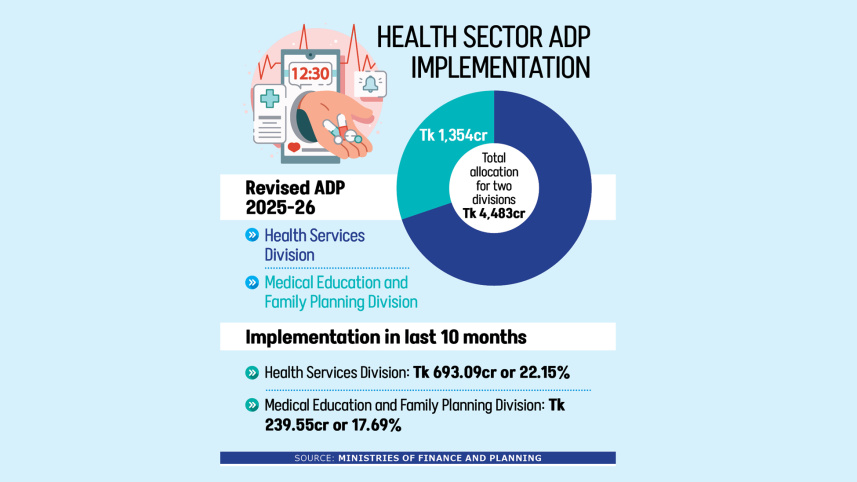
The budget increase, however, comes against a backdrop of poor expenditure performance by the two divisions under the health ministry, the primary users of health funds. In the first 10 months of the current fiscal year, the two divisions spent approximately Tk 933 crore -- less than one-tenth of their annual allocation.
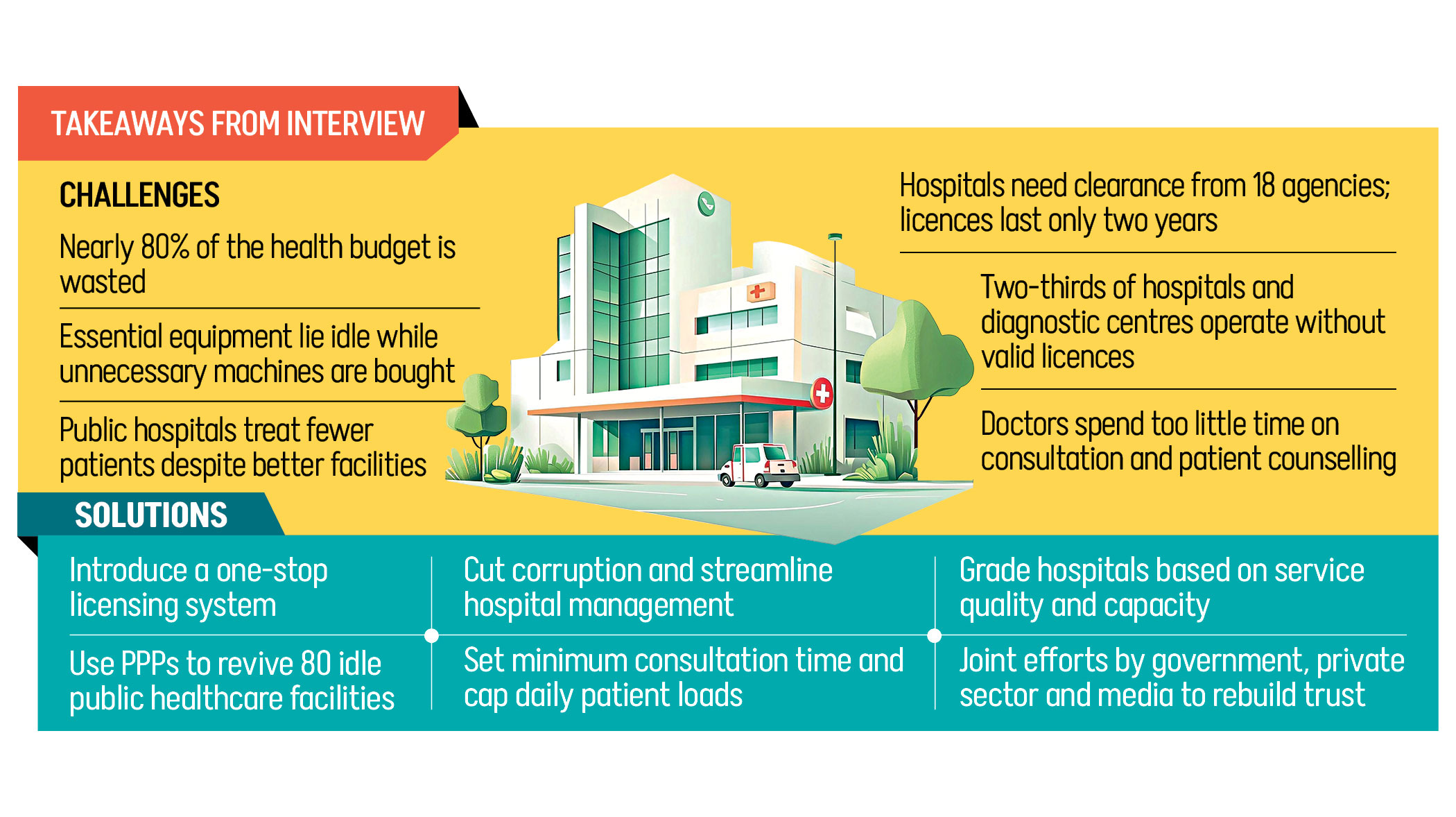
Experts attribute the shortfall to weak implementation capacity, cumbersome procurement and approval processes, and outdated budgeting practices. While a larger health budget is necessary, they argue that institutional reform and sound financial management are equally -- if not more -- critical to ensuring funds are used effectively.
Health campaigners and experts have long pressed for greater investment in the sector, which has languished below one percent of GDP for over a decade. The Health Sector Reform Commission, constituted during the interim government’s tenure, called for raising health spending to 5 percent of GDP -- a target mirrored in the BNP’s election manifesto.
With the BNP government set to present its first budget this month, the National Economic Council, chaired by Prime Minister Tarique Rahman, approved the Tk 3.09 lakh crore ADP on May 19.
Of the Tk 35,530 crore health allocation, the Health Services Division will receive Tk 26,806 crore and the Medical Education and Family Welfare Division Tk 8,221 crore, with the remaining Tk 503 crore earmarked for health-related activities across other ministries.
When contacted, Health Minister Sardar Md Sakhawat Husain said the interim government had worked in an unplanned way and did not prioritise development spending.
Asked whether the ministry would be able to utilise the increased allocation, the minister said, “We will make every effort to achieve it… We will prove that through our work.”

POOR IMPLEMENTATION RECORD
In the outgoing fiscal year, a total of Tk 18,148 crore was allocated to the health sector under the ADP, with over Tk 12,884 crore earmarked for the two divisions.
The remaining amount was set aside for block allocations as well as health-related activities carried out by other ministries.
But like in previous years, the two divisions once again ranked among the worst performers in implementing development budgets, prompting the government to slash more than 65 percent of their original ADP allocation in the revised budget.
The two divisions could spend only Tk 933 crore till April this year -- around 20 percent of the revised ADP.
Except for fiscal 2020-21, none of the two divisions achieved the national average of ADP implementation since 2017 when the health ministry was split into two divisions. In fiscal 2020-21, the MEFWD had barely crossed the national average of 82.11 percent, show documents from the Monitoring and Evaluation Division.
REASONS BEHIND POOR SHOW
Rumana Huque, a professor of economics at Dhaka University said that lengthy and complicated procurement process is one of the key reasons behind the poor budget implementation.
Procurement which was supposed to take 12 months often took up to 18 months, delaying expenditure significantly, she said adding that though the electronic government procurement (e-GP) system has been introduced, many officials still lack the skills to use it effectively.
 For all latest news, follow The Daily Star's Google News channel.
 Another major obstacle is the complicated process of approving and releasing funds. While allocations for the first two quarters are often released together, authorities must submit expenditure statements and seek fresh approvals to access funds for the remaining two quarters, leading to delays in spending, she said.
Problems in the supply chain and weak coordination between planners and budget officials also hamper implementation, said Rumana, also the executive director of ARK Foundation, which works on the health sector.
In particular, delays in project approvals and the replacement of many project directors following the 2024 political transition were major reasons for poor implementation this fiscal year, she added.
Sayed Abdul Hamid, a professor at the Institute of Health Economics of DU, said many project directors and officials lack the necessary training in public financial management, hindering progress in project implementation.
WHAT SHOULD BE DONE?
Welcoming the increased allocation for the health sector, both economists suggested several measures to ensure proper utilisation of funds.
Rumana said the government should prioritise reducing people’s out-of-pocket healthcare expenditure instead of focusing heavily on new infrastructure.
To ease the financial burden on patients, the government should increase spending on medicines, vaccines, and other essential services, as patients currently bear a large share of these costs, she said, adding that preventive healthcare should also be prioritised.
Hamid said that if the government is to ensure proper and full implementation of the health budget, it must strengthen health agencies, provide project directors with necessary training, make fund disbursement smoother, and select qualified contractors.
He also suggested establishing a cell at the health ministry to ensure coordination among the agencies involved in procurement and a help desk at the Directorate General of Health Services to assist health administrators in proper utilisation of funds.
Comments