


Khrushchev’s Secret Speech: The 4 hours that shattered Stalin’s empire

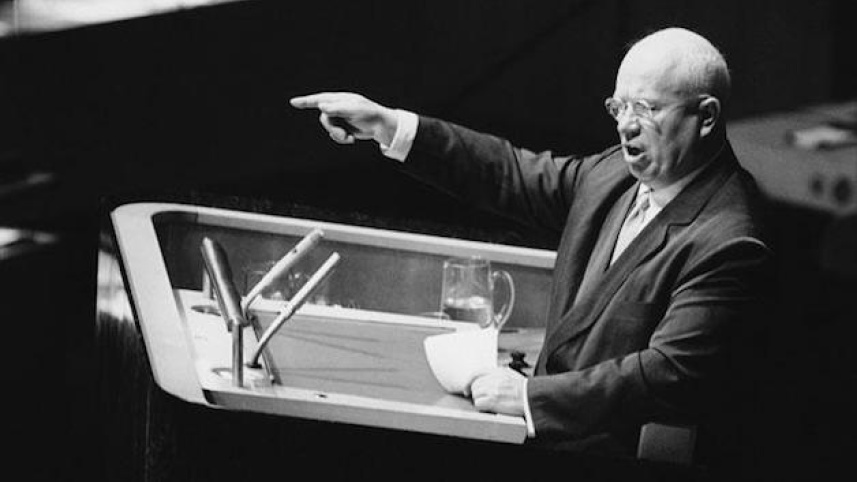
Seven decades ago, in the early hours of February 25, 1956, inside the precincts of the Kremlin, Nikita Khrushchev, the first secretary of the Communist Party of the Soviet Union, stood before a closed session of the party’s 20th Congress and delivered a four-hour oration that detonated like an ideological atom bomb.
Its target was not an external adversary, but the man who both mended and marred the USSR’s history -- Joseph Stalin.

For nearly three decades, Stalin had been not merely a ruler but a quasi-divine presence, an omniscient patriarch whose portrait presided over classrooms, factories, and homes with sacerdotal authority.
To question him was not dissent but heresy in the then USSR.
Yet, before the trembling elite of the Soviet hierarchy, Khrushchev accused Stalin of tyranny, paranoia, and gnarled abuse of power.
He spoke of fabricated conspiracies, mass purges, arbitrary executions and the grotesque elevation of one man above Marxist principle.
Stalin, Khrushchev declared, had perverted socialism into a theatre of terror and personality worship. This was not merely criticism. It was ideological regicide given the era.
The speech, officially titled “On the Cult of Personality and Its Consequences,” was never meant for public ears.
Yet like all great acts of revelation, secrecy proved futile. Its contents leaked, first within the Soviet Union, then across the world. The myth of Stalin’s infallibility dissolved overnight.
And the effect was seismic.
For Soviet citizens, the revelation induced a peculiar existential vertigo. For decades, they had lived in a moral universe where Stalin was synonymous with truth. Now the state itself declared that truth to be a lie.
The consequences were not merely political but metaphysical.
Entire lives had been shaped by terror. Families had vanished in midnight arrests. Careers had been built on denunciations.
This confession undermined the psychological foundation of totalitarian control, which depends less on brute force than on the perception of inevitability and moral legitimacy.
Fear persists most effectively when it appears justified. Khrushchev stripped fear of its sanctity. The result was a subtle but irreversible corrosion of the system’s authority.
The repercussions radiated far beyond Moscow.
In Eastern Europe, satellite states that had endured Stalinist repression sensed opportunity. In Poland, unrest forced concessions. In Hungary, events spiralled into open rebellion.
The Hungarian Revolution of 1956, though ultimately crushed by Soviet tanks, demonstrated that Moscow’s ideological grip had weakened.
Communism’s aura of monolithic certainty had fractured.
Even more consequential was the rupture with Mao Zedong in China.
 For all latest news, follow The Daily Star's Google News channel.
 Mao regarded Khrushchev’s denunciation as an act of ideological betrayal.
Stalin, despite his flaws, had embodied revolutionary authority. To repudiate him was to undermine the principle of absolute leadership itself.
This disagreement metastasised into the Sino-Soviet split, dividing the communist world into rival camps.
Communism ceased to be a unified global movement and became instead a fractured constellation of competing orthodoxies.
The Cold War, once a binary confrontation, became triangular and infinitely more complex.
Ironically, Khrushchev’s speech strengthened the moral position of the West.
For years, liberal democracies had denounced Stalinist repression. Now the Soviet leadership itself had validated those accusations.
This eroded communism’s ideological appeal among intellectuals worldwide. The romance of the revolutionary state, once sustained by myth and mystique, now confronted empirical horror.
US and its allies gained a propaganda windfall.
Institutions such as NATO now faced an adversary whose moral authority was visibly compromised.
Though the Soviet Union would endure for another 35 years, Khrushchev’s speech marked the beginning of its slow intellectual demise.
Totalitarian systems rely on mythological coherence. Once the state admits fallibility, the spell weakens.
Subsequent Soviet leaders oscillated between reform and repression, unable to restore the absolute authority Stalin had commanded or to fully embrace liberalisation.
Eventually, under Mikhail Gorbachev, the forces Khrushchev had unleashed culminated in glasnost and perestroika.
These reforms accelerated transparency and openness, but also exposed systemic rot too profound to repair.
In 1991, the Soviet Union dissolved.
Khrushchev had not intended to destroy the system. He had sought to save it by purging its excesses. Instead, he had punctured the mythology that sustained it.
Empires can survive poverty, defeat and stagnation. However, they cannot survive disillusionment.
And even now, the ghost of Khrushchev’s speech continues to haunt modern geopolitics.
The lesson drawn from Khrushchev’s experience is not that truth liberates, but that uncontrolled truth destabilises.
Modern authoritarian regimes have internalised this lesson. They permit controlled criticism but resist revelations that might delegitimise foundational myths.
The management of historical memory has become a strategic imperative.
Khrushchev’s denunciation remains one of history’s great paradoxes.
It was an act of courage and calculation, honesty and expediency. It sought to rescue socialism by severing it from tyranny, yet instead exposed tyranny as intrinsic to its practice.
It liberated minds but weakened institutions. It restored moral clarity but eroded political stability.
Most profoundly, it demonstrated an enduring truth about power -- authority built upon myth is formidable but fragile. It can command armies, silence populations and reshape continents. Yet it remains vulnerable to a single act of revelation.
Comments