


The chain of oppression of our tea-workers
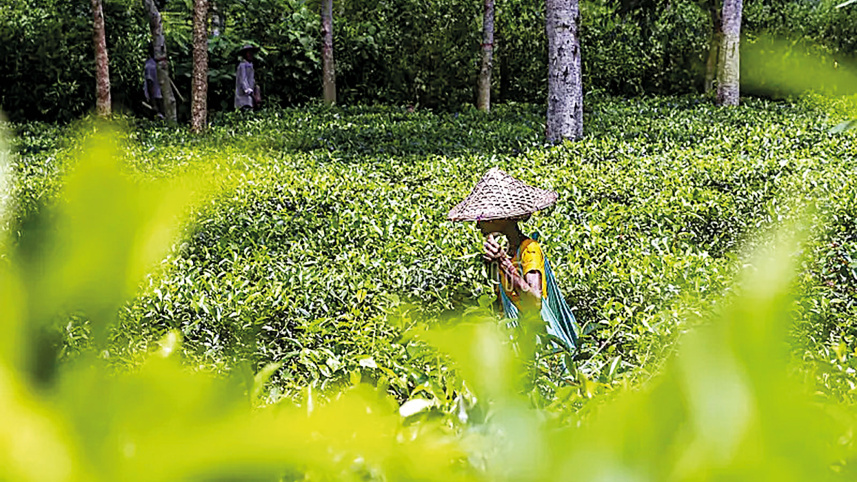
Despite being part of a BDT 3500 crore industry, tea workers in Bangladesh face unsustainable wages, horrendous living conditions, and structural marginalisation. The history of the repression of tea workers in Bengal stretches dates far beyond the colonial era. From the echoes of the Mulluk Cholo uprising to the present day, tea workers have endured a persistent cycle of exploitation, inhumane labour, and systemic neglect.
Tea gardens in Sylhet, Moulvibazar, Habiganj and the Northern regions collectively form an industry worth crore annually, making Bangladesh the 64th-largest tea exporter. However, the daily wages of tea-workers are Tk 178, which is barely sufficient to secure one meal, let alone feed a family. Despite the vast workforce of 300,000 workers, of which 75% are women, their socio-economic status stands in stark contrast to the value they produce, evident from the fact that 74% of the tea workers live below the poverty line. Needless to say, a change to this condition is imperative.

Critics argue that increased labour costs could render some gardens uncompetitive internationally, or that enforcement will remain weak without political will. However, these shortcomings are pale in comparison to the profits made by tea plantation owners and the moral costs of maintaining a labour system that treats human beings as expendable units of production.
If we firstly look at our law, the Bangladesh Labour Act 2006, we will find that it formally guarantees tea workers minimum wages, provident fund, and certain welfare benefits. Specifically, the Act provides for a Tea Plantation Workers’ Provident Fund and for employer contributions. The Bangladesh Tea Workers’ Welfare Fund Act 2016 establishes a government-supervised welfare fund and management board to provide financial assistance and social-welfare grants, such as death, disability, education, medical, and family-support benefits to tea workers and their dependents. However, in reality, instead of effective labour protection, workers of the tea industry experience violations such as the absence of appointment letters and identity documentation despite the requirement under the Labour Act.
Despite the great promises of the law, the reality is far grimmer. Firs, tea workers are subjected to legal discrimination and labour rights violations. For instance, per section 115 of the Labour Act, they have discriminatory leave provisions, as unlike most other sectors, they are explicitly excluded from paid casual leave or equitable earned leave, which goes on to institutionalise the inferior status of the tea workers within the same legal framework. Second, tea workers become dependent on housing provided by tea plantation owners and an employment structure which is coercive in nature. Essentially, many workers reside on employer-owned land without ownership rights. Moreover, section 32 of the Labour Act requires workers to vacate employer accommodation upon termination. This creates a coercive dynamic resembling bonded labour. The net effect of all these is that legal rights exist solely in the abstract. Unfortunately, their enforcement is undermined by weak monitoring and the socio-economic dependency of workers.
Tea-producing regions like Assam and West Bengal have attempted to institute minimum wage boards, profit-sharing rules and social welfare mechanisms. They offer models for statutory welfare schemes, and wage indexing to inflation. For Bangladesh, concrete steps need to be taken. Legal reform through amending labour laws to eliminate discriminatory provisions targeting tea workers is a must, and it is important to explicitly incorporate enforceable standards for wages and other rights. Similarly, institutional and enforcement reform through empowering labour courts that are accessible and equipped to monitor tea gardens and sanction violators is equally necessary. Besides, socio-economic and community welfare reform through offering a secure land tenure to the employers for their homes and cultivation plots may end the dependency cycle.
Indeed, each proposal will face budgetary constraints, employer resistance, and political indifference. Critics argue that increased labour costs could render some gardens uncompetitive internationally, or that enforcement will remain weak without political will. However, these shortcomings are pale in comparison to the profits made by tea plantation owners and the moral costs of maintaining a labour system that treats human beings as expendable units of production.
If anything, exploitative labour conditions can be challenged through a collective reading of Articles 14, 15 and 32 of the Constitution, alongside Dr. Mohiuddin Farooque v Bangladesh (1996), where the Appellate Division interpreted the right to life to include environmental and livelihood protections. This, in turn, can be interpreted to extend to be a safeguard against substandard living conditions and structural dependency perpetrated in tea estates. In neighbouring India, the Supreme Court in People’s Union for Democratic Rights v Union of India (1982) held that payment below the minimum wage constitutes forced labour. How long before Bangladesh follows suit?
The writer studies law at the Department of Law, University of Dhaka.
 For all latest news, follow The Daily Star's Google News channel.
Comments