


Rethinking the child labour laws in Bangladesh
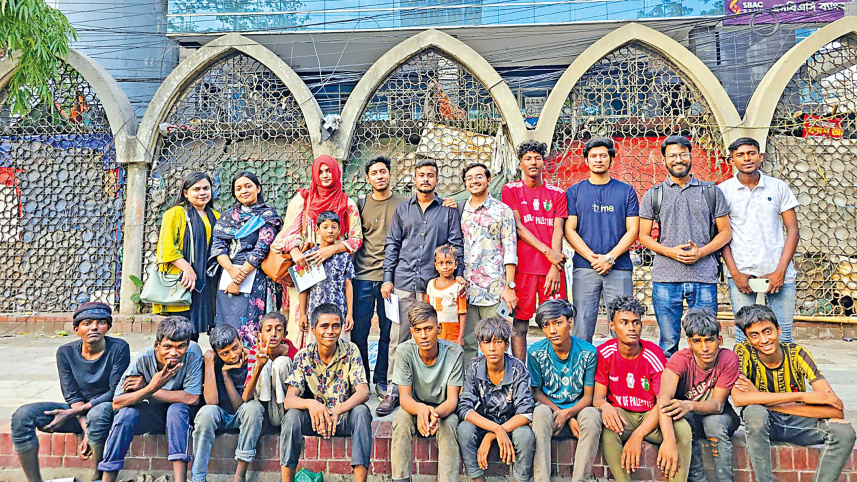
Child labour in Bangladesh is typically associated with factories and hazardous industries. Yet a recent experience by the law students from East west University revealed another reality of the street children whose labour remains largely invisible in law and policy discourse. Recently, a group of law students from East West University Law Clinic, with the support of a social organization Pother Ishkul, organised a series of sessions with street children under the “Street Law” programme conducted by the Law Clinic. Through open conversations they engaged with seventeen children between the ages of seven and seventeen, mostly living around the Gulistan Stadium Gate No. 3 area. These children worked in small tea stalls, Sharbat shops, scrap collection or sweeping. Their daily earnings ranged between 100/- to 300/-, barely enough to survive.
The Bangladesh Labour Act 2006 recognises three categories of workers based on their age- children under fourteen who are prohibited from employment, adolescents between fourteen and eighteen who are allowed to work under certain conditions, and adults being eighteen or above who are fully eligible for employment. What the law failed to recognise is the existence of children under fourteen who are compelled to work for survival, placing them entirely outside regulation. It is true that international instruments such as the ILO Conventions and the United Nations Convention on the Rights of the Child emphasise protecting children from hazardous labour; however, it is equally important that law does not remain isolated from local realities. The law cannot function with the assumption that in Bangladesh every child under the age of fourteen has family care or social protection.

Special provisions should be introduced in the labour legislation for street children under fourteen years, recognising their compulsion to work for survival; guidelines should be developed for small-scale employers employing street children, that focus on safety, fair wages, and non-exploitation; and transitional education programmes should be implemented that combine part-time education with part-time work, enabling children to gradually shift away from full-time labour while maintaining their livelihood.
The grim consequences of this legal vacuum become even more apparent through individual stories. The law students met Nahid, a fifteen-year-old boy who collects scrap materials during the day and also works as a sweeper. He earns about 300/- a day, and deposits the entire amount with a shop owner. He has no idea how the money is kept, or whether he will ever be able to claim it back. This is not an isolated story, across Ershad Road and beyond, hundreds of children live in the same way. Another boy, Arif, aged seventeen, works at a tea stall and is forced to pay 100/- everyday as chanda even with his irregular income. Fifteen-year-old Nur-A-Alam collects loads of scarps across Dhaka, doing such heavy lifting as no child should do. Twelve-year-old Rafi works with his uncle in a small tea-stall and has never been inside of a classroom. Fourteen-year-old Jibon sweeps the street around bus terminals and has to share his little income with his younger brother. Another child, Badar, the youngest aged only seven years, does not yet work, but his future hangs in uncertainty. A local group is trying to get him enrolled in a school but this is merely a glimmer of hope in an otherwise bleak reality.
Conversation with the employers of these children revealed another layer of complexity which is not reflected in the law. It should be noted that these children are employed by small vendors working within the informal economy themselves, many of whom struggle to make ends meet. One of such employers, a vendor, locally known as Chandu Mama, explained that many of the children who work under him do not have any birth certificates. Without identification documents, they lack recognition as a citizen, and cannot access education or healthcare. He recalled a time when he had to use his own identification papers to register the marriage of one boy who had no legal identity of his own. Another shopkeeper explained that the children working in his stall do not have fixed hours, nor do they get proper medical attention when sick. Even toilets and bathing facilities require payment, making hygiene a daily challenge for these children.
From a legal perspective, these employers are in violation of the Bangladesh Labour Act 2006- section 34 in particular. Apart from employing children under fourteen, which is expressly prohibited by the Act, these employers also do not maintain employment records, cannot ensure occupational safety, and are unable to provide most of the facilities mandated by the Act. If they are forced to comply fully, the inevitable outcome would be the dismissal of all underage workers. And once again, it is the same children who will bear the brunt.
Labour laws must therefore respond to the lived reality, particularly that of the street children, and policies must be framed in a way to accommodate the real needs. It is important to clarify that the solution certainly does not lie in legalising child labour, but in recognising that pushing a vast majority of working children outside the scope of legal protection is no solution either. Based on their field visit, the students at East West University’s Law Clinic propose that a more viable approach lies in developing a regulatory framework that govern child labour in a manner that prioritises and safeguards the best interests of the child above anything else. Accordingly, special provision should be introduced in the labour legislation for street children under fourteen years, recognising their compulsion to work for survival; guidelines should be developed for small-scale employers employing street children, that focus on safety, fair wages, and non-exploitation; and transitional education programmes should be implemented that combine part-time schooling with part-time work, enabling children to gradually shift away from full-time labour while maintaining their livelihood.
The writers are students of law, East West University, who conducted research with their peers as part of a project with the Law Clinic Programme under the supervision of Oishe Rahman, Lecturer, East West University.
 For all latest news, follow The Daily Star's Google News channel.
Comments