


Navigating questions revolving the July Charter and constitutional reforms
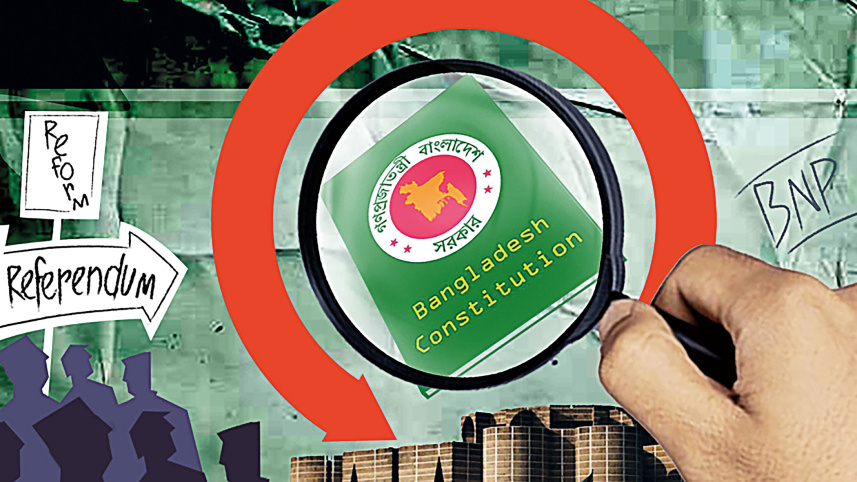
In Bangladesh’s constitutional history, the ‘July Charter’ and the issuance of the July National Charter (Constitutional Reform) Implementation Order, 2025 (hereinafter referred to as the ‘Order’) are not mere administrative measures. They bring forth three fundamental questions at once: the source of state power, the legitimacy of constitutional change, and the legal recognition of the sovereign will of the people. With the public endorsement of the Charter through a ‘Yes’ vote in the referendum, the matter has now moved beyond a political commitment to the level of a national and legal obligation. The question, however, is whether this obligation will survive constitutional scrutiny in the future.

Ultimately, the central question remains: will legal challenges obstruct reform, or will the referendum verdict prevail? The issue is less ‘law versus politics’ than ‘law and politics’ in coordination.
Questions regarding the limits of presidential power are inevitable. The Constitution grants the President authority to promulgate Ordinances under specific conditions. However, it does not authorise the issuance of a new type of executive order drawing legitimacy from ‘revolutionary will’ or a ‘sovereign popular verdict.’ Therefore, such an order may easily be challenged as ultra vires. In a democracy, while popularity may be the source of power, the Constitution determines the manner of its exercise. That popularity can never serve as a license to breach constitutional limits is the essence of constitutional governance.
Indeed, Article 93 of the Constitution empowers the President to promulgate Ordinances only when Parliament is not in session. Yet the Order claims legitimacy beyond the traditional Ordinance framework, deriving authority from the sovereign will of the people as derived from July uprising. The Court may, therefore, question whether the President can issue an order that transforms Members of Parliament into members of a ‘Constitution Reform Council’ and imposes a time-bound obligation to amend the Constitution. The core debate will be whether this constitutes an administrative mechanism within the constitutional framework or represents a new exercise of ‘constituent power’ outside of it.
The first legal challenge in this process is whether an executive order can form the basis of fundamental constitutional reform. Article 93 authorises only Ordinances, which must subsequently be approved by Parliament. However, the ‘July Implementation Order’ claims a higher legal foundation—not in any specific constitutional provision, but in the doctrine of revolutionary legality. Should the matter reach the Court, the judiciary would need to determine whether the President is merely a preserver of the Constitution or, in moments of crisis, may act as a bearer of the people’s constituent power. Thus, if it is treated as an ordinary administrative order, the reform process may falter at the outset. But if it is accepted as a transitional legal framework, it may receive constitutional protection.
There may also arise a debate owing to the implications of the terms ‘Order’ and ‘Act’. Although Article 152 includes ‘order’ within the definition of law, an executive order does not carry the same status as a parliamentary statute. Proposals such as a bicameral legislature, proportional representation, or decentralisation are not merely procedural reforms; they are structural transformations of the State. The question is whether such fundamental changes can be initiated through an order, or is a full legislative process indispensable. If the court finds the Order lawful yet insufficient for such a structural reform, the entire process may become entangled in legal complexity at a much early stage.
The procedure for constitutional amendment is an even more fundamental. Articles 142 and 142(1A), as reinstated by the High Court Division in the 15th Amendment case, provide the recognised methods for amendment through Parliament. Transforming Parliament into a ‘Constitution Reform Council’ via executive order is not merely administrative rearrangement it may be viewed as bypassing the constitutional amendment framework itself. To amend the Constitution, one must use the doors within it—breaking in through a window is inconsistent with constitutional propriety. If the Court does not prioritise procedural purity, future governments may be encouraged to take constitutional shortcuts ‘in the name of the people’, risking constitutional anarchy.
The third and most sensitive issue concerns the Basic Structure Doctrine. Although the repeal of Article 7B led some to believe that no barrier remains to altering the Constitution’s fundamental structure, the doctrine now exists as a judicial principle rather than merely a textual restriction. If the character of Parliament, separation of powers, or democratic framework is fundamentally altered, the Court may ask whether the very spirit of the Constitution is being undermined. Popular support may exert moral pressure but that does not automatically remove constitutional limits. Comparative jurisprudence supports this view.
Bangladesh’s judicial tradition has also recognised this doctrine, interpreting elements such as unicameralism, democracy, judicial independence, and separation of powers as possible parts of the basic structure. Yet, with the repeal of Article 7B, the amendment rigidity has somewhat relaxed. Thus, if the people clearly endorse bicameralism or PR through referendum, can the court reject that will on basic structure grounds? Here arises the tension between judicial authority and popular sovereignty. Is the court’s role to protect the Constitution, or to recognise the people’s power of reconstruction?
This debate is not new. In India’s Kesavananda Bharati case, the Basic Structure Doctrine was established in the context of questioning the limits of Parliament’s amending power. In Nepal, after mass movements, the judiciary adopted a transformative interpretation during constitutional rewriting. In South Africa, during the post-apartheid constitution-making process, popular participation and referendum created moral pressure on the judiciary. These comparative experiences show that in moments of deep reform, courts that cling solely to technical interpretation may clash with political reality.
Thus emerges the classic debate of judicial review versus popular sovereignty. Experiences from Nepal and South Africa suggest that in transformative moments, courts may adopt an evolutionary rather than rigidly conservative interpretation. A constitution is not an immutable inscription in stone but a living reflection of the people’s aspirations. It is submitted that elevating the referendum verdict above the Basic Structure Doctrine may, therefore, be the true realisation of democratic justice.
The fourth issue concerns the 180-day deadline. While time limits may accelerate reform, they raise concerns about constitutional stability. If reform is not completed within the prescribed period, questioning Parliament’s legitimacy could endanger state continuity. A constitution is not a project to be completed on schedule; it is the state’s foundational compact. Excessive haste may undermine deliberation, consensus, and public participation. Legally, such a timeframe should be viewed as directory rather than mandatory. Preserving the quality of reform is more vital than meeting a deadline.
From a comparative view, while the Indian Supreme Court in Kesavananda case restrained Parliament, it did not confront a direct popular mandate. In South Africa, the court acted as a certifier of the new constitution, bridging judicial authority and popular aspiration. Should a similar question arise in Bangladesh, the judiciary may need to assume a comparable role. If reforms are inclusive and transparent, the author believes, courts should adopt a transformative jurisprudence rather than mechanical interpretation.
Furthermore, with the ruling party taking oath, matter of implementation of the July Charter arises, and new political and legal complexities may emerge as well. One may argue that the referendum’s victory elevates the Order from a political document to a legal framework. Taking an oath under the Charter would signify a constitutional undertaking to abide by the framework, supported by a referendum. If the Charter were to be implemented, older political reservations will lose legal force. If disagreement arises, Court may introduce further complexity. However, political dissent remains possible through proposing amendments within the constituent body, arguing for modifications of specific clauses, or attempting future repeal or revision. Thus, oath-taking means accepting the framework but not surrendering dissent.
Ultimately, the central question remains: will legal challenges obstruct reform, or will the referendum verdict prevail? The issue is less ‘law versus politics’ than ‘law and politics’ in coordination. If litigated, in author’s opinion, judges must look beyond literal interpretation, considering context, popular will, and the evolving character of the Constitution. Indeed, a constitution is not a museum artifact; it is a living document.
The writer is Head of the Department of Law at Bangladesh University.
 For all latest news, follow The Daily Star's Google News channel.
Comments