


How Sabina Khan reinvents Bangladeshi flavours abroad

If you ask Sabina Khan where her cooking began, she starts with her mother's kitchen. It's a place where Bangladeshi "shorshe ilish" sat comfortably next to pizzas and Chinese stir-fries.
"My earliest memories of food are of my mum cooking all kinds of different dishes," she says. "My friends would come over just to eat her food. I believe my exposure began with her and my grandmother. They were fabulous cooks who never limited themselves to one cuisine."

That said, her life did not follow a predictable cultural arc. She has lived in Dhaka, India, the US, Nova Scotia, and now England.
"I've experienced a lot of different types of food from moving around," she explains. "But I do not see that as fusion. I am not interested in fusing things. I want to see how different flavours can co-exist on a plate and still tell a story."
Her explanation is firm: "People confuse what I do with fusion, and I always correct them. I am more interested in flavour than identifying labels."
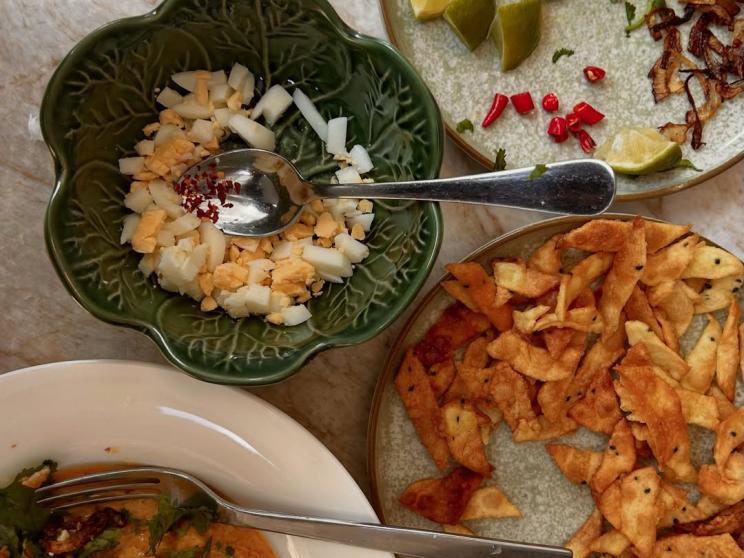
Redefining Bangladeshi food in a diasporic context
Living abroad has shown her how often Bangladeshi food is misunderstood.
"In England, the idea of Bangladeshi food is mistakenly tied to Indian restaurant menus," she says.
Dishes that dominate, such as chicken tikka and vindaloo, can overshadow the complexity of Bengali cooking.
"A lot of Bangladeshi immigrants had to set up restaurants serving Indian food because that is what the British public wanted. Our own flavours never got space. Mustard, fish, panch phoron — they are barely represented in fine dining. There's a lot of scope for Bangladeshi cuisine abroad," she insists.
And adds, "I'm sure that if people had a chance to taste our ingredients, they'd be amazed."
A laboratory, not a kitchen
Khan does not describe her work as recipe development. She calls it experimentation.
"In my lab," she laughs, "I have my spices, and I create different experiments. Some work. Some do not. Sometimes they look beautiful but do not taste good. Other times they look terrible and taste incredible."
She always begins with a traditional recipe, then follows her instinct rather than the rules. Her recent rethink of a standard fish curry captures this approach.
"Usually, we cook fish in the curry until everything becomes one," she says, "But sometimes the ingredient gets lost."
So, she bought fresh fish with her father, filleted it, pan fried it separately, and served it over the curry. "I didn't tell him anything. He ate it and said, 'Oh, this fish is so fresh!' That said everything."
She is not abandoning Bangladeshi flavours. She's rethinking how they behave. "What vegetables could we use that we don't have? Could a Baba Ganoush work with our flavours? Maybe. Why not try?"

The birth of Sabina's Flavour Lab
Despite cooking for two decades, Sabina only recently considered turning her curiosity into a brand.
"I realised this is something I'm passionate about," she says. Her vision for Sabina's Flavour Lab is not to teach people recipes, but to invite them into her experimentation.
 For all latest news, follow The Daily Star's Google News channel.
 She imagines supper clubs that bring unlikely cuisines together: "Mexican with Bangladeshi influences, or Italian with Asian twists."
A cookbook may follow, though not a traditional one. "It would not be a 'Bangladeshi cookbook.' It would be a Flavour Lab cookbook — something that lets people see food outside categories."
She also wants to explore professional kitchens in Bangladesh, perhaps as part of a show. "We do not see behind-the-scenes journeys of chefs here, especially female chefs. It would be a new avenue, and a way to show how much Bangladeshi cuisine has evolved."
What she wants next
Khan's hopes for the future centre around one idea: giving Bangladeshi cuisine global legitimacy without diluting it.
"There's so much our food can offer that the world hasn't tasted yet," she says.
She wants to rethink bhortas, salads, and mishti.
"Healthy Bangladeshi food exists. We eat it every day," she smiles.
Her flavours are steady but with surprises folded in, like the simmer of a curry being tested in the Flavour Lab, the place where Sabina Khan keeps turning ingredients into possibilities.
Photo: Courtesy
Comments