


Cancer could not stop Farah Noshin’s Muay Thai journey
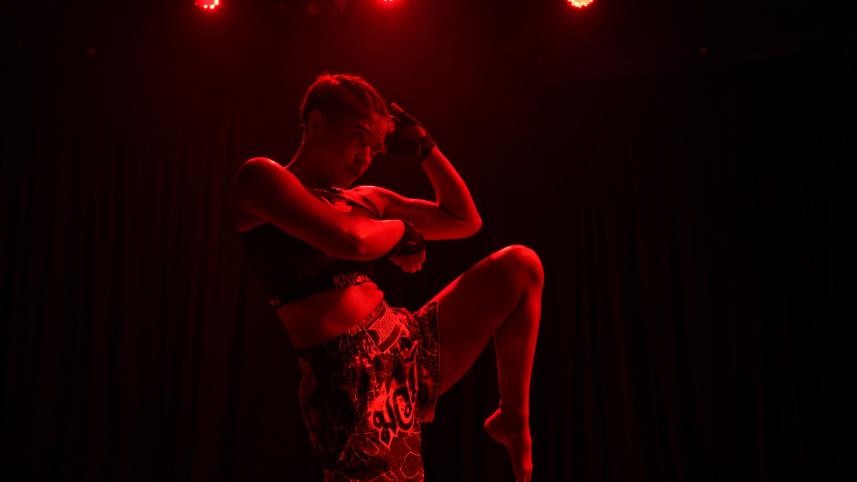
At 39 kilograms, Farah Noshin Bhuiyan – also known as Noshin Knight – was rebuilding a body that cancer had almost erased.
Today, she steps into a Muay Thai ring knowing her nose might break again. Between those two realities is not a miracle story. It is discipline. In 2015, during her third year studying Genetic Engineering and Biotechnology, she was diagnosed with first-stage colon cancer.

“I was a very bright student since childhood,” she says. Her father, an assistant scientist, had dreamed she would become a scientist. That path stopped abruptly.
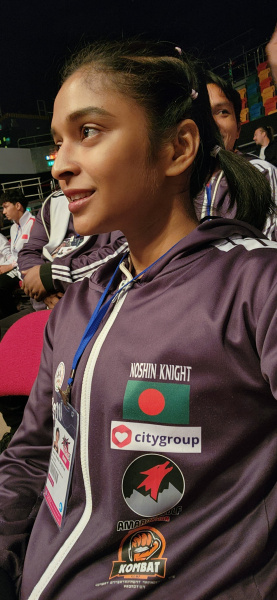
For eighteen months, she underwent treatment. “I was around 39 kgs when I recovered,” she recalls. “You can imagine how frail that is for someone who is five feet two inches.” At one point, doctors warned that part of her colon might have to be surgically removed and replaced with an external waste bag. “You can imagine how terrifying that scenario is,” she says. Her father insisted on trying therapy first. After four cycles of chemotherapy, the cancer receded.
But recovery was not a clean exit. Even today, she undergoes APC (Argon Plasma Coagulation) procedures two to three times a year to control internal bleeding. She has annual biopsies. “The doctors say the cancer could return anytime.”
Surviving cancer, she says, felt like a second birth.
The body as project
After returning to complete her B.Sc., she realised something had shifted. “My body wasn’t like it used to be. I felt very frail.” That weakness bothered her more than fear. Her mother enrolled her in Karate classes.
“I developed a strong liking towards fitness,” she shares.
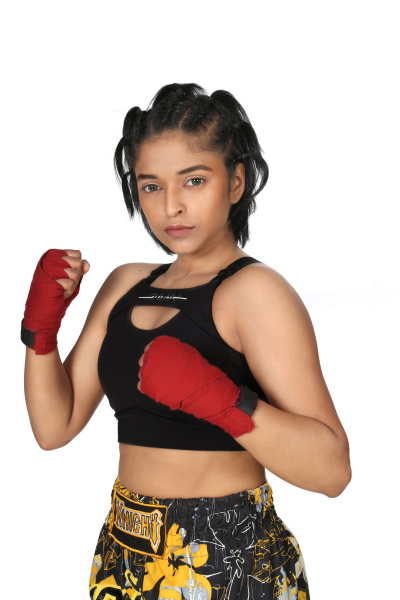
From 2016 to 2019, she trained relentlessly and earned her Karate Black Belt. Then came COVID-19. Gyms closed. Momentum stalled. In 2021, she joined boxing. She fought twice and lost both matches. “My coach said, ‘Get in the ring. It doesn’t matter if you lose. You need the experience.’”
Experience led her to Muay Thai.
Why Muay Thai
She is quick to clarify: Muay Thai is not MMA. “Boxing only involves punches. Muay Thai has kicks, elbow strikes, knee strikes, and sweeps. MMA includes ground fighting.”
She joined the Bangladesh Muay Thai circuit at the end of 2022. Her coach, Ishtiak Ahmed Chowdhury, Coach at Invictus BJJ & MMA, helped refine her technique and ring strategy.
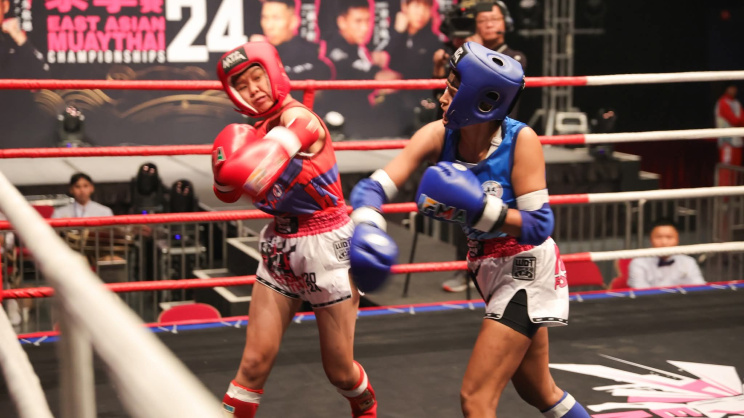
In December 2024, she represented Bangladesh at the IFMA East Asian Muay Thai Championship in Hong Kong, competing in the Women’s 48 kg category. Her nose was broken mid-match. The fight was stopped due to heavy bleeding.
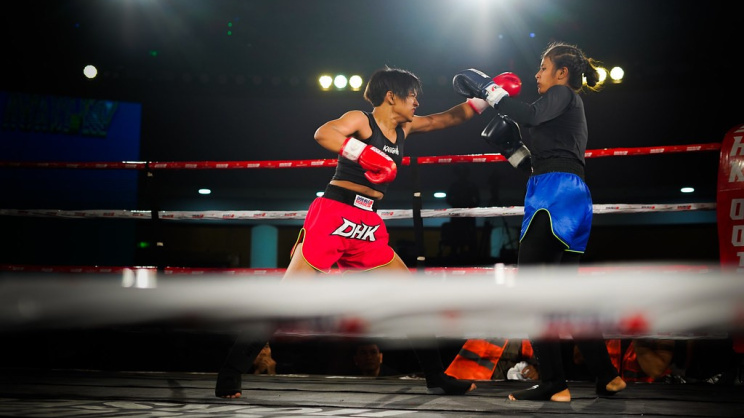
“I didn’t lose on score,” she says. “They stopped it for safety.”
In July, at “Double Horse Knockout Night 1” in Dhaka, she fought a 16-year-old opponent. She is 33. She won. “For me, winning or losing is secondary,” she says. “The fact that I can still play in this physical condition is enough.”
Her next challenge is the Four Nation Muay Thai Championship in Pakistan this May, where Bangladesh will compete alongside India, Pakistan, and Iran.
Money, myth, and reality
There is a common assumption in Bangladesh that fitness and combat sports are financially unstable careers. She rejects that outright. “People think there is no money in fitness or as a fighter,” she says. “That is not true.”
 For all latest news, follow The Daily Star's Google News channel.
 Through coaching, training clients, and building her platform, she earns more than Tk 1 lakh per month. She funds her own career. During her early training years, she paid for boxing through private tuition work and coaching. “No one handed me money and told me to do this,” she says. Her family supported her emotionally and provided shelter, but financially, she had to carry herself.
To her, the idea that fitness is not a “real” career is outdated. “If you look at millionaires and billionaires globally, most of them are athletes or deeply connected to sports culture,” she says. “Fitness is important — not just physically, but economically.”
Strength over everything else
Her vision now extends beyond competition. She wants girls in Bangladesh to train — not necessarily to fight professionally, but to defend themselves. “Every girl should learn to fight,” she says. “It makes them confident in daily life.”
She challenges the cultural fixation on slimness. “In Bangladesh, women think they should only do cardio to stay thin. It doesn’t matter if you are fat or thin. What matters is if you are strong.” She encourages parents, especially, to let their daughters participate in combat sports. “This is how girls will learn to defend themselves.”
When she walks alone, she says she does not feel vulnerable. “My gait, my gaze, my speech — they show confidence.” Often, presence alone prevents confrontation.
The second life
Before cancer, she wanted to be a scientist. After cancer, she began questioning meaning. “Surviving cancer is like a second birth,” she says. “The meaning of my existence matters now.”
She wants Muay Thai to receive full Federation recognition in Bangladesh, opening institutional support for future athletes. She does not ask for personal benefits. “If the sport grows, I will naturally benefit.”
Today, her life is not arranged around fear or approval. It is arranged around improvement.
Photo: Courtesy
To follow Farah Noshin Bhuiyan’s training journey and upcoming competitions, visit her Instagram profile: @noshinknight.
Comments