


Teaching boys to cook can rewrite gender roles at home

Across the world, women’s equality is still decided not in parliaments or boardrooms, but in kitchens. In 1905, Bengali feminist pioneer Rokeya Sakhawat Hossain imagined Ladyland in Sultana’s Dream, a society where women ran science and men were confined to domestic work, cooking with solar stoves behind purdah walls. More than a century later, my thirteen-year-old son has just taught himself to brown a steak. This, I believe, is not a small thing.
Care work and domestic labour remain profoundly unequal worldwide. According to the International Labour Organization, women perform more than three-quarters of unpaid care work globally, and in South Asia, the share exceeds 80 per cent.

Here, where women’s labour force participation remains among the lowest in the world, this imbalance inside the home directly shapes inequality outside it. The kitchen is not a private space. It is an economic frontier. Until unpaid care is redistributed, gender equality in wages, leadership, and political power will remain structurally incomplete.
Yet, in my own childhood, that inversion felt almost ordinary.
I grew up in a home where both my parents worked, and where my father experimented with a newly acquired microwave in the early nineties. During Eid ul Adha, my father and the house staff would set up a makeshift charcoal grill. Wearing a chef’s apron, he would marinate the cubed meat and slide it onto long iron skewers.
We children, took turns squeezing lime juice over the meat, impatient for the sheekh kebabs to be ready. As soon as they came off the skewer, we were the first to taste. At lunch, those tender charcoal-smoked kebabs sat at the centre of the table surrounded by our joint family.
My father enjoyed the kitchen, and he taught my mother how to navigate it. Married at seventeen, my mother was bookish, with younger sisters far more culinarily inclined.
When she followed my father to the UK, she could not cook. My father was in charge of their kitchen, but when guests arrived, they often assumed the meals were hers. With time she learned. What I absorbed was a quiet disruption of gender roles, one that allowed her to focus on a career.
From those years I remember my mother making her signature cream jamun for special occasions. Its subtle sweetness came from the malai layered onto the fried dough, lightly kissed with cardamom-flavoured sugar syrup.
Then I went abroad to study at Smith College, where I met my best friend.
Chef Julia Child once attended the same institution. She famously said, “No one is born a great cook; one learns by doing.” That line mattered to me — not only as culinary wisdom, but as feminist truth.
My best friend and I spent long evenings whipping up meals together, guided by Siddika Kabir’s cookbook, Ranna, Khaddo, Pushti. She made cooking accessible to generations of Bangladeshi men and women across the globe.
One evening, we argued while making khichuri. Should we follow Siddika’s vegetable khichuri, or my friend’s uncle’s recipe from his student days in Japan? In the middle of that argument, the oil in the pan overheated and caught fire. The burnt kitchen was sealed off for the rest of the semester. After that I cooked more carefully.
When I lived abroad, I cooked regularly. But after returning home, where domestic help was available, I chose not to spend time in the kitchen. During pregnancy, cravings were frequent, especially for my mother’s cream jamun. In a moment of vulnerability, I threw a tantrum. I complained that everyone’s mothers made their favourite dishes while mine attended meetings and conferences.
I saw in that moment that even the most liberated woman can internalise society’s expectations of care. This is not a personal weakness; it reflects how deeply unpaid labour is embedded in our economies.
As a Chartered Accountant, I am trained to measure value, assets, liabilities, and returns. Yet, I had failed to account for the invisible capital of my mother’s time, expecting her to revert to a traditional role for my comfort. Teaching the next generation differently would require a kind of reparative accounting.
Soon my son was born.
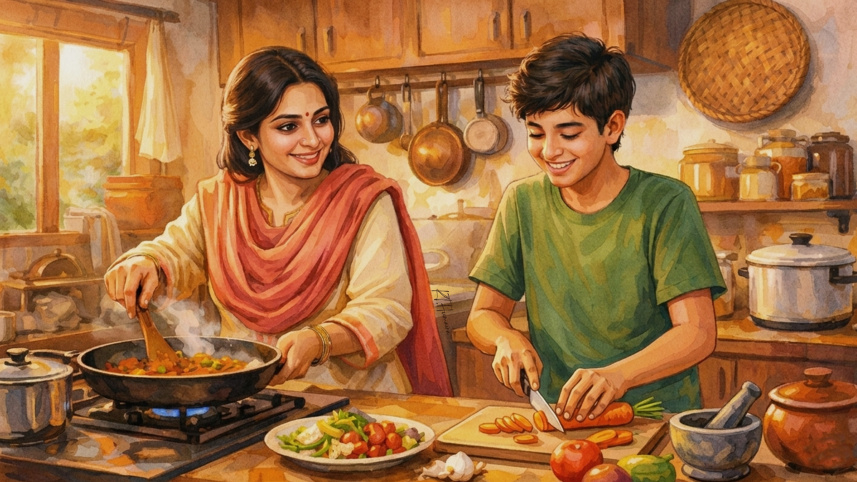
Raising him while working was joyful and exhausting. We read books about baking and food together. One day, after a birthday at daycare, he came home with a small apron and chef’s hat. We started spending time baking, not to produce meals, but to build belief. The belief that the kitchen belongs to neither women nor men alone. It is a place to share joy and the burden of household chores.
Learning to feed oneself is a life skill. Teaching my son his way around the kitchen was also teaching him to respect unpaid labour—the invisible work that still falls disproportionately on women. This imbalance underpins economic inequality and shapes women’s participation in public life.
Redistributing that labour inside homes is one of the quietest and most necessary forms of economic reform.
 For all latest news, follow The Daily Star's Google News channel.
 Then Covid arrived. Our world narrowed. We lived inside shared routines. By the time the school reopened, my son had learned far more than recipes. We watched Junior MasterChef, studied flavours, and tried to recreate dishes at home. His favourite chefs became Jamie Oliver and Gordon Ramsay, whose shows made the kitchen feel creative and disciplined. Yet, his comfort food, like mine, remains rice and chicken curry with potatoes.
And suddenly, he is thirteen.
This afternoon, I came home to the fragrance of onions browning in beef fat. My son was at the stove, without being asked.
For centuries, the kitchen has been framed as women’s territory. What I smelled was not simply dinner. It was an inheritance changing hands.
Rokeya imagined liberation inside the walls of Ladyland. Ours may arrive more quietly, across ordinary homes and generations. Reimagining care within the household is a political act everywhere.
Feminism, I have learned, is not only argued. It is practised. The future of women’s equality may depend less on speeches than on whether the next generation of boys learns to cook, clean and care.
Zareen Mahmud Hosein is a Bangladeshi Chartered Accountant and governance professional working on gender and leadership.
Comments