


Overseas Jobs
Call for maintaining highest ethical standards
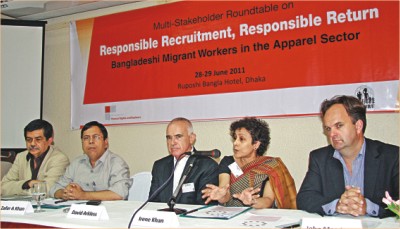
Irene Khan, board member of UK-based Institute for Human Rights and Business, speaks at a press conference after the concluding session of a two-day roundtable titled "Responsible Recruitment, Responsible Return: Bangladeshi Migrant Workers in the Apparel Sector" at a city hotel yesterday. On her left is John Morrison and on her right are David Arkless, Zafar Ahmed Khan and Prof CR Abrar.Photo: STAR
Human rights activists yesterday called upon international recruiting agencies and employers to maintain the highest ethical standards by ensuring protection of labour in all the stages starting from recruitment to repatriation. Employers must bear the migration costs and the migrants, based on their work, should be ensured equal pay, access to health and safety facilities, they said. They urged global brands and governments to put pressure on the labour receiving countries, which are deviant from global standards, to run a decent recruitment industry. The suggestions came at a press conference at a city hotel after the end of a two-day roundtable titled "Responsible Recruitment, Responsible Return: Bangladeshi Migrant Workers in the Apparel Sector" yesterday. UK-based Institute for Human Rights and Business (IHRB) and Refugee and Migratory Movements Research Unit (RMMRU) organised the programmes. Speaking at the press conference, David Arkless, vice president-elect of International Confederation of Private Employment Agencies, said, “The message for the recruitment business here is you can operate ethically, correctly. “Treat your candidate with human dignity and you can still make money." Terming the practice of charging high fees from jobseekers in Bangladesh as "terrible", he said there is a huge gap between global norms and the recruitment practice in Bangladesh. Some foreign countries in the Gulf are exceptionally deviant from the global practice of recruitment, said David. It will take time for the manpower exporting industry here to bring standards up to global norms, which is why commitment of Bangladesh Association of International Recruiting Agencies, the government and civil society is crucial, he said. "Human rights comes first, business comes after," said IHRB Board Member Irene Khan. It is the first and foremost responsibility of the states to ensure human rights. But the states alone can not do it and here comes the role of the recruitment agencies and global brands, she said. Businesses, for their own interest, not only have to ensure a safe and responsible recruitment but also a safe return, she added. "We have to look at the entire spectrum of migration -- recruitment, employment and return," she said. Job contracts should have clauses for repatriation, a fact which the government needs to address in bilateral agreements, she said, urging on global brands to put pressure down the supply chain of labour to ensure transparent recruitment. The sector is not just about profit, but about people, she said. Irene, former head of Amnesty International, said they are trying to create a framework for multiple stakeholders including businesses, the government, labour associations and civil society organisations to make these principles come to practise. RMMRU Executive Director Prof CR Abrar said this is high time Bangladesh signs bilateral agreements having clauses that meet labour demands with countries receiving labour, as the Arab world is moving for reforms following the current uprisings. IHRB Executive Director John Morrison said principles adopted at the meeting include -- none will retain migrants' travel documents, migrants will face no discrimination on any grounds and companies will maintain code of conduct. Migrants will also have access to a confidential mechanism for complaints and access to a safe return with due pay and employers will ensure that job contracts are written in migrants' language, he added.
 For all latest news, follow The Daily Star's Google News channel.
Comments