


Imran to face no-trust vote
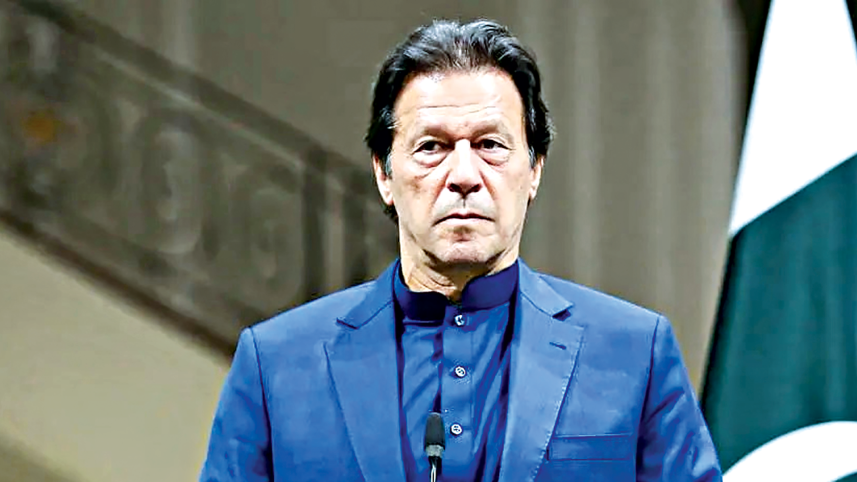
Pakistan Prime Minister Imran Khan faces being booted from office at the weekend after the Supreme Court yesterday ruled that parliament had been illegally dissolved and a no-confidence vote on his government must go ahead.
Khan's coalition lost its majority in the national assembly last week, but he avoided being dismissed when the deputy speaker blocked a no-confidence motion against him and the president dissolved parliament and ordered fresh elections.

"The advice tendered by the Prime Minister on or about 03.04.2022 to the president to dissolve the Assembly was contrary to the Constitution and of no legal effect," Chief Justice of Pakistan Umar Ata Bandial said, as he read out a 13-point order to a packed courtroom.
"The national assembly continues to remain in session," he added, with officials saying it would sit again tomorrow.
The court's judgment was broader than expected after the chief justice said earlier this week they would only rule on the legality of the no-confidence motion being blocked.
The decision -- which the court said was unanimous -- was met with jubilation by opposition supporters in the capital, with packed cars racing through the streets, sounding their horns.
There was no immediate reaction from Khan, but Shehbaz Sharif, head of the Pakistan Muslim League-N (PML-N) and likely to be the next prime minister, said the decision "has saved Pakistan and the constitution of Pakistan".
Pakistan People's Party (PPP) leader Bilawal Zardari Bhutto, who had joined forces with Sharif to oust Khan, tweeted: "Democracy is the best revenge".
Khan claimed the opposition had colluded with the United States for "regime change" when the deputy speaker -- a loyalist -- refused to allow the no-confidence motion.
Simultaneously, Khan asked the presidency -- a largely ceremonial office also held by a loyalist -- to dissolve the assembly.
President Arif Alvi has already told the feuding factions to nominate candidates for interim prime minister and asked the country's election commission to fix a date for a new national ballot.
The opposition had refused to cooperate.
The 69-year-old Khan, who steered Pakistan to cricket World Cup victory in 1992, came to power in 2018 after rallying the country behind his vision of a corruption-free, prosperous nation respected on the world stage.
But it appears that the firebrand nationalist's fame and charisma may not be enough to keep him in power. He could not deliver on all of his lofty promises and failed to avert an economic decline partly sparked by the COVID-19 pandemic.
If Khan were to lose the no-confidence vote, the opposition could nominate its own prime minister and hold power until August 2023, by which date fresh elections have to be held.
The opposition has already said it wants early elections, but only after delivering a political defeat to Khan and passing legislation it says is required to ensure the next polls are free and fair.
Pakistan's election commission yesterday said that the earliest it could hold the ballot was October.
Yesterday, the rupee was trading at a historic low of 190 to the dollar, and the central bank raised the key interest rate by 250 basis points to 12.25 percent -- the biggest hike in over a quarter of a century.
Pakistan has been wracked by political crises for much of its 75-year existence, and no prime minister has ever seen out a full term.
Khan has blown anti-US sentiment into the political atmosphere by saying the opposition had colluded with Washington. The PM says western powers wanted him removed because he will not stand with them against Russia and China.
 For all latest news, follow The Daily Star's Google News channel.
 The Supreme Court is ostensibly independent, but rights activists say previous benches have been used by civilian and military administrations to do their bidding throughout Pakistan's history.
Publicly the military appears to be keeping out of the current fray, but there have been four coups since independence in 1947 and the country has spent more than three decades under army rule.
Comments