


Monsoon flooding in Pakistan: Death toll tops 1,000
northern rivers; Turkey sends team to help with rescue efforts
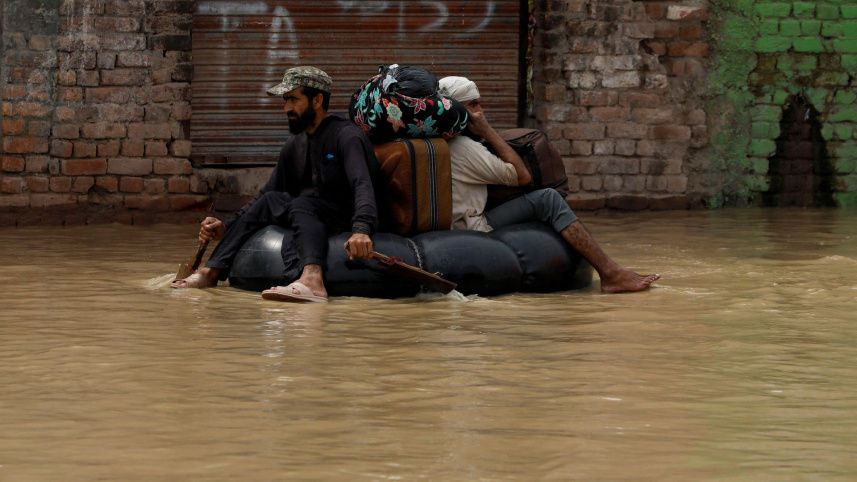
Pakistan's flooded southern Sindh province yesterday braced for a fresh deluge from swollen rivers in the north as the death toll from this year's monsoon topped 1,000.
The mighty Indus River that courses through Pakistan's second-most populous region is fed by dozens of mountain tributaries to the north, but many have burst their banks following record rains and glacier melt.

Officials warned torrents of water are expected to reach Sindh in the next few days, adding misery to millions already affected by the floods.
"Right now, Indus is in high flood," said Aziz Soomro, the supervisor of Sukkur Barrage -- a massive colonial-era construction that regulates the river's flow and redirects water to a vast system of canals.
The annual monsoon is essential for irrigating crops and replenishing lakes and dams across the Indian subcontinent, but it also brings destruction.
Officials say this year's monsoon flooding has affected more than 33 million people -- one in seven Pakistanis -- destroying or badly damaging nearly a million homes.
The country's National Disaster Management Authority yesterday said the death toll from the monsoon rains had reached 1,033, with 119 killed in the previous 24 hours.
It said this year's floods were comparable to 2010 -- the worst on record -- when over 2,000 people died and nearly a fifth of the country was under water.
Pakistani leaders have appealed to the international community for help and plan to launch an international appeal fund. The foreign affairs ministry said Turkey had sent a team to help with rescue efforts, reports Reuters.
"The magnitude of the calamity is bigger than estimated," said Prime Minister Shehbaz Sharif, in a tweet, after visiting flooded areas in Balochistan province. He announced a grant of Rs10 billion for the province.
Thousands of people living near flood-swollen rivers in Pakistan's north were ordered to evacuate from danger zones, but army helicopters and rescuers are still plucking laggards to safety.
"People were informed around three or four o'clock in the morning to evacuate their houses," rescue worker Umar Rafiq told AFP. "When the flood water hit the area we had to rescue children and women."
Many rivers in the area -- a picturesque tourist destination of rugged mountains and valleys -- have burst their banks, demolishing scores of buildings including a 150-room hotel that crumbled into a raging torrent.
Guest house owner Nasir Khan, whose business was badly hit by the 2010 flooding, said he had lost everything. Officials blame the devastation on human-driven climate change.
The flooding could not come at a worse time for Pakistan, where the economy is in free fall and the former prime minister Imran Khan was ousted by a parliamentary vote of no confidence in April.
While the capital Islamabad and adjoining twin garrison city of Rawalpindi have escaped the worst of the flooding, its effects were still being felt.
"Currently supplies are very limited," said Muhammad Ismail, a produce shopkeeper in Rawalpindi.
"Tomatoes, peas, onions and other vegetables are not available due to the floods," he told AFP, adding prices were also soaring.
 For all latest news, follow The Daily Star's Google News channel.
Comments