


Yunus seeks WTO support for smooth LDC graduation
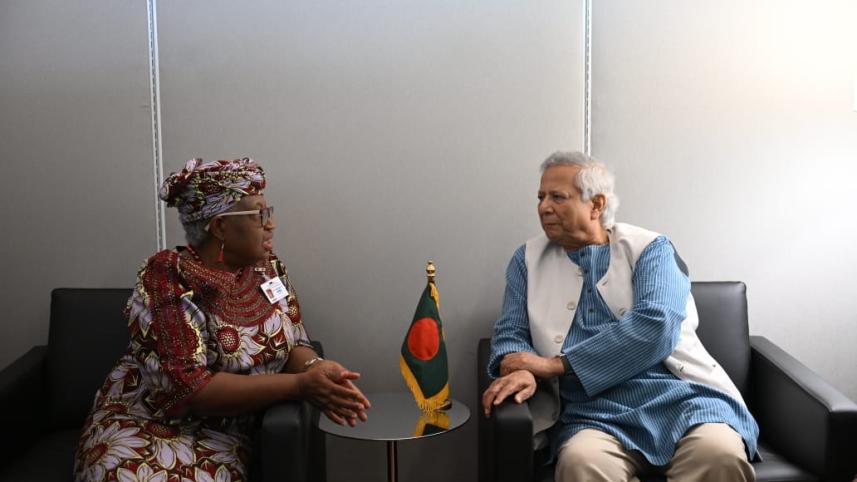
Chief Adviser Professor Muhammad Yunus yesterday urged the World Trade Organization (WTO) to provide full support to ensure a smooth transition for Bangladesh as it prepares to graduate from Least Developed Country (LDC) status.
He raised the issue during a meeting with WTO Director-General Dr Ngozi Okonjo-Iweala on the sidelines of the 80th United Nations General Assembly at the UN Headquarters in New York.
 For all latest news, follow The Daily Star's Google News channel.
 He requested the director-general's involvement in the upcoming WTO Ministerial Conference to achieve a meaningful outcome that would assist countries on the path to LDC graduation, ensuring they are not adversely affected by the potential withdrawal of trade concessions or preferential trade access in developed markets.
The director-general assured him of her full support.
Bangladesh is expected to graduate from LDC status in late 2026.
Their discussion also touched on long-anticipated WTO reforms and current global trade challenges, amid growing concerns over protectionism and a possible retreat from globalisation.
Yunus also attended the inaugural session of the UNGA.
Prior to the session, he met Uruguayan Foreign Minister Mario Lubetkin and former Chilean President Michelle Bachelet, and World Bank President Ajay Banga.
On Monday, the chief adviser also attended a high-level event on "Social Business, Youth and Technology" at the UN Headquarters where he gave a keynote speech.
He said cuts to UN aid and shrinking official development assistance risk deepening Bangladesh's vulnerabilities in facing climate shocks and managing the responsibility of hosting 1.3 million Rohingyas.
Many countries, including Bangladesh, are preparing to graduate from the least-developed country bracket amid severe challenges, he said.
For Bangladesh, this includes hosting 1.3 million forcibly displaced Rohingyas, managing repeated climate shocks and navigating global economic turbulence.
"In such a context, reducing UN budgets or shrinking official development assistance would be counterproductive."
Yunus's comments come a week before the UN is set to host for the first time a High-Level Conference on the Situation of Rohingya Muslims and Other Minorities in Myanmar scheduled for September 30.
Instead, the world must "redouble" efforts to expand international support, provide technical assistance and ensure a just transition for nations facing heightened vulnerability, he said.
"What we need urgently is renewed multilateral diplomacy, deeper international cooperation and collective commitment to sustainable development."
Meanwhile, at his meeting with Sergio Gor, the US special envoy for South and Central Asia and the US ambassador-designate to India, Yunus said Bangladesh making comprehensive preparations to ensure a free, fair and peaceful general election in early February.
"The election will be held in February. It will be free, fair and peaceful. The country is fully prepared," Yunus told the special envoy.
During the meeting, the two sides discussed a wide range of bilateral and regional issues, including trade, South Asian regional cooperation, the revival of SAARC, the Rohingya crisis and the proliferation of disinformation targeting Dhaka.
Yunus sought continued US support for more than one million Rohingya refugees currently residing in camps in Cox's Bazar. In response, the US officials said that their life-saving aide for the Rohingyas would continue.
Belgium's Queen Mathilde met Yunus on the sidelines of an event at the UN headquarters. Former British Prime Minister Gordon Brown and IMF Managing Director Kristalina Georgieva also called on Yunus.
Family members of Bangladesh-origin slain New York policeman Didarul Islam also met Yunus at his hotel.
Comments