


3-day weekend worsens supply to pumps


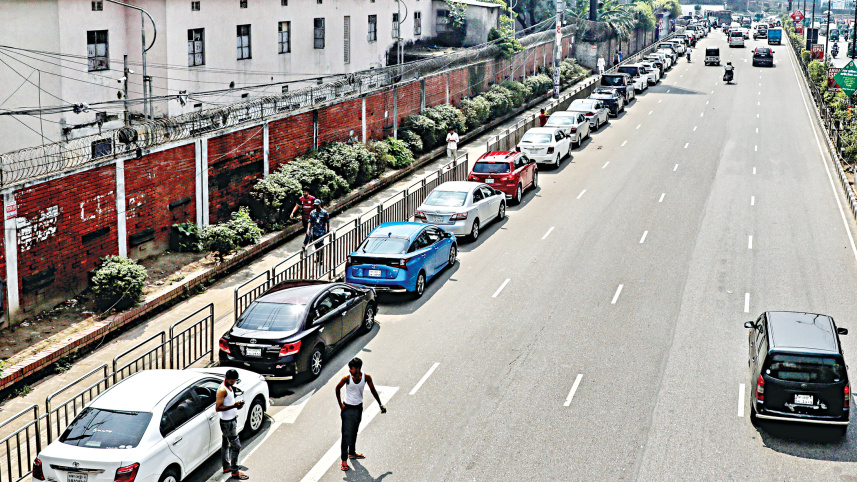
Fuel supply shortfall shows little sign of easing, as global uncertainty, disruptions during the extended Eid holidays and weekend, and high domestic demand continue to pressure the energy chain.
Amid the US-Israel war on Iran, concerns are mounting over shipments, particularly for April, with only a limited number of planned consignments having been confirmed.

Officials said the war has already disrupted procurement, with suppliers delaying shipments or invoking force majeure.
Six of the 17 shipments planned for March remain unconfirmed.
Extended Eid holidays worsened the situation, as banks and logistics services remained closed for several days, disrupting payments and delaying deliveries. Pump owners said they struggled to place orders or secure supplies.
“There is no major improvement. The situation is more or less the same as before,” said Mohammad Nazmul Haque, president of Bangladesh Petroleum Dealers, Distributors, Agents and Petrol Pump Owners Association.
“You can manage one or two days, but a five-day banking gap cannot be covered. That is where the problem started during Eid,” he added.
After the resumption of work on Tuesday following the Eid holidays, offices were closed yesterday on Independence Day. Today and tomorrow are weekly holidays.
Nazmul said operators are limiting sales to Tk 2,000 for cars and Tk 500 for motorcycles to manage demand.
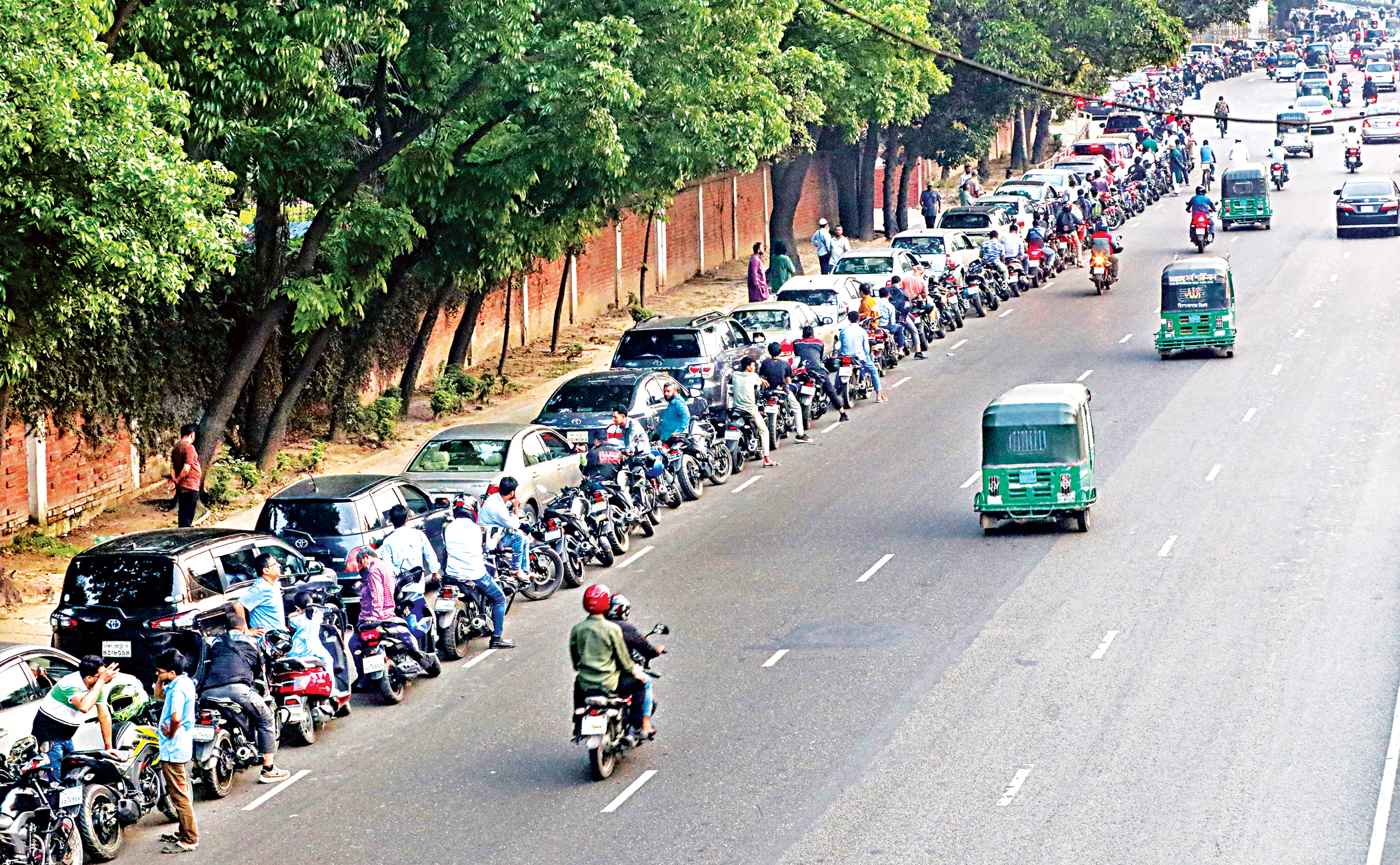
“We are trying to avoid panic with whatever fuel we have,” he said, noting long queues and pressure from anxious customers.
“People are anxious. Many are trying to take fuel even when they do not need it immediately, fearing shortages or price hikes. This is adding to the pressure on the system,” he added.
Despite official assurances of adequate stock, long lines were seen at filling stations in Tejgaon, Mohakhali, and Bijoy Sarani.
Ride-sharing drivers and others reported waiting hours to refuel, often leaving empty-handed.
THE SITUATION
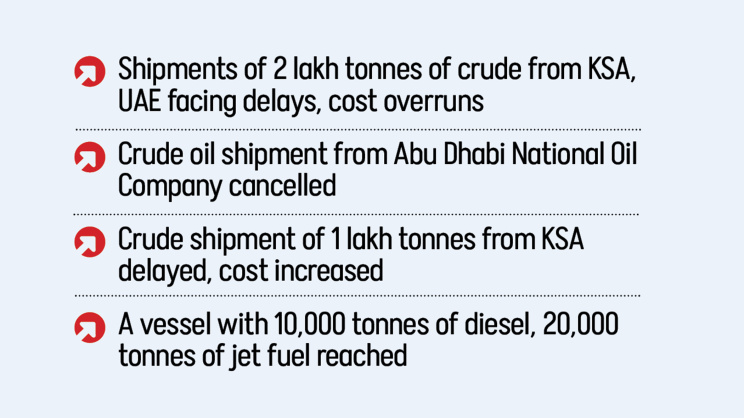
The government plans to import 14 shipments by sea and three via pipeline in April, including 25,000 tonnes of octane, 1,00,000 tonnes of crude, and 3.03 lakh tonnes of diesel. But only 1.1 lakh tonnes of diesel have been confirmed so far.
Bangladesh has not received any crude this month, as shipments have been cancelled or delayed.
Two shipments totalling 2,00,000 tonnes of crude from Saudi Arabia and the UAE have been deferred to mid-April due to shipping route disruptions, contract complications, and rising freight costs.
A deal with Abu Dhabi National Oil Company was also cancelled.
 For all latest news, follow The Daily Star's Google News channel.
 At least 1,00,000 tonnes of crude oil were supposed to be loaded into a tanker at Ras Tanura in Saudi Arabia. This shipment for Bangladesh is now being loaded at Yanbu, with an additional cost of $0.25 per barrel.
Eastern Refinery Ltd (ERL), the country’s lone refinery, is operating at reduced capacity.
Stocks are expected to last about two weeks, with daily refining cut to 3,500–4,000 tonnes against a capacity of 5,000 tonnes. The reduction in refining is aimed at conserving the stock.
Md Shihabul Islam, manager (purchase) of ERL, said the facility is configured to process crude from Saudi Arabia and Abu Dhabi, limiting alternative sourcing.
A vessel carrying 10,000 tonnes of diesel and 20,000 tonnes of jet fuel arrived yesterday under a contract with China’s Unipec, offering temporary relief.
Octane has emerged as the most vulnerable product, with stock estimated to last only a week. Local condensate -- a byproduct of gas -- has become the main source.
The 25,000 tonnes of octane imports planned for April also remain unconfirmed, according to BPC sources.
Although overall stock is considered “adequate” on paper, except for octane, the situation may worsen, particularly without smooth banking and logistics operations, if shipment delays continue and disruptions persist, said a BPC official, requesting anonymity.
In a bid to ease the pressure, the government yesterday approved urgent diesel imports.
Under the approved deals, AP Energy Investments Limited will supply 1 lakh tonnes and Superstar International (Group) Limited 2 lakh tonnes through direct international purchase, according to a finance ministry statement.
Comments