


Bangladesh Bank seeks legal overhaul for full autonomy



Bangladesh Bank has sent a set of sweeping reform proposals to the government, seeking to align its autonomy with global standards and shield the institution from political influence.
Governor Ahsan H Mansur outlined the draft amendments to the Bangladesh Bank Order 1972 in a Demi-Official letter dated October 9 to Finance Adviser Salehuddin Ahmed, with copies to the finance secretary and the financial institutions secretary.
 For all latest news, follow The Daily Star's Google News channel.
 The proposals, backed by detailed justifications, aim to elevate the status of the central bank's leadership, restructure its board, and overhaul the appointment and removal process for top officials.
Finance ministry officials said the central bank had placed the draft amendments before its board on September 16, where it was agreed in principle to forward them to the finance ministry to promulgate it as an ordinance.
"Through these amendments, a strong legal foundation will be established to prevent the recurrence of past mistakes and irregularities in the financial sector," the governor wrote.
Past reform attempts, he noted, faltered "due to lack of political and administrative will", adding that the current moment is "the most appropriate time" and would stand as a significant contribution by the government.
Through these amendments, a strong legal foundation will be established to prevent the recurrence of past mistakes and irregularities in the financial sector.
The nine proposed amendments draw on practices from advanced and regional economies. The letter argues that passing the Bangladesh Bank (Amendment) Ordinance 2025, in step with broader interim-government reforms, would empower the central bank to act with greater independence and modern oversight.
The IMF, which has pushed for enhanced central bank autonomy under its $5.5 billion loan programme and provided technical assistance in drafting the amendments, had set a September deadline for securing the advisory council's approval, a deadline already missed.
Speaking to The Daily Star by phone, Mansur said he wrote to clarify the rationale for reform and "the basis of the central bank's autonomy". He had yet to hold formal talks with the government, having left for the IMF-World Bank Annual Meetings on October 10; he is due back this week.
When asked if the proposals are ambitious, he replied, "I think it's not at all ambitious; it is overdue, long overdue."
Asked whether the interim government could implement the changes, he said it could if it wants.
On IMF conditions, he noted, "We will try our best to get it approved by the advisory council before November. If the government doesn't want to do it, that's on them."
APPOINTMENT, REMOVAL
In his letter, Mansur proposed forming a three-member search committee, led by a former finance or planning minister or adviser, or a former or outgoing BB governor, to appoint the governor and deputy governors, under rules defining its mandate.
The main goal of the proposal is to ensure merit-based appointments free from political interference, which is "a fundamental condition for a modern and autonomous central bank", he wrote.
He cited examples of countries like the Bank of England, Reserve Bank of India, Bank of Canada, South African Reserve Bank, and European Central Bank.
Allegations requiring removal of top officials would be examined by a three-member Court of Inquiry headed by a justice of the Supreme Court's Appellate Division, ensuring removal only through due legal process.
The letter cites global practice, including the Bank of England, where removal requires proof of misconduct or incapacity under law.
Contacted by this newspaper, Mustafizur Rahman, distinguished fellow at the Centre for Policy Dialogue, said the proposed amendments are essential for strengthening the central bank's autonomy.
However, he noted, the genuine autonomy of the central bank will ultimately depend on the governor's individuality, independent mindset, and performance -- particularly in how the officeholder independently exercises the responsibilities entrusted to them with independence and integrity.
BOARD RESTRUCTURING
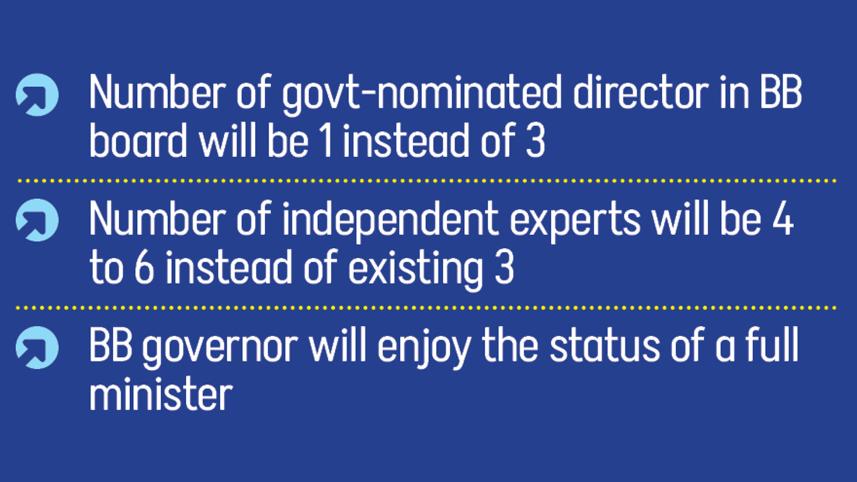
The letter proposed reducing government-appointed directors from three to one, while the number of independent experts would rise from four to six, strengthening regulatory and policy independence.
Many leading central banks, including the Bank of England, operate with predominantly independent boards, the letter noted.
The Bank of England's board is formed with 12 members, including the governor, two deputy governors, and nine non-executive members.
Currently, the BB's board has eight members, including the governor, one deputy governor, three secretaries, two economists and a leader of the business chamber.
GOVERNOR'S STATUS
The governor's rank would be elevated to that of a full cabinet minister, matching peers in Singapore, Malaysia, Thailand, Sri Lanka, and India, which helps them maintain policy independence and decision-making authority.
This will also help ensure the central bank's stature, international representation, and effective coordination with other government agencies involved in economic policymaking.
NEW OVERSIGHT POWERS
New sections proposed by Mansur would cover whistleblower protection, prevention of monopolistic practices, oversight of credit rating agencies, collateral valuation, and legal vetting.
These measures aim to enhance discipline, transparency, and accountability in the banking sector by preventing irregularities, mismanagement, and conflicts of interest.
These will also enable Bangladesh Bank to establish a modern, integrated supervisory framework, which will play an effective role in curbing unethical practices, information concealment, nepotism, and monopolistic behavior in the banking sector.
The letter cites the World Bank's 2022 Global Financial Development Report, which highlights whistleblower protections as a powerful guard against corruption and moral hazard.
Comments