


Country sees sharp rise in HIV cases

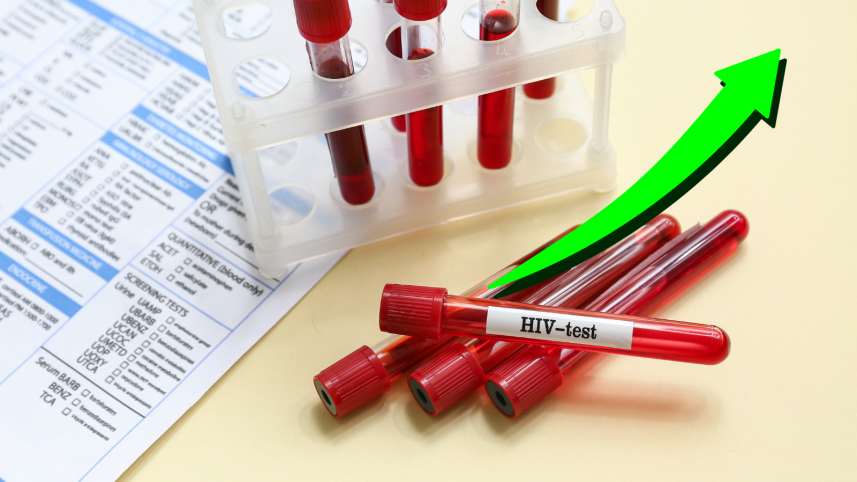
The country witnessed the highest-ever year-on-year rise in new HIV cases over the last one year since 2000, a new document shows, raising serious public health concerns.
Some 1,891 new cases of Human Immunodeficiency Virus (HIV) were recorded from November last year to October this year, which is 453 more than the preceding year.
 For all latest news, follow The Daily Star's Google News channel.
 The rise in cases came even though the number of HIV tests fell by around two lakh compared to the preceding year, according to the HIV/AIDS Situation Report-2025 published yesterday.
The country logged 254 deaths from HIV infections during the November-October period, down from 326 in the preceding year.
The National AIDS/STD Control Programme of the Directorate General of Health Services (DGHS) revealed the data at an event at the National Institute of Cancer Research and Hospital auditorium, marking World AIDS Day yesterday.
Experts and officials suggested expanding HIV testing and treatment services, strengthening coordination between government and community-based organisations, and increasing community-level awareness about HIV.
HIV attacks the body's immune system, weakening its ability to fight infections and diseases, and if left untreated, can lead to Acquired Immune Deficiency Syndrome (AIDS).
In Bangladesh, the first HIV case was detected in 1989. The total number of HIV-positive cases stood at 14,313 till this year. Of them, 2,666 died.
Health officials said around 18 percent of those potentially living with HIV remain unaware of their health status. The estimated cases are 17,480.
SHARPEST RISE
The new data shows that 14.21 lakh people underwent HIV tests in last one year, which is 1.91 lakh fewer than 16.12 lakh tested in the preceding year.
Besides, another 10.72 lakh people were tested for HIV as part of health screening during the same period, up from 10.34 lakh the preceding year.
A DGHS official said the decline in tests among migrants going abroad -- from 13.05 lakh to 10.11 lakh -- was the main reason behind the overall drop in testing numbers.
Among the tested population, the data shows that 1,891 new HIV cases were detected, including 217 Rohingyas.
The previous biggest year-on-year rise was 329 cases recorded between 2022 and 2023.
Asked about the reasons in going up HIV cases, Zubaida Nasreen, deputy director of the National AIDS/STD Control Programme, said the increase in testing among "key populations" is the main factor behind the rise.
Key populations include people who inject drugs, female and male sex workers, and transgender individuals, officials said.
The data shows that 1.17 lakh people from key populations were tested during the November-October period, up from 96,922 in the previous year.
The expiry of a government programme in June last year caused disruptions to preventive services such as the distribution of condoms, needles, and syringes among key populations, officials said.
Asked whether this could be a reason behind the rise, Zubaida said the expiry of the programme caused some disruptions in preventive services, but it could not be directly attributed to the increase.
She, however, said further research would be needed to identify all other factors contributing to the rise.
Among the new cases, key populations accounted for 56 percent, migrants 12 percent, Rohingyas 11 percent, and the rest were from the ordinary people, according to the data.
Male accounted for 81 percent, female for 18 percent, and Hijra individuals for 1 percent. Of them, 52 percent were married, 42 percent single, while the rest were either widowed, divorced or separated.
The highest proportion -- 63 percent -- falls within the 25-49-year bracket, followed by 21 percent in the 20-24-year group.
The data also shows that the proportion of HIV-positive individuals receiving treatment dropped to 74 percent from 78 percent in the preceding year.
A DGHS official said the rise in "lost to follow-up" cases, a term used when an HIV-positive person stops taking medication for more than three consecutive months -- might be the reason behind the decline of people under medication.
The data shows that 82 percent of potential HIV-positive individuals were aware of their health status, and 91 percent of people living with HIV were able to achieve viral suppression.
Comments