


Dengue cases cross 50,000 mark
With 782 new dengue cases reported yesterday, the total number of cases this year has surpassed 50,000, marking an alarming trend, according to official data.
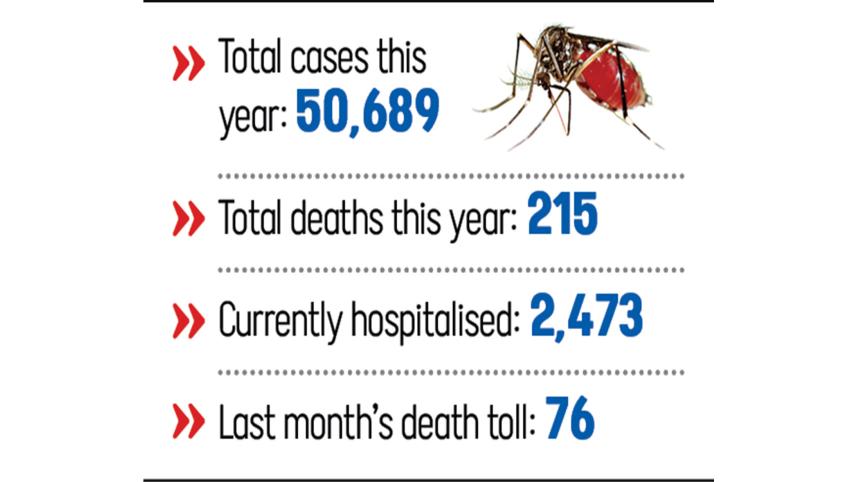
The Directorate General of Health Services (DGHS) said at least three dengue patients died yesterday, raising the total death toll to 215 and confirmed cases to 50,689.
 For all latest news, follow The Daily Star's Google News channel.
 Currently, 2,473 dengue patients are undergoing treatment at hospitals across the country, of whom 1,622 are from outside Dhaka.
Prof Kabirul Bashar, an entomologist at Jahangirnagar University, said dengue comes in waves, and when mosquito density is high alongside rising cases, it becomes very difficult to stop.
"Our forecasting model shows that cases will peak in October, start to decline in November, but continue significantly until January. Stopping it completely now is almost impossible," he said.
He stressed that while city corporations must intensify source reduction, breeding-site management, hotspot control, and other measures, community involvement is equally crucial.
"Without active participation in eliminating breeding grounds, controlling this outbreak will be extremely difficult," Bashar added.
GM Saifur Rahman, an entomologist at National University, also urged intensified mosquito-control drives in hotspots, including targeted breeding-site eradication, adult mosquito elimination, and sustained nationwide action. He further called for community mobilisation through awareness campaigns.
In a press statement on October 6, the DGHS urged all patients with fever to undergo dengue testing immediately at the nearest hospital and to seek prompt medical attention if diagnosed.
Abu Hussain Md Moinul Ahsan, director (hospital) at DGHS, told The Daily Star that delayed hospitalisation has been a major factor behind the recent rise in fatalities.
According to DGHS data, seven of the nine patients who died recently passed away on the very day of hospitalisation, while one of the remaining two died the following day. "Primarily, the delay in reaching hospitals caused the dengue infection to become complicated, leaving little opportunity for effective treatment. Late admissions or delayed consultation with doctors make treating complicated cases extremely difficult," read a DGHS statement.
The health authority also said all hospitals are stocked with sufficient dengue testing kits, saline, and medicines. However, it emphasised that reducing fatalities will require rapid detection, treatment in line with clinical guidelines, and simultaneous mosquito-control measures.
Comments