


Downpour drowns Dhaka


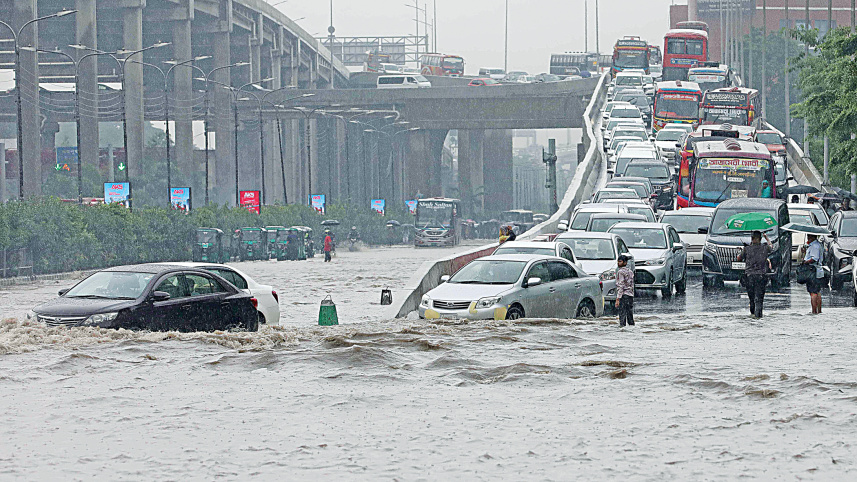
Hours of heavy rain yesterday left large parts of Dhaka submerged in ankle- to waist-deep water, crippling traffic, and stranding commuters on streets and people in their homes.
Businesses and some schools had to close, and once again the capital’s chronic drainage failures were exposed.

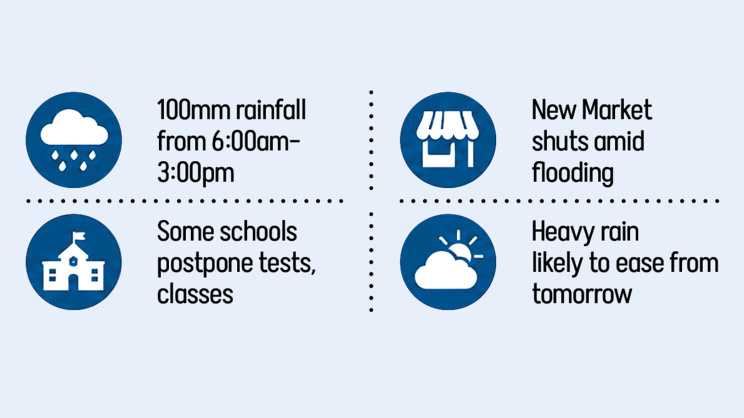
The sufferings caused by the 100mm of rainfall recorded by the Bangladesh Meteorological Department (BMD) between 6:00am and 3:00pm renewed questions about city authorities’ ability to tackle waterlogging and whether years of projects were money down the drain.
Key areas that went under water included parts of Bijaysarani, Kazipara, Shewrapara, Mirpur, Uttara, Banani, Gulshan, Badda, Motijheel, Arambagh, Kakrail, New Market, Azimpur, Swamibagh, Nazirabazar, Gandaria, Gopibagh, Segunbagicha, Dhanmondi-27, Sukrabad, Maghbazar, Malibagh, Fakirapool, Green Road, Dhaka University, and Bashundhara Residential Area.
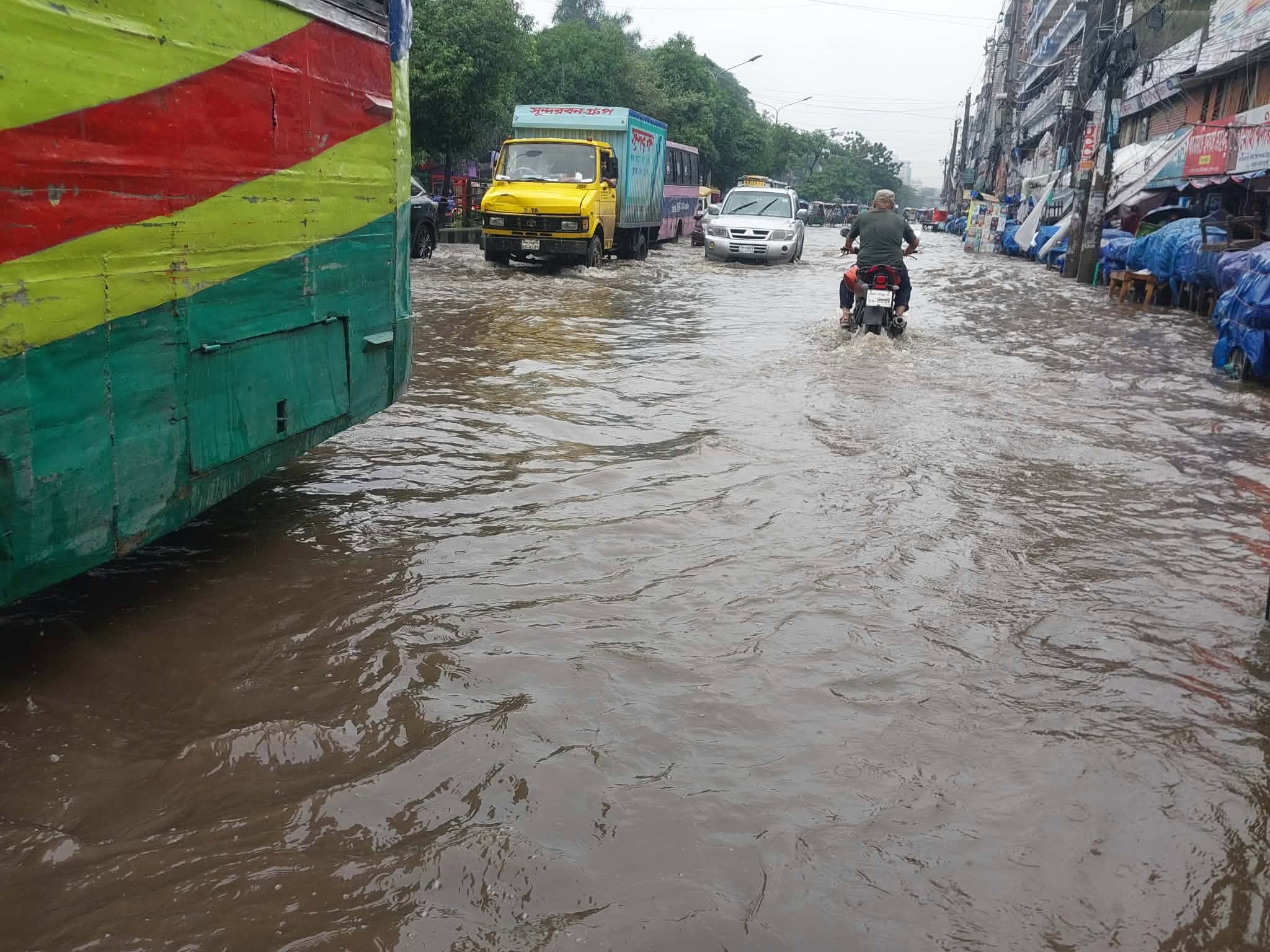
Flooded roads brought traffic to a crawl as vehicles broke down in stagnant water. Thousands of commuters waded through inundated streets, while rickshaw fares rose in some areas. Water also entered shops, forcing many businesses to close.
While some educational institutions postponed exams, many students braved floodwater to attend ongoing tests.
“I had no choice but to wade through knee-deep water from Mirpur-10 to sit for my mid-term exam,” said an eighth-grade student of Sher-e-Bangla Nagar Government Boys’ High School in Agargaon.
Kazipara resident Tanvir Rahman Quazee said he also had to wade through knee-deep water near IDB Bhaban on his way to nearby Probin Nibash Hospital.
With regular goods transport work halted, rickshaw-van pullers carried passengers instead. Alal Hossain, who usually transports furniture by van, said he was charging Tk 50 per passenger for the roughly one-kilometre trip between Ibrahimpur Pakarmatha and Kazipara Metro Station.
A journey by one of the correspondents from Ittefaq intersection to Kakrail, which normally takes about 40 minutes on foot, took nearly one and a half hours by rickshaw. Near Notre Dame College in Arambagh, water rose above the rickshaw’s footrest.
“It is impossible to pedal a rickshaw in this water. The waves created by passing vehicles make it dangerous,” said rickshaw puller Motaleb.
The road between Notre Dame College and Fakirapool intersection was submerged under about four feet of water, flowing above the road median and stranding dozens of vehicles, including buses.
“I left home because I have to earn a living. But after coming out, I feel like this is a big mistake,” said Rahat Hossain.
“Only those who have no other choice continue to live in this city,” said Ashraful Alam who was commuting to work.
The New Market area experienced severe flooding. Roads around Gausia Market, Chandrima Super Market, Nurjahan Market. and Hawkers Market went underwater.
“I couldn’t even open my shop this morning,” said Jamal Hossain.

Bangladesh Dokan Malik Samiti President Helal Uddin said all shops in New Market remained closed after power was disconnected as a safety measure. A decision on reopening would be taken today depending on the situation.
Knee-deep water accumulated at the main gate of Dhaka College. A tree uprooted near Eden Mohila College briefly blocked traffic, while another fell on a Jagannath University student bus, damaging it. No one was injured because the bus was empty.
At Dhaka University, waterlogging affected Curzon Hall and several dormitories. Bangamata Sheikh Fazilatunnesa Mujib Hall and Bangladesh-Kuwait Maitree Hall experienced power outages, while floodwater entered ground-floor rooms of Dr Muhammad Shahidullah Hall.
 For all latest news, follow The Daily Star's Google News channel.
 “There has been no power since 11:00am,” said Tasnim Akter Alif Nabila, vice-president of the Fazilatunnesa Mujib Hall union.
BMD Meteorologist AKM Nazmul Haque said the prolonged rainfall was caused by an active monsoon combined with a low-pressure system.
“The rain-bearing system remained almost stationary over Dhaka, resulting in prolonged heavy rainfall,” he said.
Rain is likely to continue across the country today. Its intensity is expected to decline from tomorrow, with the heaviest rainfall shifting to the north of Dhaka, he added.
Urban planners blamed the recurring flooding on poor planning, shrinking wetlands, and inadequate drainage infrastructure.
Dhaka lacks an integrated drainage master plan linking natural waterways with artificial drains, said Adil Mohammed Khan, executive director of the Institute for Planning and Development and former president of the Bangladesh Institute of Planners (BIP).
“Drainage projects are implemented separately with little coordination, while canals, wetlands, and retention areas continue to disappear,” he said, adding that clogged drains and poor maintenance have significantly reduced drainage capacity.
Iqbal Habib, vice-president of Bangladesh Paribesh Andolon, blamed outdated planning, saying the 2015 Drainage Master Plan no longer reflects the realities of climate change, while rapid urbanisation has sharply reduced the city’s natural water-retention capacity.
He called for restoring wetlands and canals and adopting an integrated citywide water-management strategy.
Shaikh Muhammad Mehedi Ahsan, vice-president of BIP, said unplanned urbanisation has destroyed natural drainage channels and retention areas, making seasonal flooding inevitable.
Md Shafiqul Islam Khan, administrator of Dhaka North City Corporation, inspected waterlogged areas in Mirpur, Kazipara, Shewrapara, Gulshan, Banani, and Mohakhali, and directed officials to speed up emergency drainage operations.
He said additional pumps, manpower, and equipment had been deployed, while drain and canal cleaning had been intensified.
He attributed the flooding to intense rain, shrinking natural water-retention areas, encroached canals, indiscriminate waste disposal, and the ageing drainage network, adding that the DNCC is working on long-term solutions, including canal restoration and drainage upgrades.
Dhaka South City Corporation Administrator Abdus Salam said high-capacity pumps had been deployed at Kamalapur and Dholai Khal, while emergency teams had been working since dawn to clear drains.
Comments