


Energy-focused urban development amid global changes crucial
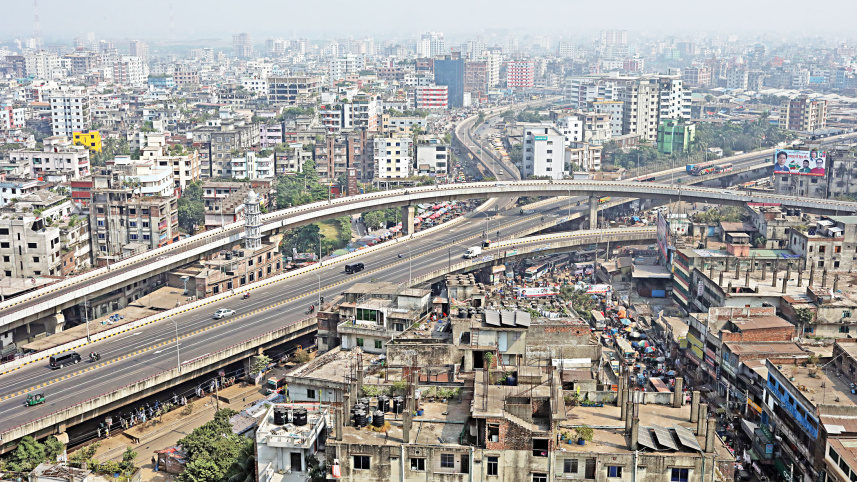
Speakers at a discussion yesterday said integrated urban development and transport planning aligned with sustainable energy systems is crucial in the context of the evolving global situation.
They stressed the need for energy impact assessments to measure and reduce energy consumption across sectors.
 For all latest news, follow The Daily Star's Google News channel.
 The discussion, titled “Urbanisation and Development Thinking in Bangladesh in the Context of the Energy Crisis and Changing Global Situation”, was organised by the Institute for Planning and Development (IPD) at the Bishwo Shahitto Kendro’s conference room in Dhaka.
IPD Executive Director Prof Adil Muhammed Khan identified energy-efficient lighting and effective public transportation as key ways to reduce demand.
He called for strengthening rail-and-water-based transport services, warning that overdependence on roads and fossil fuels is unsustainable in the long term.
He also recommended planned expansion of electric vehicles, highlighted the need for energy demand mapping and realistic rationing during power shortages, and underscored expanding public-private partnerships (PPP), microfinance, and community-based initiatives, alongside raising awareness through education, research, and alternative energy use.
Dr Ariful Islam, president of the Bangladesh Institute of Planners and also IPD director, said rural energy shortages are accelerating migration to cities, hindering decentralisation and sustainable development.
He stressed improved public transport, green buildings, transit-oriented development, and energy efficiency.
He also pointed to limited use of solar energy and reliance on private transport as major challenges, warning that without immediate action, urban and energy crises will intensify.
Sajedul Haque, president of the Bangladesh Traffic and Transport Forum, noted that unplanned, reactive decisions and a lack of people-friendly infrastructure remain key barriers and emphasised organised and innovative spatial planning as the foundation for long-term development.
He recommended public transport-based mobility, integrated bus routes, shaded sidewalks, dedicated bicycle lanes, behavioral change, integrating rickshaws into modern systems, and promoting electric and hybrid vehicles.
KM Asif Iqbal, IPD research fellow and also faculty member at the State University of Bangladesh, urged for immediate approval of an effective renewable energy policy.
Dr Farhadur Reza of Jahangirnagar University said buildings account for 40-50 percent of global energy use, making green buildings and energy-efficient technologies essential.
He noted that increased FAR under the Detailed Area Plan (DAP) has raised energy consumption, indicating policy gaps, and recommended passive design, mixed-use development, blue-green infrastructure, and integrated planning through smart grids and energy demand mapping.
Prof Shammi Akter Setu called for a “National Spatial Plan” and the proposed “Spatial Planning Ordinance 2025” to ensure coordinated planning at all levels.
She added that land-use planning can integrate industry, transport, and renewable energy, with immediate priorities on expanding public transport, promoting walking and cycling, improving sidewalks, increasing solar energy use, raising public awareness and promoting responsible behaviour.
WBB director Gaus Piyari stressed regulating private vehicle use and reducing energy dependency across sectors for sustainable change, along with infrastructure development, expanded public transport, regular vehicle fitness checks, and improved bicycle networks.
Planner Abu Nayeem Sohag and Associate Professor Mohammad Ullah spoke, among others.
Comments