


Govt to discuss reducing metro costs with Japan

A high-level team of the interim government led by Finance Adviser Salehuddin Ahmed will hold meetings with the Japanese government on the possibilities of reducing the metro-rail project costs.
The delegation will leave Bangladesh for Japan on Sunday and return on September 5.
 For all latest news, follow The Daily Star's Google News channel.
 Japan is financing several projects in Bangladesh, including three metro rail projects.
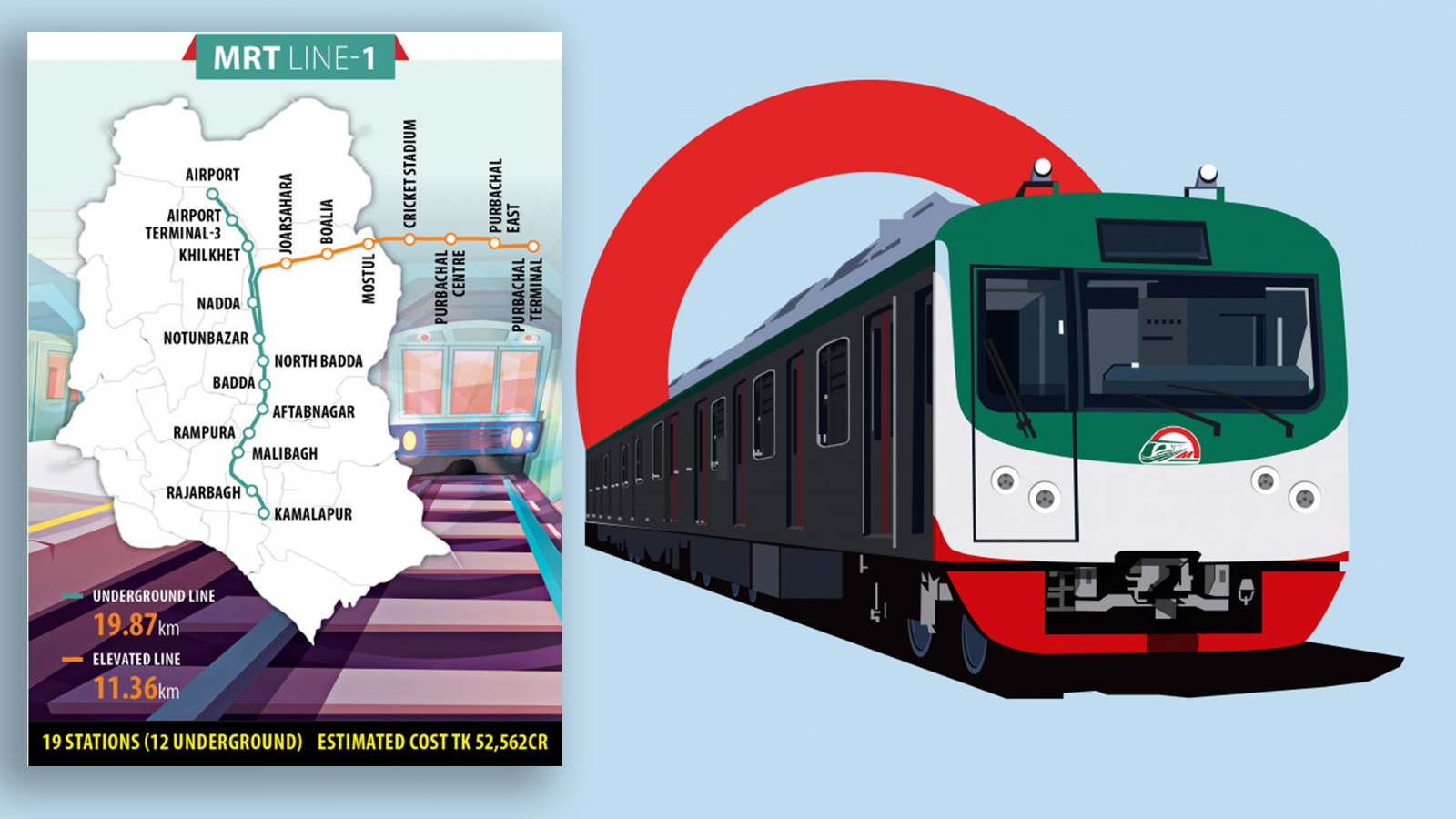
Of these, MRT Line-1 and MRT Line-5 are at the initial stage, while MRT Line-6 is about to be completed, with its major part from Uttara to Motijheel already in operation.
When the MRT Line-1 and MRT Line-5 were approved in 2019, their estimated cost was Tk 95,000 crore. Now, according to bidders' proposals, the cost might be almost double the initial estimate.
"Even the initial costs approved for the two projects are very high," said a finance ministry official involved with the proceedings.
In the annual development programme of the ongoing budget, the government has listed 26 unapproved projects, most of which are small but would have a high impact.
The estimated costs of the projects are Tk 25,650 crore and there is a possibility of Japan financing those. This will be discussed at the meetings.
The delegation will also explore opportunities for future projects in Bangladesh including one to better integrate the railway and transportation sectors with tourism.
Yesterday, ahead of the team's two-week visit to Japan starting Sunday, the finance adviser, Planning Adviser Wahiduddin Mahmud and different senior officials of relevant ministries held a preparatory meeting at the Economic Relations Division.
At the meeting, the Asian Development Bank, which will provide all kinds of technical and financial support to the Bangladesh delegation during their stay in Japan, made a presentation on how tourism has been integrated into transport and railway in Japan.
The Bangladesh delegation in Japan will visit some of the sites of successful integration.
For example, the delegation will visit the "rail-tourism marketing strategies" in Japan and for this, they will visit the office of Japan Railway (JR) Central, a railway operator in central Japan, in the city of Kyoto.
According to the ADB presentation, Bangladesh Railway, at present operating at a financial loss, can draw valuable lessons from JR Central's tourism promotion.
Developing rail tourism packages linked to heritage sites such as Paharpur, Mahasthangarh, Mainamoti-Cumilla and Cox's Bazar can attract domestic and foreign tourists.
Implementation of such rail-tourism integration in Bangladesh would require strategic partnerships with the Bangladesh Tourism Board and private operators, with investment in marketing, digital ticketing and service quality.
The ADB presentation gave an example of the Kyoto Station in Japan and said the redevelopment of that station offers valuable insights for Bangladesh Railway and urban planners.
By taking lessons from Kyoto Station, Bangladesh can transform major railway stations such as Kamalapur, Chattogram and Cox's Bazar into mixed-use complexes that can generate non-fare revenue, improve passenger experience, and transform them into commercial hubs.
Besides, the delegation will also visit various metro-rail sites including stations in Japan to get first-hand experience of how such sites in Bangladesh could be transformed into "mixed-use hubs with housing, retail and public services".
Moreover, during the visit, the government delegation will hold meetings with relevant authorities in Japan to get a better idea of how multimodal logistics can be applied in successful port operations in Chattogram, Mongla and Matarbari.
At present, Matarbari Deep Sea Port is being developed as a high-capacity, transshipment-ready port with rail and road links to industrial zones and neighbouring countries.
Comments