


Govt passes stricter tobacco ordinance

The advisory council yesterday approved an anti-tobacco ordinance, expanding the definition of tobacco products and introducing several new provisions to control their use, particularly emerging ones.
The ordinance, however, omitted several sections of the original draft such as the prohibition on the sale of loose or unpackaged tobacco products, which weakened the law intended to control tobacco use.
 For all latest news, follow The Daily Star's Google News channel.
 Proposals to ban the sale of tobacco products through hawking and without registration, as well as a ban on flavors that make tobacco and nicotine products more appealing, were also excluded from the ordinance following recommendations of a finance adviser-led committee, The Daily Star has learnt from officials involved with the proceedings.
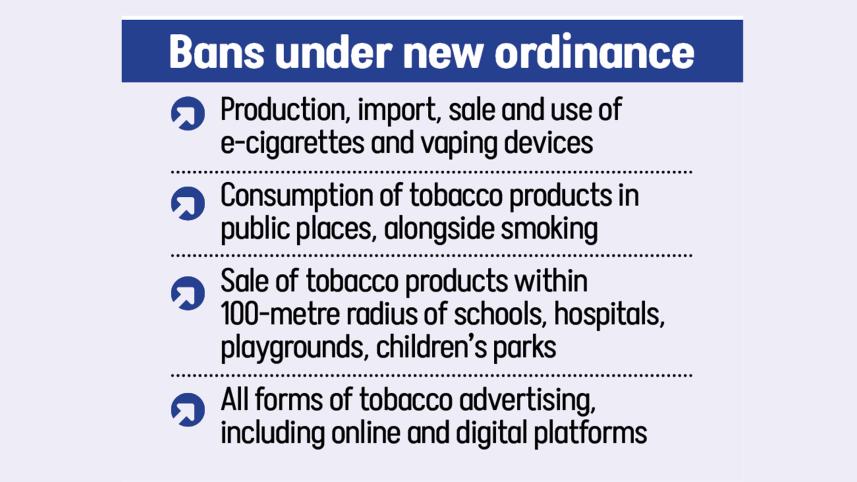
The ordinance incorporated new items such as nicotine pouches as tobacco products and banned the consumption of tobacco products in public places alongside smoking.
The incorporation of nicotine pouch as tobacco product comes after the Bangladesh Economic Zones Authority in April approved the Bangladeshi arm of global tobacco company Philip Morris to set up a factory in Narayanganj to produce nicotine pouches, triggering widespread crticism and protest from anti-tobacco campaigners.
The new law bans the production, import, sale and use of electronic nicotine delivery systems like e‑cigarettes and vaping, as well as banning the sale of tobacco products within a 100‑metre radius of educational institutions, hospitals, playgrounds and children's parks.
It also increased the fine for smoking in public places from Tk 300 to Tk 2,000 and repealed the provision that allowed "smoking zones", meaning there will no longer be such zones in public places or transport.
All kinds of advertisements, including those on the internet, for tobacco products have been banned.
Prominent anti-tobacco campaigner Sohel Reza Choudhury welcomed the approval of the ordinance, saying it would contribute to public health.
He urged that the law be enforced strictly.
Replying to a question, Sohel, who is also the head of epidemiology and research at the National Heart Foundation Hospital and Research Institute, said it would have been better if their proposals had not been omitted and went on to express hope that the government would consider them in the future.
Last year, an estimated 3.71 crore people of 15 years old or above consumed various tobacco products in Bangladesh, while 1.97 crore people smoked, according to a World Health Organisation report published in October.
The Smoking and Tobacco Products Usage (Control) Act was enacted in 2005 to curb tobacco use in Bangladesh, with a ban on smoking in public places as one of its key features.
The law was strengthened in 2013 through amendments but anti-tobacco campaigners have been calling for further amendments to make the law more stringent and to close loopholes that tobacco companies exploit to promote tobacco use.
An amendment proposal for the act was placed before the then-cabinet in October 2023 but was sent back for further review.
Another proposal was submitted to the incumbent advisory council in November last year, but it was not approved.
Instead, a committee led by Finance Adviser Salehuddin Ahmed was formed to review it further.
Shafiqul Alam, the chief adviser's press secretary, while announcing the decision on November 7 last year, said: "On one hand, tobacco use has many adverse health effects. On the other, the cigarette industry contributes significantly to revenue. So, a decision has been taken to revisit the law, considering all these perspectives."
PROVISIONS EXCLUDED
The committee held three meetings with the last meeting held on December 4, where six decisions were taken and the draft ordinance was modified accordingly, acocrding to health ministry officials.
The meeting decided to omit the draft provisions of banning the sale of tobacco products through hawking; the sale of such product without registration; a ban on flavored tobacco products and a prohibition on the sale of loose or unpackaged tobacco products.
The draft ordinance had proposed printing pictorial health warnings covering 90 percent of the surface area on all packaging, wrappers, cartons, bags and containers -- up from the current 50 percent. But the meeting decided to make it 75 percent.
Besides, the meeting also decided to incorporate nicotine pouches under the definition of tobacco products, the ministry sources said.
The omission proposals came from the National Board of Revenue and the finance ministry as the measures could reduce revenue generation and thus the opposition from the health ministry was ignored, said an official of the health ministry seeking anonymity.
Health Secretary Saidur Rahman could not be reached for comment.
Comments