


Key reform ordinances left to expire

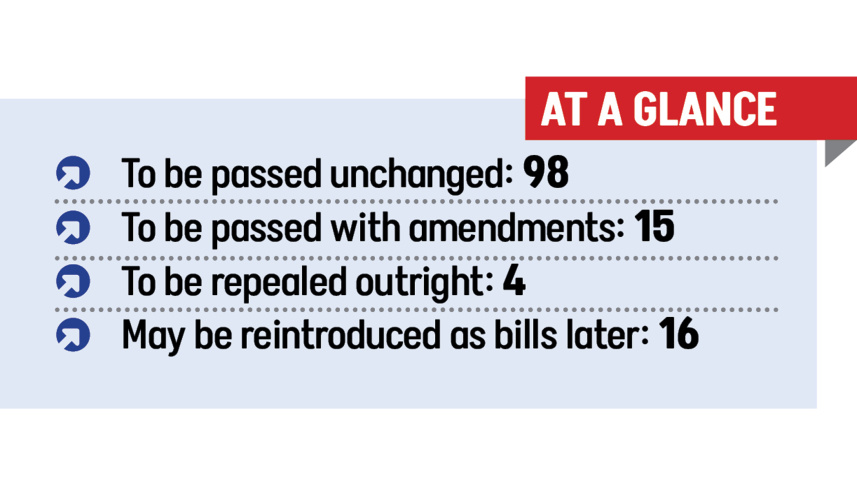
A special parliamentary committee, reviewing ordinances issued by the interim government, yesterday recommended that 20 of them lapse or expire, including those aimed at ensuring judicial independence, curbing enforced disappearances, and strengthening the anti-corruption and human rights commissions.
In a report placed before parliament by its chief Zainul Abedin, the committee also proposed repealing four of the 20 ordinances.

The 13-member special JS panel, which includes three from the opposition bench, was formed after 133 ordinances passed by the interim government were tabled during the first sitting of the 13th parliament. It was directed to submit its findings by April 2.
According to the constitution, parliament must approve or reject ordinances within 30 days of its first sitting, which took place on March 12. If they are not ratified within this period, the ordinances automatically lapse.
The committee recommended that 98 ordinances remain unchanged and 15 others be amended.
Opposition members in the special committee issued notes of dissent on the decisions regarding 20 ordinances. The notes concern four proposed to remain in force, two recommended for amendment, 11 set to lapse but to be reintroduced later by ministries, and three slated for repeal.
After the report was placed, and following proposals from the law and home ministers, Speaker Hafiz Uddin Ahmad said the reviewed bills recommended for passage will begin to be placed in the House from Monday (April 6).
TO BE REPEALED
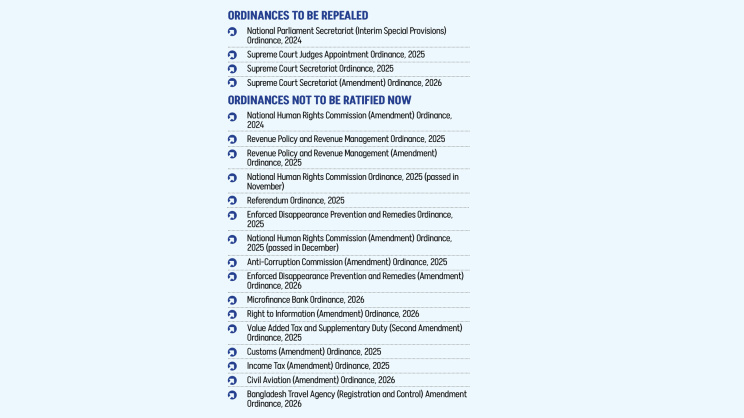
The four ordinances that will be straightaway repealed are the Jatiya Sangsad Secretariat (Interim Special Provisions) Ordinance, 2024; Supreme Court Judges Appointment Ordinance, 2025; Supreme Court Secretariat Ordinance, 2025; and Supreme Court Secretariat (Amendment) Ordinance, 2026.
The three ordinances related to the apex court were introduced to ensure judicial independence, create judicial posts, and support the development of the judiciary, with budgetary authority entrusted to the Supreme Court Secretariat under the chief justice’s control. Under the Secretariat’s full operation, authority over the transfer, promotion, and discipline of lower court judges would also be vested in the SC.
Although the constitution requires a law for appointing judges, such legislation has not yet been enacted.
In 2025, the interim government issued the Supreme Court Judges Appointment Ordinance, which aimed to establish a process whereby suitable candidates would be selected and the chief justice would advise the president on appointments.
It stipulated that a “Supreme Judicial Appointment Council”, led by the chief justice, would recommend qualified individuals for appointment to the Appellate and High Court divisions of the SC.
Separately, the interim government also issued the Supreme Court Secretariat Ordinance to establish an independent secretariat for overseeing, controlling, and maintaining discipline in the subordinate courts, thereby ensuring judicial independence.
Under this ordinance, the secretariat would handle all administrative and clerical responsibilities related to subordinate courts and administrative tribunals. It would also manage matters such as the posting, promotion, transfer, discipline, and leave of judges engaged in judicial work.
Overall control of the secretariat would rest with the chief justice, while its secretary would serve as the administrative head.
Three Jamaat-e-Islami MPs issued notes of dissent on all three ordinances related to the apex courts.
TO BE EXPIRED
The special committee also recommended that 16 ordinances not be ratified in the current parliamentary session; they may be reintroduced in parliament as bills by the relevant ministries later.
 For all latest news, follow The Daily Star's Google News channel.
 These include amendments to the National Human Rights Commission and Anti-Corruption Commission laws, a proposed referendum law, legislation on preventing and addressing enforced disappearances, and the Right to Information law.
The enforced disappearance prevention and remedies ordinance is aimed at curbing, investigating, and punishing enforced disappearances.
Criminalising enforced disappearances, the ordinance sets the death penalty as the maximum punishment for this crime, according to the law.
Among these, the referendum ordinance was issued with the aim of holding a referendum to implement the July National Charter.
Jamaat issued notes of dissent for both ordinances.
In 2025, the Anti-Corruption Commission (Amendment) Ordinance was issued to expand the ACC’s investigative powers; allow direct filing of cases; cover serious financial crimes, including those committed abroad; and increase the number of commission members.
The interim government also issued the Revenue Policy and Revenue Management Ordinance, restructuring the existing framework by separating revenue policy formulation from revenue collection.
It provides for the establishment of two separate divisions under the finance ministry: the Revenue Policy Division and the Revenue Management Division. The move sparked protests among officials.
The Microfinance Bank Ordinance establishing microfinance banks was also issued under the interim rule.
TO BE PASSED WITH AMENDMENTS
Fifteen ordinances are set to be passed with amendments.
These include Women and Child Repression (Amendment) Ordinance, 2025; Public Procurement (Amendment) Ordinance, 2025; Bank Resolution Ordinance, 2025; Anti-Terrorism (Amendment) Ordinance, 2025; Code of Criminal Procedure (Second Amendment) Ordinance, 2025; National Data Management Ordinance, 2025; Bangladesh Labour (Amendment) Ordinance, 2025; Human Organ Transplantation Ordinance, 2025; Police Commission Ordinance; Smoking and Tobacco Products Use (Control) (Amendment) Ordinance; Prevention and Suppression of Human Trafficking and Migrant Smuggling Ordinance, 2026; Land Use Control and Agricultural Land Protection Ordinance; Bangladesh Telecommunication Regulation (Amendment) Ordinance; Private Educational Institutions Teachers and Employees Retirement Benefits (Amendment) Ordinance; and Private Educational Institutions Teachers and Employees Welfare Trust (Amendment) Ordinance.
Among these, the Anti-Terrorism (Amendment) Ordinance introduced provisions allowing the prohibition of activities by any specified entity, including rallies, meetings, and publications. Following its promulgation, the political activities of the Awami League were banned.
The special committee’s report, however, does not specify what further changes will be made.
The interim government also issued the Police Commission Ordinance to establish a commission through a selection committee.
The commission would recommend the appointment of the inspector general of police and address citizens’ complaints as well as internal grievances within the police force.
This ordinance too has been recommended for passage in its amended form. However, the opposition Jamaat issued notes of dissent on this as well.
TO BE PASSED UNCHANGED
Ninety-eight ordinances were recommended to be passed unchanged, including several relating to local government institutions with provisions for appointing administrators in special circumstances and in public interest.
Jamaat also expressed its objections in this regard.
Other ordinances include the Grameen Bank (Amendment) Ordinance; International Crimes (Tribunals) (Second Amendment) Ordinance; Delimitation of Constituencies (Amendment) Ordinance; Representation of the People (Amendment) Ordinance, 2025; Cyber Security Ordinance; Government Service (Amendment) Ordinance; the ordinance on welfare and rehabilitation of families of July uprising martyrs and fighters; the July Uprising Memorial Museum Ordinance; the July Uprising (Protection and Liability Determination) Ordinance; as well as several other ordinances relating to the renaming of various organisations.
The July Uprising (Protection and Indemnity) Ordinance provides indemnity to July fighters in cases where killings occurred as part of the political resistance against the fascist regime.
Jamaat issued notes of dissent regarding ordinances on the Value Added Tax and Supplementary Duty (Second Amendment) Ordinance, 2025; the Customs (Amendment) Ordinance, 2025; the Income Tax (Amendment) Ordinance, 2025; the Civil Aviation (Amendment) Ordinance, 2026; and the Bangladesh Travel Agency (Registration and Control) (Amendment) Ordinance, 2026.
CONCERNS
Political analysts and former parliamentary officials warned that repealing ordinances related to apex court reforms may derail efforts to grant the judiciary administrative and financial autonomy. Without these measures, the executive branch would continue to control judicial appointments, transfers, and promotions -- undermining the separation of powers.
They also cautioned that shelving 16 ordinances could stall key reform initiatives introduced by the interim government.
Meanwhile, ongoing political debate over the formation of the Constitutional Reform Council, coupled with opposition dissent on nearly all ordinances set to expire, is likely to deepen political divisions.
As a result, the reform issue could further intensify tensions in the political arena in the days ahead.
Comments