


Price shock threatens BPC’s profit streak


Bangladesh Petroleum Corporation (BPC) may slip back into losses if fuel prices are not adjusted in the upcoming cycle, as global oil prices surge.
Officials and sector insiders warn that the state-run fuel importer is under mounting financial pressure due to the fallout of the US-Israel war on Iran.

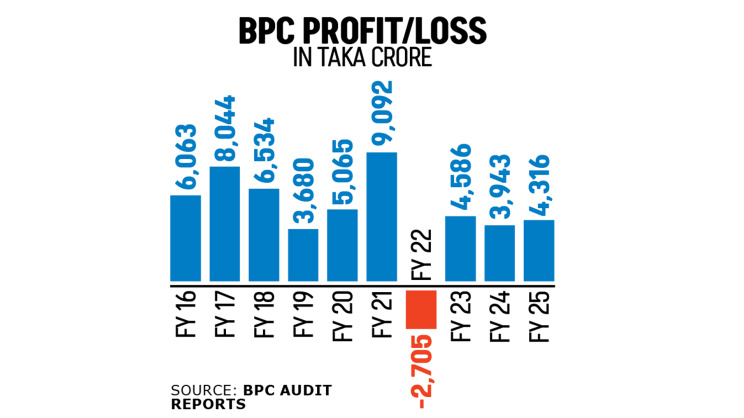
Audit data show that over the last decade, BPC incurred losses in just one fiscal year -- Tk 2,705 crore in FY22 -- when domestic prices were kept below import costs as the Russia-Ukraine war drove up global oil prices.
In March 2024, the government introduced an automated fuel pricing mechanism to align domestic rates with global markets. Adjustments are typically made in the last week of each month and take effect from the first day of the following month.
The last adjustment on February 28 -- coinciding with the US-Israel attack on Iran -- left prices unchanged.
Since then, global fuel prices have risen sharply, raising questions about whether the government will follow the formula or absorb the impact through subsidies.
After the losses in FY22, the corporation recorded profits consecutively -- Tk 4,586 crore in FY23, Tk 3,943 crore in FY24, and Tk 4,316 crore in FY25.
The current situation suggests a reversal may be imminent if global price pressures persist.
Anindya Islam Amit, state minister for power, energy and mineral resources, reiterated yesterday that there are no plans to raise fuel prices for now despite multifaceted economic pressures.
Speaking at a programme in Jashore, he explained that higher fuel prices would trigger increases in power tariffs, transport fares, and essential goods, making life more difficult.
The choice is proving expensive for the government.
“The government is providing a subsidy of Tk 167 crore on fuel every day to reduce public suffering,” Anindya said.
Yet BPC officials say financial pressure is escalating rapidly. They have been asked to submit updated expenditure data, with a report expected by Monday.
The officials said that a team is working to determine subsidy requirements for different fuel types and will submit a report to the government this week.
Initial estimates suggest losses across major fuel types if current prices remain unchanged, including Tk 68–69 per litre on diesel.
Just a month ago, BPC was earning modest margins -- Tk 1–2 per litre on diesel and Tk 3–4 per litre on petrol and octane, said an official. Rising import costs have now largely erased those margins, the official said.
Officials warned that without timely price adjustments or financial support, the corporation could face significant strain, potentially affecting future fuel imports.
Data from the US Energy Information Administration (EIA) show Brent crude has climbed by $6–8 per barrel over the past month, reaching $95–97 amid the war.
Diesel prices are rising more sharply. The international benchmark price for diesel (Singapore Gasoil 10 ppm) increased by about 17 percent from the previous week.
In Bangladesh, diesel accounts for about 65 percent of total fuel consumption, making the economy particularly sensitive to global price movements.
 For all latest news, follow The Daily Star's Google News channel.
 A BPC official, speaking anonymously, explained that import costs vary depending on procurement methods.
“If fuel is imported from the spot market, prices fluctuate with global trends. Under government-to-government agreements, prices remain relatively stable, with a 2–5 percent tolerance depending on the product and contract,” the official said.
Suppliers have recently been seeking higher prices due to the war, though negotiations on costs are still underway. “Nothing has been finalised yet, and there is room for discussion,” the official added.
With regular procurement plans disrupted, including G2G and tender processes, the government has decided to purchase 3 lakh tonnes of diesel from third parties, a move that may further increase costs.
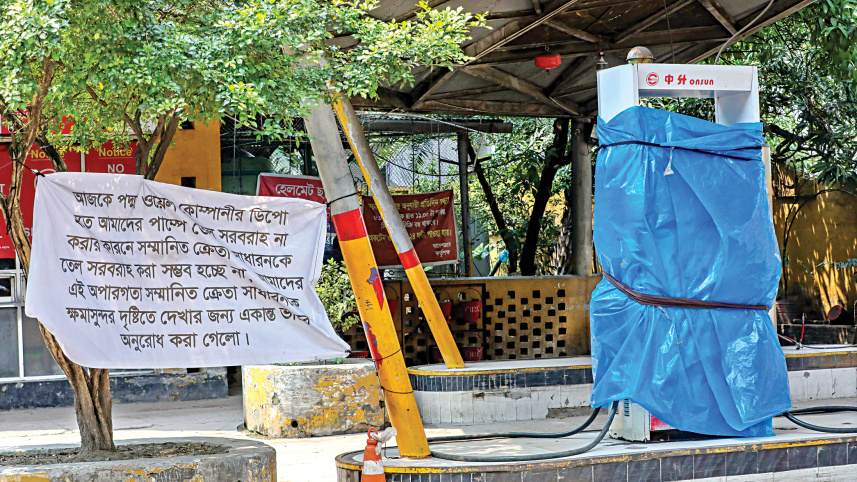
On the ground, rising demand and supply pressures are already visible, with long queues reported at filling stations in most parts of the country.
Comments