


Prolonged inaction, recurring fire tragedies

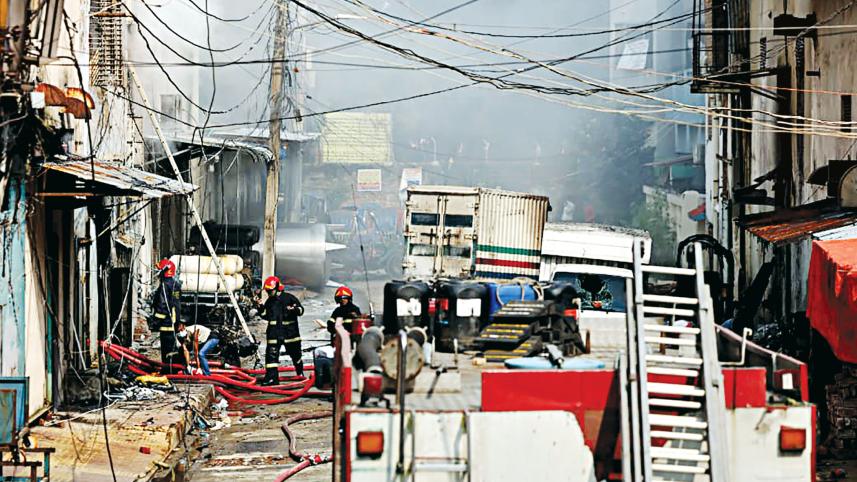
Despite repeated deadly fire incidents, the government has yet to relocate hazardous chemical warehouses from Dhaka's residential areas to designated industrial zones in Munshiganj.
Tuesday's fire at Mirpur's Rupnagar, which has so far claimed 16 lives, once again points to the failure of successive administrations to implement relocation plans launched over a decade ago.
 For all latest news, follow The Daily Star's Google News channel.
 The devastating blaze at a chemical warehouse and garment factory is believed to have started from a chemical explosion that released toxic gas.
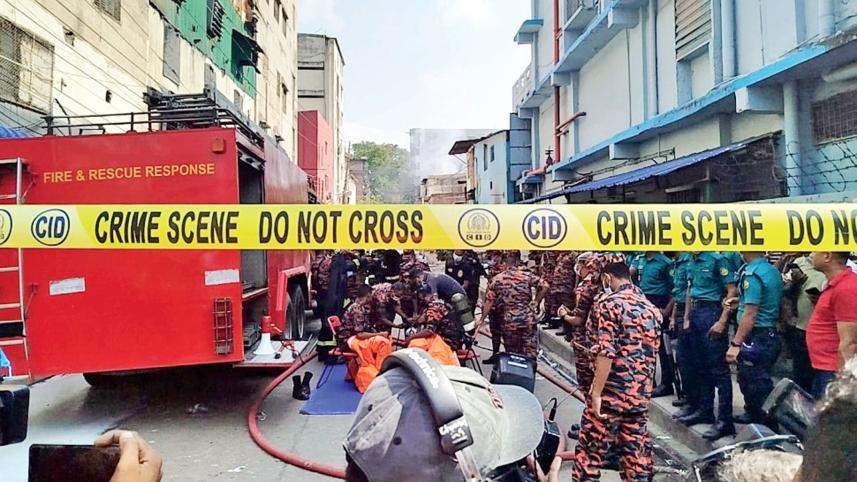
"We suspect the fire began with a chemical explosion that produced poisonous gas. Many victims might have died instantly after inhaling the toxic fumes," said Lt Col Mohammad Tajul Islam Chowdhury, director (operation and maintenance) of the Fire Service and Civil Defence.
Despite repeated promises, the relocation of chemical warehouses and factories from Old Dhaka remains largely incomplete, even after several catastrophic fires have claimed hundreds of lives over the past 15 years.
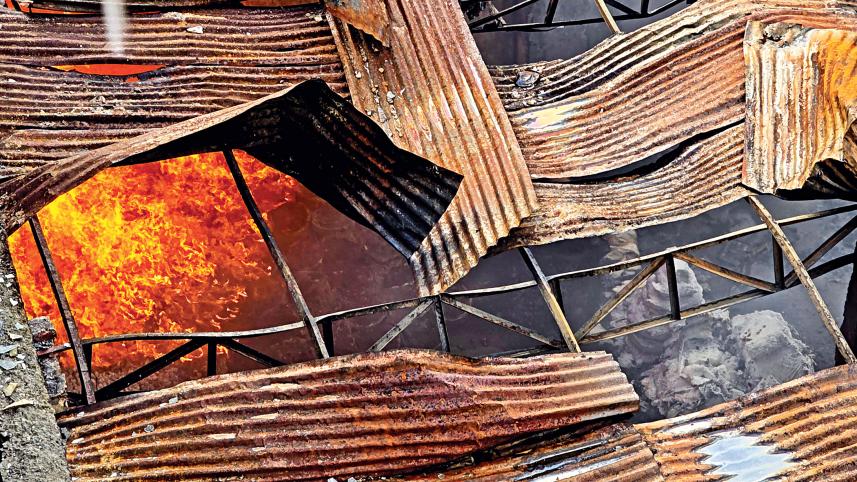
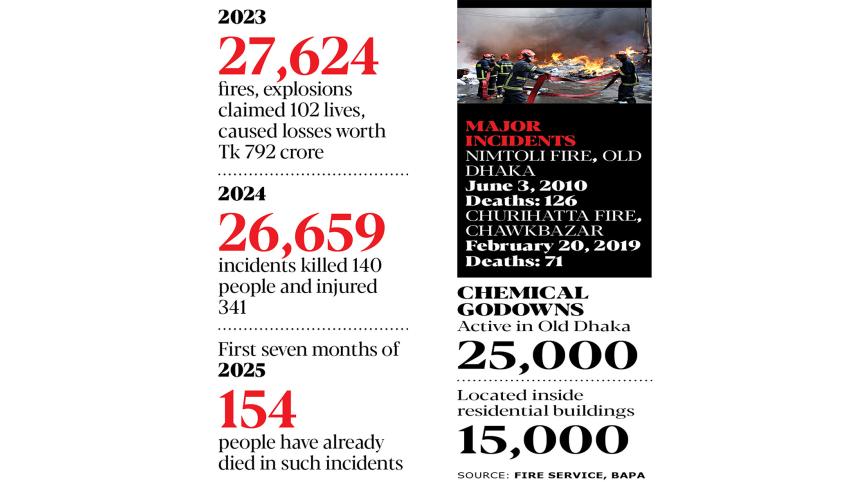
Following the 2010 Nimtoli fire that killed 126 people, the government launched four relocation projects for chemical, plastic, printing, and electrical goods industries. However, only one project has been completed, while the others remain stalled due to bureaucratic delays and land disputes.
Even the 2019 Churihatta fire in Chawkbazar, which killed 71 people, failed to accelerate the process.
Authorities have not updated the list of chemical warehouses in Old Dhaka since 2019, when a Dhaka South City Corporation survey identified 1,924 warehouses, 98 percent of which were categorised as "moderately risky".
Locals say the real number is higher, as many unregistered warehouses operate inside residential buildings.
Under the Bangladesh Environment Conservation Rules (1997), industrial units handling hazardous materials are banned in residential areas. The DSCC stopped issuing or renewing licences for chemical businesses after the Nimtoli and Churihatta fires, but the move has had little effect.
Chemical traders argue they cannot relocate until the government provides the promised resettlement under a 2017 MoU.
"We are ready to move and have submitted all documents. We will relocate as soon as the project is complete," said Shafiqul Islam Milon, general secretary of the Chemical and Perfumery Merchant Association.
He said 1,600 traders are prepared to shift their godowns while keeping their showrooms in current locations.
Similar issues persist in Gazipur, where at least 31 chemical warehouses reportedly operate illegally in residential areas of Tongi, including Gazibari, Titas Gas Road, and Morkun Tekpara.
The fire service is currently investigating these facilities.
The fire at Tongi's Famous Chemical warehouse on September 22 killed four people, including three firefighters. Although the owner claimed only salt was stored, investigators found highly flammable materials and revealed that the same owner runs 11 more unauthorised warehouses.
Md Alim Uddin, assistant inspector of the Directorate of Explosives, said some warehouses in Gazipur had permits, but illegal ones are under investigation.
After the Churihatta fire, the government built 53 modern chemical warehouses on six acres of land in Tongi's Kathaldia area through the Bangladesh Steel and Engineering Corporation. Completed in December 2024, the site remains unused as traders are reluctant to move.
Salman Mahmud Khan, deputy director of the project, said, "We have issued notices and letters, but no applications have been received so far. If they are moved to designated locations, the risk of major accidents will be greatly reduced."
Another temporary relocation project in Shyampur, completed in June 2024 to accommodate 54 warehouses, has seen only 30 warehouses rented so far.
"Traders are reluctant, but we are trying to motivate them," said Md Noor Nabi, general manager (commercial) of Bangladesh Chemical Industries Corporation.
The Bangladesh Small and Cottage Industries Corporation (BSCIC) Chemical Industrial Park in Sirajdikhan, Munshiganj, has achieved about 80 percent progress.
Project Director Hafizur Rahman said the new deadline is December 2025 after a one-year extension. "Although 80 percent of the work is done, road and drainage construction will take until April next year," he said.
Launched in 2018 on 308 acres, the project has 1,525 plots after part of the land was reassigned. Plot handovers are expected to begin in January 2026, with 1,500 stakeholders already signed up under an MoU, he added.
The BSCIC Plastic Industry Estate Project, aimed at relocating around 391 plastic factories from Old Dhaka to Sirajdikhan, is also progressing slowly.
Only 20 percent of landfilling is complete, with full development expected to take two more years, said Project Director Anis Uddin.
Initially approved in 2015 for completion by 2020, the deadline has been extended to 2025, with another extension until 2027 under review.
The BSCIC Printing Industrial Estate Project in Sirajdikhan, spread over 100 acres, has achieved 37 percent progress.
Land acquisition delays slowed the Tk 448 crore project, now targeted for completion by June 2027, said Project Director Md Rakibul Hasan.
The Electric Goods Industrial Estate in Betkabazar, Tongibari, completed in 2022 at a cost of Tk 297 crore, offers 361 plots for entrepreneurs in the light engineering and electrical goods sectors, with plot sizes ranging from 3,000 to 6,000 sq ft.
Comments