


Tk 707cr spent in 9yrs, dengue still ravages Dhaka


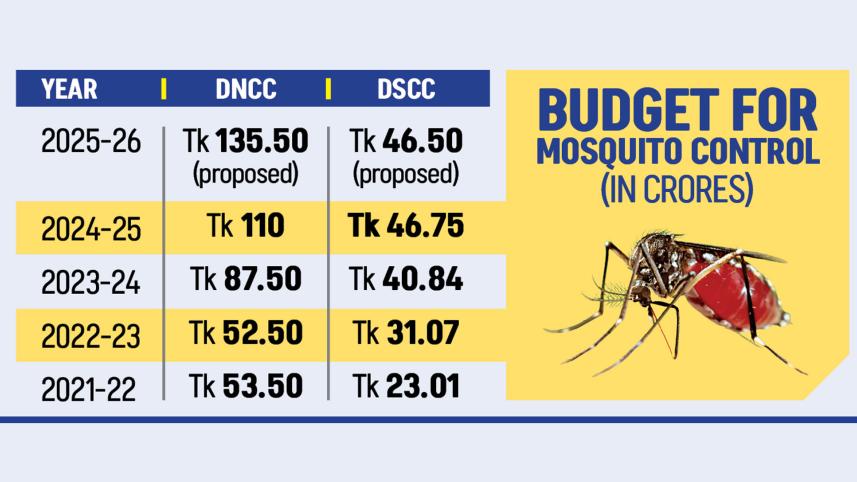
Despite spending around Tk 707 crore over the past nine years, Dhaka's two city corporations have failed to shield residents from the relentless surge in dengue and other mosquito-borne diseases.
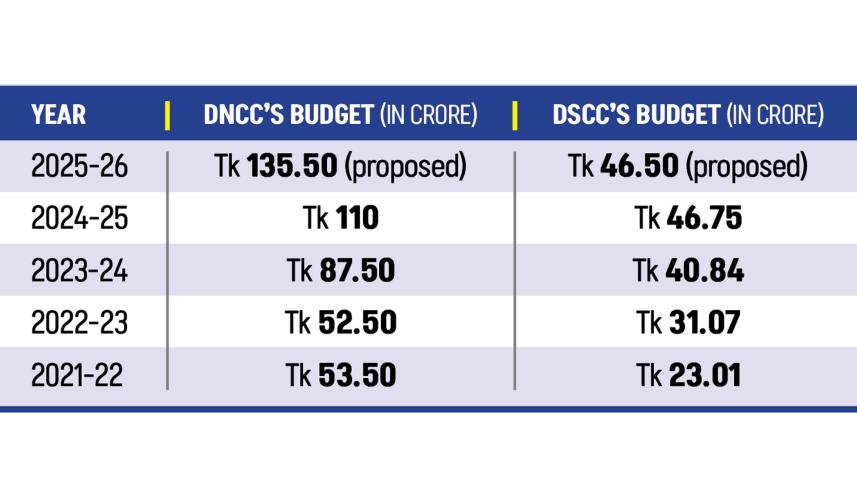
Dhaka North City Corporation (DNCC) spent nearly Tk 464 crore on pesticides, cleaning weeds and water bodies, and equipment purchases, while Dhaka South City Corporation (DSCC) spent around Tk 243 crore on similar initiatives during the period.
 For all latest news, follow The Daily Star's Google News channel.
 This year, DNCC proposed Tk 135 crore budget and DSCC Tk 46.50 crore for mosquito-control activities.
Yet the capital remains in the grip of recurring outbreaks of mosquito-borne diseases that pose an escalating threat to public health.
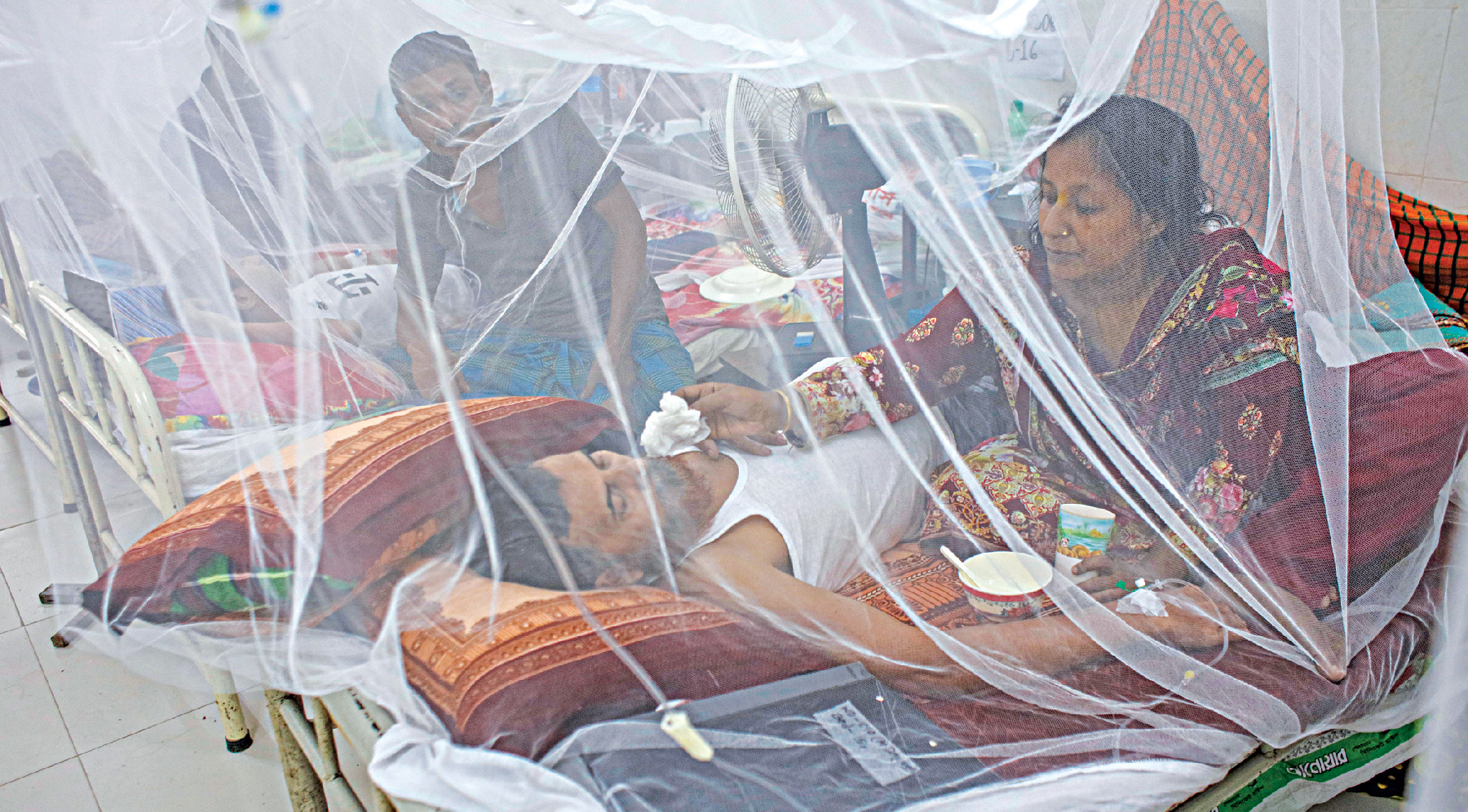
Experts say the city corporations' mosquito control efforts have largely been ineffective due to outdated strategies, poor planning, and the absence of a comprehensive policy.
Without coordinated, science-based action backed by nationwide monitoring, the fight against Aedes mosquitoes, the vector for dengue, will remain futile, they warn, calling for an end to the repeated use of the same outdated approach year after year.
They suggest a specialised integrated vector management department to lead the initiatives with effective community engagement.
While city officials continue to debate strategy and funding, residents continue to suffer. Neighbourhoods brace for the worst with every rainfall, and families fall ill despite taking every possible precaution.
Take the case of Asad Rahman, a private company employee living in a modest apartment in Mirpur. He spent a considerable sum on mosquito nets, sprays, coils, repellents, and cleaned his home regularly. Yet two weeks ago, he, his wife, and his elderly mother were infected with dengue.
"We did everything we could and even spent money beyond our capabilities," he said.
Asad said that although dengue has taken a dangerous turn in recent years, he has not seen any urgency in the authorities' response. In his neighbourhood, fogging is sporadic at best, and other preventive measures are rarely visible.
"It feels like we're on our own," he added.
First identified in 2000, dengue, once considered a seasonal issue, has now become a major public health concern, with cases occurring throughout the year.
Directorate General of Health Services (DGHS) data show the dengue outbreak is worsening. In 2016, the number of deaths was only 14, while 6,060 people were infected.
The situation worsened in 2019, when more than 100,000 cases and over 271 deaths were recorded. However, the worst dengue outbreak in the country's history occurred in 2023, with 1,705 deaths and 3,21,179 hospitalisations.
As of yesterday morning, 105 people have died from dengue this year, according to DGHS, with 45 of the fatalities reported from the Dhaka metropolitan areas. At least 380 dengue patients were hospitalised in the 24 hours leading up to yesterday morning, bringing the total number of reported infections to 26,758, including 6,133 from Dhaka metropolitan areas.
The daily dengue bulletin of DGHS is based on data from only 59 public and private hospitals in Dhaka and 80 district- and divisional-level hospitals, whereas around 16,000 hospitals, clinics, and diagnostic centres across the country provide dengue care. This means the true scale of the outbreak remains undetermined.
SAME OLD APPROACH
Every year, both DNCC and DSCC launch mosquito control drives in the capital aimed at curbing the spread of dengue and other vector-borne diseases.
These efforts typically include fogging operations in residential areas, markets, and public spaces to kill adult mosquitoes, larvicide spraying in stagnant water bodies, drains, and construction sites. They also run awareness campaigns and some special drives.
And the lion's share of the city corporations' spending is on insecticide purchases.
For example, DNCC proposed allocating Tk 135.5 crore for mosquito control activities in fiscal 2025-26, of which Tk 80 crore has been set aside for insecticide purchase. It spent Tk 65 crore on insecticides in the last fiscal year.
Meanwhile, DSCC proposed Tk 46.50 crore for mosquito control programmes, of which Tk 45 crore has been allocated for buying insecticides, up from Tk 40 crore in FY24-25.
The rest of the money is usually spent on equipment, including fogger, wheel, and spray machines, their transportation, and special cleaning activities.
Experts, however, say this old approach is unlikely to produce significant results in curbing the menace amid a changing climate.
Entomologist GM Saifur Rahman said the city corporations must identify breeding sources from the beginning of the year. Authorities should first categorise neighbourhoods based on dengue cases and then carry out vigorous anti-mosquito drives in those areas.
Entomologist Kabirul Bashar said, "Field-level work must be assessed regularly -- ideally every two months. Monitoring reports should guide decisions."
He also said insecticide resistance patterns vary from city to city and strategies must be tailored accordingly. "We keep using the same types of insecticides even though mosquitoes here have developed resistance to them. We have also failed to involve researchers in the process. The government must engage experts and use laboratory findings to design effective interventions," he added.
WHAT NEEDS TO BE DONE
Experts said it will not be possible to check the Aedes mosquito population without an integrated vector management department.
The department would conduct research on vectors and develop plans to manage them. The outcomes would be shared with all city corporations, municipalities, upazilas, and union parishads across the country, they said.
"The absence of a dedicated national authority for vector management is a major gap in the efforts to control mosquitoes," said Saifur Rahman.
"City corporations alone cannot do the job. There should be a specialised government department led by entomologists to conduct surveillance, analyse data, issue directives, and coordinate responses nationwide."
The department would employ a multidisciplinary team, including biochemists, biologists, serologists, and GIS (Geographic Information Systems) experts, working year-round to track resistance patterns and guide insecticide use, he said.
"We do not even know which insecticide is currently effective against Aedes mosquitoes," he added.
Farhad Hussain, director (disease control) of DGHS, said they handle dengue management, while vector control is carried out by other authorities.
"Instructions have already been given to all centres under DGHS across the country to take necessary steps and strictly follow the national guidelines on dengue management," he said.
WHAT TWO CITY CORPORATIONS SAY
Asked whether the insecticides are effective, DSCC Chief Health Officer Nishat Parvin said they use insecticides only after receiving positive results from three separate tests conducted by the IEDCR, the Plant Protection Wing of Agriculture Extension Department, and DSCC itself.
"We only use them when we get 95 percent effectiveness in this coordinated testing in field applications," she said. She added they have not found any proof of insecticide resistance so far.
On the complaint of irregular fogging, Nishat said they conduct area-based fogging drives based on patient lists provided by DGHS.
Contacted, DNCC Administrator Mohammad Azaz said the insecticides used for larviciding and adulticiding are effective. Apart from the three tests before purchase, he said they conduct daily chemical tests after collecting Aedes larvae.
Azaz, however, said the main challenge lies with fieldworkers, many of whom have not applied the insecticides properly in the past. Another problem, he said, is their inability to carry out drives inside houses, where breeding grounds exist and contribute to infections.
However, he claimed the situation has improved.
"We are conducting awareness campaigns and operating mobile courts to ensure the destruction of breeding sources inside houses across DNCC areas," he said.
Comments