


Too close to ignore, Dhaka must act now


No recent quake has been felt as strongly in Dhaka and its surrounding areas as yesterday's tremor. The shallow 5.7 magnitude earthquake, with its epicentre in Madhabdi just around 13km from the capital's Agargaon, forced residents onto the streets, fearing aftershocks.
However, no aftershocks were reported.
 For all latest news, follow The Daily Star's Google News channel.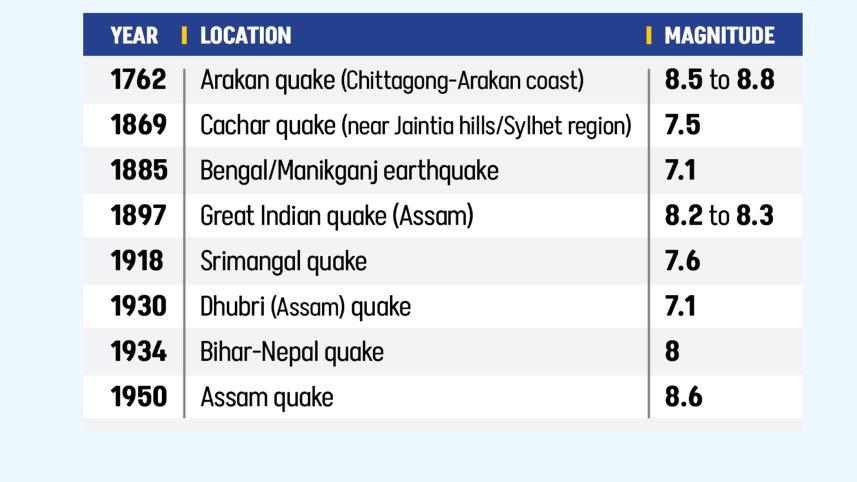
Some experts have suggested that yesterday's quake might have been a "foreshock", a warning of a potentially larger earthquake to come. Its location also surprised seismologists.
Professor Mehedi Ahmed Ansary of Buet's Civil Engineering Department said historical trends indicate that earthquakes of magnitude 7 on the Richter scale tend to recur every 100–125 years, while magnitude 8 quakes occur every 250–300 years in Bangladesh and the surrounding region.
"There has been no major quake in this area for the past 100 years," Ansary told The Daily Star. "Based on that trend, a major event could be imminent. I believe yesterday's earthquake is one of those foreshocks -- smaller quakes that occur before a larger one."
Professor Munaz Ahmed Noor, vice president of the Bangladesh Earthquake Society, said the epicentre's proximity to Dhaka was unexpected.
"We always assumed major quakes would originate from the Madhupur fault, but this shows that magnitude 5 or 6 earthquakes can originate closer to the city. A magnitude 6 quake could spell disaster for Dhaka," he said.
Madhupur fault is around 60km from the city.
Noor explained that shallow earthquakes, like yesterday's, are common in Bangladesh. "These quakes occur close to the surface, so the energy reaches the surface strongly, causing more damage to structures."
The Comprehensive Disaster Management Plan (CDMP) identifies five major fault zones in Bangladesh -- the Madhupur Fault, Dauki Fault, and three Plate Boundary Faults -- each capable of generating quakes of magnitude 7-8.5.
Both Ansary and Noor warned that unregulated urbanisation, weak enforcement of building codes, and rampant construction on land-filled wetlands have significantly increased Dhaka's seismic risk.
"Mainly, 4-8 storey buildings are most vulnerable. Dhaka doesn't have many tall buildings. Shallow earthquakes usually have short frequencies, which affect mid-rise buildings more. Taller buildings are impacted by longer waves from distant earthquakes, and we don't have many of those near Dhaka," Noor said.
Ansary added that a magnitude 7 earthquake within 100 km of Dhaka could cause 100,000–300,000 deaths and flatten roughly 35 percent of the city.
A RAJUK study, based on surveys from 2018–2022, estimates that a 6.9-magnitude quake along the Madhupur Fault could destroy over 850,000 buildings, claiming more than 200,000 lives and injuring another 200,000.
Noor stressed the importance of enforcing building codes. "The message is simple: everyone must strictly follow current regulations. In the past, enforcement was weak."
He also criticised Dhaka's real estate regulator. "RAJUK was supposed to check building designs, but they don't. It's time to follow Malaysia, Thailand, and Indonesia, requiring third-party verification of designs before approval."
Ansary called for immediate inspections. "We must identify buildings that need urgent repairs. Some may already have cracks but are still salvageable."
Adil Mohammad Khan, president of the Bangladesh Institute of Planners (BIP), said structures are being planned and built without considering earthquake risks, despite repeated warnings.
He highlighted ongoing issues: construction on wetlands, large buildings on narrow roads, and constant changes to building plans to serve commercial interests. "Even rules on minimum space between buildings are altered whenever developers want," he said.
Khan cited global examples. "In Chile, strict regulations meant minimal damage during strong quakes. In Haiti, where rules were ignored, destruction was massive. Turkey saw deadly consequences from compromised standards."
Comments