


Unlicensed kitchen markets plague DSCC

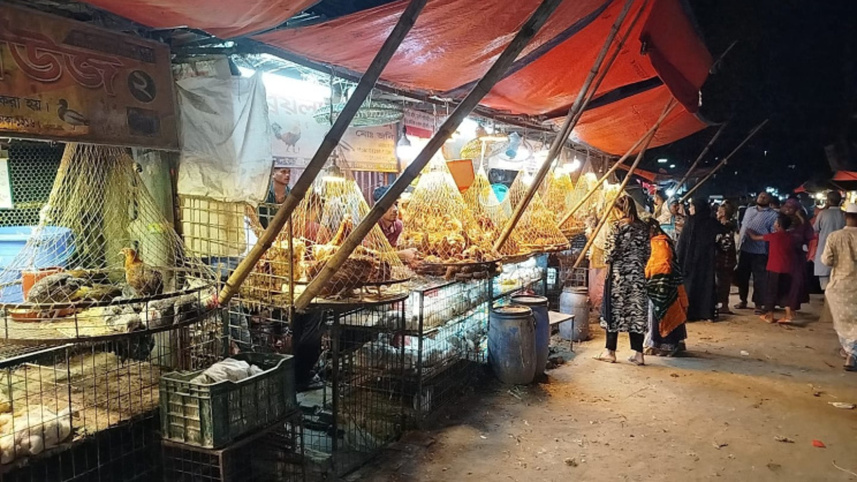
Only 12 of the 116 private kitchen markets operating under the Dhaka South City Corporation (DSCC) are legally registered, while the remaining 104 continue to operate without oversight, often encroaching on footpaths or land owned by government agencies and private individuals.
Although these markets supply essential goods to lakhs of residents, their lack of registration hampers revenue collection and raises concerns over public health, fire safety, and urban management.

To regulate such establishments, the DSCC introduced a policy in 2022 requiring all private markets -- excluding supershops and shopping malls -- to obtain licences.
These practices deprive the government of legitimate revenue. Authorities should identify such syndicates and investigate whether political figures, influential groups, or law enforcement members are involved.
However, enforcement has been slow. According to data from the DSCC Estate Department, only 12 private markets have registered in the last three and a half years. Of them, only Shantinagar Kitchen Market has a valid, up-to-date licence.
Under the 2022 policy, a private market is defined as any land or establishment where daily trade takes place between multiple buyers and sellers. Operators must obtain a licence from the Estate Department, renew it annually, and comply with zoning, health, and safety regulations.
Failure to comply is a punishable offence under Section 92 of the City Corporation Act, which allows authorities to shut down markets, impose fines, or take legal action.
The licensing process is relatively affordable. Applicants must pay a Tk 500 fee, followed by an annual renewal fee -- Tk 215 per square metre for markets on main roads and Tk 108 per square metre for those on secondary roads.
For example, a 1,500-square-metre market on a main road would require an annual fee of Tk 2.15 lakh.
On September 2 last year, the DSCC issued a public notice reiterating that operating without a valid licence is illegal and punishable under the Local Government (City Corporation) Act, 2009.
DSCC Chief Estate Officer Mobasswer Hasan told The Daily Star, “As the policy is new, many people are still unaware of it. We are working to raise awareness. After Eid, we will begin conducting mobile courts against illegal markets.”
He added that the corporation plans to re-inspect these sites to assess their suitability for commercial use. “We will verify whether the locations are appropriate for markets before making a final decision,” he said.
Urban planner Adil Mohammed Khan said operating private raw markets without licences is unlawful, as it violates the 2022 policy.
He noted that these markets generate significant revenue, a portion of which should go to the city corporation.
Calling it a failure of authorities, he said many markets remain unlicensed.
He also questioned how such markets continue to operate and under whose patronage, suggesting the possible involvement of syndicates engaged in extortion or informal collections.
“These practices deprive the government of legitimate revenue,” he said, adding that authorities should identify such syndicates and investigate whether political figures, influential groups, or law enforcement members are involved. “If proven, legal action must be taken.”
 For all latest news, follow The Daily Star's Google News channel.
Comments