Bangladeshi mariner stranded on drone-hit tanker
6 December 2025, 13:54 PM
Special Read
Daria-i-Noor, ‘sister’ to Koh-i-Noor, awaits first light in 117 years
8 October 2025, 15:06 PM
Special Read
Nafisa’s HSC result the last memory left with her mother
16 October 2024, 19:58 PM
Special Read
A glimpse into Zahir Raihan's Films
19 August 2024, 08:55 AM
Special Read
Dubai floods / Thousands of Bangladeshis stranded at Dhaka, Dubai airports
18 April 2024, 13:56 PM
Natural disaster
From outlaws to flower growers
14 April 2024, 06:45 AM
Special Read
'Genuine' SSC, HSC certificates for sale!
1 April 2024, 15:14 PM
Special Read
Counterfeiting currency / Learning from YouTube, he sells them on Facebook
28 March 2024, 14:43 PM
Special Read
Why many countries are trying a four-day work week
21 January 2024, 12:52 PM
Special Read
Shaheed Asad: The spark that lit a fuse in 1969
20 January 2024, 14:11 PM
Special Read
About Town
A Little Bit of Vietnam
10 May 2018, 18:00 PM
What Bangladesh Is Not Telling The Human Rights Council
In less than a week a United Nations body called Human Rights Council will be meeting in Geneva to reflect on the human rights situation in Bangladesh. Bangladesh will be presenting a report summarising the scenario in the country. The other states will then analyse the report, make observations and recommend steps that Bangladesh can take to improve the situation. This is called the Universal Periodic Review.
“The Universal Periodic Review (UPR) is an accountability mechanism—all states self-assess and then are made to answer for their human rights situation,” says Sultana Kamal, prominent human rights activist and Chairperson of Centre for Social Activism. The UPR process has happened twice before—once in 2009 and again in 2013.
So far, so good—except civil society organisations are now pointing out that the government's report submitted for UPR titled “National report submitted in accordance with paragraph 5 of the annex to Human Rights Council resolution 16/21”, is sunnier than it should be.
“The government submitted the report to the Human Rights Council on February 8 this year. They held a consultation with us the day before the submission—essentially the civil society could make no input into what was going to said at the UN,” says Sultana Kamal.
What will the government be telling other states at the Human Rights Council—and more importantly, what will it be omitting from the official report?
In response to the government's submission to the Human Rights Council, 56 prominent national and international organisations created their own reports of the human rights scenario, where they dutifully added the sections the state's report glossed over.
What the government did not say about child rights and underage marriage
The government presents the Child Marriage Restraint Act as a milestone, saying that it gives all public officials the power to stop underage marriages.
However, civil society organisations point out that the state's report does not reflect the new amendment to the Child Marriage Restraint Act, 2017 that allows underage marriage under special circumstances. “[The Act] meant to restrain child marriage, although still allowing child marriage 'if it is in the interest of the underage girl' with the consent of the parents and meeting directives of a court,” says a report prepared by Ain o Salish Kendra, Aparajeyo Bangladesh, Association for Community Development and a Thailand-based NGO ECPAT International.
The Netherlands-based non-profit Institute of Statelessness and Inclusion notes something else that neither the government nor any national NGO has highlighted—that the Rohingya children have rights to nationality. The organisation says that the Rohingya refugees are not going to be repatriated in the short term—and so the government must “Ensure that all children born in the territory of Bangladesh [...] are guaranteed without discrimination, their right to a nationality.”
Claim: Bangladesh fully supports freedom of expression of the press and human rights defenders
The state party's report claims that “the GoBis vigilant to protect civil society, bloggers and thus create space for freedom of expression.” The civil society, reports,begs to differ.
A report by the Center for Social Activism and International Services for Human Rights, for example, mentions the threat by members of the parliament to cancel Transparency International's (TIB) registration after the anti-corruption organisation did a survey on parliamentary activities. Suranjit Sen Gupta, Chair of the Parliamentary Standing Committee on Law had warned TIB by saying, “Never speak about the constitution and the parliament ever again in your life.”
Another report by NGOs, Article 19 and Research Initiatives Bangladesh (RIB), points out that the Foreign Donations Regulations Act makes it an offence for NGOs “to make inimical or derogatory remarks against the Constitution or a constitutional body”. How are the laws, then, encouraging freedom of expression for civil society?
The fact that defamation charges are considered as criminal charges instead of civil charges is another example of how laws discourage people. “Decriminalise defamation by repealing sections 499-503 of the Bangladesh Penal Code, ensuring that individuals' reputation rights can be vindicated through the civil law only,”recommends Tahmina Rahman, Regional Director of Article 19 at a mock UPR session held in the Sonargaon Hotel last week.
The CSA report also claims that protesters of the Hill Women's Federation “were violently attacked by the Border Guards Bangladesh and Bangladesh Police personnel who snatched their banners, kicked them and detained at least 25 of them.” The report also mentions that demonstrations are often met with tear gas, rubber bullets and police action.
The government claims that it is most serious about investigating violations against journalists, but CSA refutes the claim by highlighting that the police have failed to submit the investigation of the murders of Meherun Runi and Sagar Sarowar 56 times so far.
“In the period under review, and up to June 2017, Article 19 has recorded 1159 violations against journalists, bloggers and human rights defenders,” says a joint report by RIB and Article 19, adding that “one in six violations attacks were perpetrated by state actors” not including activists of political parties. “Impunity for all such attacks is endemic,” concludes the report.
Other than the highly-publicised murders of journalists and bloggers, Article 19 and RIB's report also details how Jamuna TV reports were doused with kerosene to be set on fire while filming illegal polythene production; how a reporter of the New Age was beaten up by police while filming them violating traffic rules; and how Prothom Alo, Sakaler Khobor and Samakal photojournalists were beaten up by prison guards when reporting.
“The government has pressured major companies in Bangladesh to cease advertising in two of the country's largest newspapers: the Prothom Alo and The Daily Star,” the report goes on to say. On the other hand, the publisher of a queer poetry book called Roopongti was attacked by Islamic extremists in September 2015, says a report submitted by queer activists.
Furthermore, the state report puts the Digital Security 2018 as a milestone, done for “establishing balance between freedom of expression and public morality and interest.” All the civil organisations concerned slams the act as simply a tool to control public expression. The CSA report points out that the new law can be used to hand out life imprisonment to anyone “involved in propaganda against the 1971 Liberation War of Bangladesh and Father of the Nation.”
“We do not speak out about everything because we can be attacked—even if it is just verbally,” says Sultana Kamal. “The government does not believe the existence of the civil society is important, that we should exist to affect discourse.”
Claim: The Government of Bangladesh is interacting with international mechanisms on human rights issues
Civil society members agree that we do not have a good track record with allowing the United Nations Special Rapporteurs to come to Bangladesh and independently report on the human rights scenario.
“The UN system limits the access of civil society, but the Special Rapporteurs can interact with anyone, which is why their role is significant,” says Sultana Kamal. These individuals are specially appointed by the Human Rights Council and work independently, not being salaried staff of the United Nations. Bangladesh hosted the Special Rapporteurs on freedom of religion and belief and violence against women, but as the Centre for Social Activism points out in their report “requests for country visits from at least 12 Special Rapporteurs or Independent Experts (sic) remain pending.”
They highlight that the Special Rapporteurs on extrajudicial, summary or arbitrary executions, and minority issues have been trying to visit since 2006 and even sent several reminders to no avail. Since 2006, the Special Rapporteurs on independence of judges, migrants, toxic waste, freedom of assembly, sale of children, extreme poverty, indigenous peoples, human rights and counter-terrorism, freedom of opinion and expression, racism and the working group on disappearances, have also requested to be let in, but the government is yet to allow them in.
Enforced Disappearances: issues the government did not mention
One of the most pressing concerns of the day is enforced disappearances—and the state party report did not even acknowledge this as a problem. Both National Human Rights Commission and Amnesty International points out the phenomenon in their reports. To add context to the claims, Amnesty refers to a secret audio recording published by Swedish Radio, of a senior Rapid Action Battalion (RAB) officer claiming that the security force wing carry out abductions and extra-judicial killings. NHRC, on the other hand, recommends in their shadow report that that the state has to investigate and prosecute all cases of extra judicial killings and enforced disappearances.
The closest the state report comes to the issue is when it recounts how the state sentenced 16 RAB members for the forced abduction and murder of Narayanganj panel mayor Nazrul Islam and his six aides—in effect, to press home the claim that “Bangladesh maintains a 'zero tolerance' for crimes by law enforcement agencies”. The Center for Social Activism adds nuance to the government's statement by claiming that there were 162 deaths in which law enforcers were involved. “A pattern has emerged about the fate of victims of enforced disappearance where in most instances they are kept in undisclosed custody for weeks or months before police suddenly claim to have arrested them the previous day,” it states. The organisation's report further goes on to say that many of the disappeared are “found dead, labelled as victims of 'cross-fires'.”
The government report instead pins the blame on people impersonating law enforcers to abduct citizens, a point that was also raised by the last UPR session of 2013, then Foreign Minister Dipu Moni.
Germany has already submitted a question on this subject in anticipation of the session. “What steps does the Government of Bangladesh undertake in order to fight impunity in recorded cases of extrajudicial killings, enforced disappearances, and torture?” the state of Germany will be asking Bangladesh.
Meanwhile, while the government's report tells the Human Rights Council that Bangladesh formed the Torture and Custodial Death (Prevention) Act in 2013, it makes no mention of the resistance that this piece of legislation faced from law enforcement agencies.
“Officially recognised the gender identity of the transgender persons” (and that's all)
The state party report states transgendered persons are going to be identified as such, adding that the Election Commission will be registering transgender persons the way they self-identify. The report however gives an incomplete description of the human rights scenario for the LGBTQI community. Rights groups like Boys of Bangladesh and Roopban, in collaboration with independent queer activists, created a submission that fills up the gaps left in the government version.
To begin with, the government's identification process itself is stated as problematic by the activists' report. “Declaration of 'Hijra' as a third gender without the proper understanding of the gender spectrum has led to the problematic definition of 'Hijra' as 'sexually disabled persons [which] makes it very clear that the civil servants and law-makers have no understanding of gender identity and sex characteristics,” says the report, succinctly pointing out how all non-binary gender identities are thought by the government to be Hijras. The NHRC, meanwhile, recommends that Bangladesh must “formulate definitions of Hijras”.
Then there is the whole question of the rights of LGBTQI community to simply exist.
The report by the queer activists points out that the police detectives have no real findings regarding the murders of queer activists Xulhaz Mannan and Mahbub Rabbi Tonoy, having missed 23 deadlines to submit the investigation report. The activists included Home Minister Assaduzzaman Khan Kamal's statement from that time, saying “our society does not allow any movement that promotes unnatural sex [so] writing in favour of it is tantamount to a criminal offence as per our law” as evidence of the rights situation of the LGBTQI community in Bangladesh.
“Bangladesh has not supported the recommendation advocating the abolition of death penalty, and 'so-called' same-sex relations,” stated State Minister for Foreign Affairs Shahriar Alam in a mock UPR session held in the city last week.
“Both in 2009 and 2013 there were two recommendations to decriminalise same sex relationships but Bangladesh rejected them,” says Shakhawat Hossain Rajeeb, a queer activist, “but we are hoping this year we will also have some recommendations from other states.”
The counter-report by queer activists further states that 25 LGBTQ activists have left the country following the murders of Mannan and Tonoy. “The community had to cancel the third annual Rainbow Rally on the face of opposition from the government in April 2016 [while] four gay men were illegally detained by the police suspecting them to be attendees of Rainbow Rally,” the report states, portraying the movement's inability to exercise the right to assembly.
Roopban, the LGBT publication Mannan was the publisher of, also submitted a report to the Council. The report details the short and violent journey of the magazine. “The plan was to publish an issue every three months, but under threats it became difficult to find a printer,” says the report. They write how the magazine had allowed the movement to come out of the closet and organise events, but that “the murders of Xulhaz and Tonoy brought the visible organising of LGBT communities to a standstill.”
10 May 2018, 18:00 PM
MAILBOX
It is not a matter of consideration, nor an act of kindness or sympathy by Myanmar. Rather it is a right of the Rohingya Muslims who have been driven away from Rakhine state inhumanely, breaking all records of atrocities and barbarism the world has ever seen.
10 May 2018, 18:00 PM
Fixing a broken marriage
If we look at the history of marriage, it appears that back in the 18th century, marriage was mostly an economic arrangement. Marriage was used to manage wealth through merging properties of two families and then ensuring it through inheritance laws. Marriage also played a vital role in maintaining social class and adhering to the same social group (e.g. Brahman marrying Brahman or rich marrying rich etc.). In
7 May 2018, 18:00 PM
Ride sharing is a relief but not yet a permanent solution
For as long as anyone growing up in the Noughties can remember, Dhaka has had a traffic problem. In fact, an entire generation did much of their growing up stuck inside various forms of transport on Dhaka's gridlocked roads, waiting, sweating and cursing. The government took steps—building flyovers, introducing stricter policing and enforcement on the roads, uprooting streetside businesses to make space—but to no avail. With a growing economy and expanding purchasing power, more people bought cars and found more reason to go places.
3 May 2018, 18:00 PM
Are we willing to know more of Dhaka?
The city as we know it is as much a physical space as it is a state of mind. The mindscape—the space we bear in our mind—is constantly in dialogue with the physical city. The real city emerges out of this dialectic. Yet, and quite sadly so, our urban research remains heavily biased towards the physical city, relegating the immaterial associations of the city as secondary, if not outright unimportant.
3 May 2018, 18:00 PM
About Town
Exploring Self for Better Communication
3 May 2018, 18:00 PM
A country of famished farmers
As a small farmer, Shyamol's life was never easy. In his 10-decimal land in Rajshahi's Durgapur village under Godagari upazila, Shyamol used to grow rice. Like many other farmers of his village, he inherited that land and his profession from his ancestors. With the crop, he could hardly meet the expenditures of his family of six—his wife, elderly mother and three children. He also had to pay instalments of his debt which he had to take for buying seeds,
3 May 2018, 18:00 PM
Failing our role?
Doyasona Chakma and Monti Chakma returned just as mysteriously as they disappeared. The two women, both of whom are core elected members of the Hill Women's Federation, were dropped off by their abductors after a month of being held captive.
3 May 2018, 18:00 PM
MAILBOX
Recently, an alarming news was published in the media that a coal-loaded cargo vessel has been sunk in the Pashur river very near the Sundarbans area. This is the fourth time a water vessel has gone down in the area, which regularly cause serious environmental loss to the mangrove forest. The Sundarbans are the largest natural barrier protecting the people of the southern part of our country from many natural
3 May 2018, 18:00 PM
A legacy continues
Throughout the world, Bata is often considered a local brand; such is its connection with the masses built over the decades it has operated in various countries.
30 April 2018, 18:00 PM
Fruit’s pungent smell mistaken for gas leak, prompts panic
The pungent smell of the rotten durian fruit at an Australian university library has been mistaken for a gas leak, prompting an evacuation of the building.
29 April 2018, 06:39 AM
MAILBOX
This is in reference to a write-up on "Is social media inciting violence in Myanmar?" by Maliha Khan published in Star Weekend on April 13 which explained the controversial role of Facebook in ethnic cleansing atrocities committed against the Rohingya by Myanmar security forces and ultra-nationalist Buddhist communities.
26 April 2018, 18:00 PM
About Town
Organiser: Retired Armed Forces Officers' Welfare Association (Raowa)
26 April 2018, 18:00 PM
The man with 100 forest cases... and why he claims he is innocent
Hssan Ali appeared at Tangail Forest Court on January 4, 2018 to take bail in a 'forest case' (no. 405) that was filed in 1998 for felling of trees. He had been charged in absentia on December 27, 2017. The court issued a warrant of arrest. On January 4, he secured a bail to stay out of jail.
26 April 2018, 18:00 PM
Qualified, but Rejected
It's 11 am. Mosammat Ayesha rushes to the classroom of grade four to take attendance. After the roll call, she asks the students to open their English grammar book and go through a grammar lesson. While the students fumble through their books, Ayesha quickly moves to the classroom of grade five. There, she again takes the attendance and asks the students to open their mathematics books. Instructing them to solve some arithmetic problems, she returns to the classroom of grade four to help students with grammar lessons.
26 April 2018, 18:00 PM
How the quota reform movement was shaped by social media
The recent quota reform protests took place as much on the streets of Dhaka as it did online, particularly on Facebook. Pitched battles in the middle of the night resulted as people responded to updates in real time. Events at the University of Dhaka (DU) led to uproar spreading to other universities in the city and other major cities of the country, where the youth took up protests in solidarity as well as a shared demand that the quota system, which reserves
26 April 2018, 18:00 PM
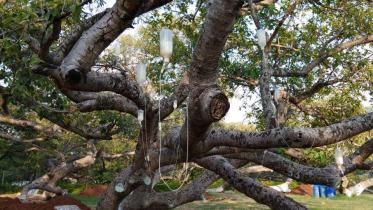
‘Saline drip’ for a 700-year-old banyan tree in India
The world's second largest Banyan tree in Mahabubnagar district of India’s Telangana which is almost dying, is on ‘saline drip’ now as part of the rejuvenation.
21 April 2018, 07:07 AM
Bank of the bold
Bangladesh International Vote Banking brings you the opportunity to avail dead people votes, double votes, interest-based group votes, and much more, all designed in ways to suit you.
19 April 2018, 18:00 PM
Blend in or stand out?
Ever wondered why the Scandinavian countries—Denmark, Norway and Sweden—top the World Happiness Report year after year? No? Well, I have. You kind of have to when your country stands 115th on this year's list.
19 April 2018, 18:00 PM