


Investigators digging into documents

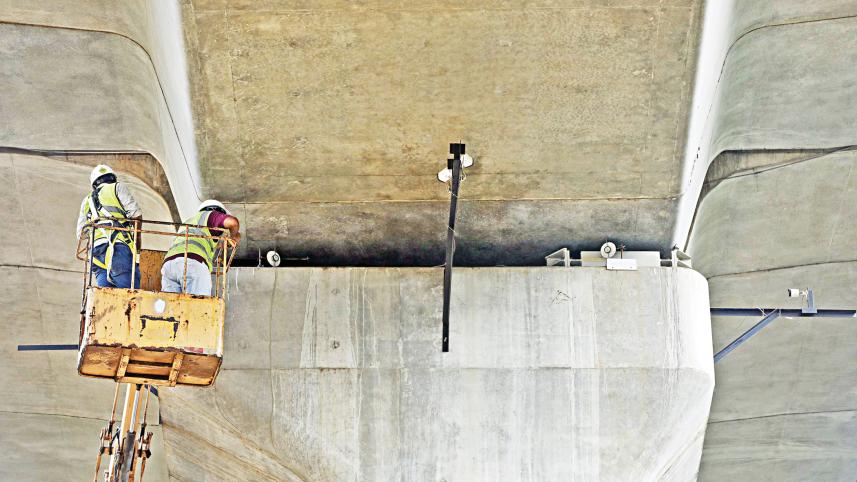
A probe committee yesterday began looking into Sunday's tragic incident, where a bearing pad fell from a metro rail pillar near Farmgate station, killing a pedestrian and injuring two others.
Investigators say they will examine whether substandard materials, construction flaws, or maintenance issues contributed to what they described as a "very unusual" incident -- occurring less than two years after the metro rail service was launched.
 For all latest news, follow The Daily Star's Google News channel.
 The committee, led by Bridges Division Secretary Mohammad Abdur Rouf, held its first meeting and visited the spot yesterday.
After a 23-hour suspension, metro rail services resumed in full at 11:00am yesterday, giving relief to the thousands of daily commuters.
On Sunday, around noon, a bearing pad fell from metro rail pillar number 433 near Farmgate station and fatally struck Abul Kalam Azad, 35. Two others were hurt at the time.
Azad, from Shariatpur, worked at a travel agency in the capital's Uttara. His wife, Irene Akter, filed an unnatural death case with Tejgaon Police Station on Sunday night.
Considering the fact that another bearing pad fell near the same spot 13 months ago, transport experts and engineers expressed concerns over the safety of this highly technical mode of transport.
WHAT'S A BEARING PAD?
On elevated structures such as bridges and metro rail lines, bearing pads are placed between the viaduct and the pillar. In this case, four bearing pads were installed on each pillar.
Experts said elastomeric bearings transmit loads from the superstructure to the pillars and absorb vibrations caused by the movement of metro trains.
These pads, each weighing around 100kg, are installed without mechanical anchorage, relying on the compressive force from the superstructure's dead load to generate adequate friction and resist lateral movement under service conditions.
On September 18 last year, one of the four bearing pads fell from pillar number 430, disrupting metro rail services on the Agargaon–Motijheel section for around 11 hours. However, no casualties were reported.
PROBE LAUNCHED
The road transport and bridges ministry initially formed a five-member committee yesterday, and it was instructed to submit a report within two weeks.
However, the appointment of Abdur Rouf as head of the committee drew criticism, as he was serving as the managing director of Dhaka Mass Transit Company Ltd (DMTCL) when the September incident happened.
To address this concern, the ministry later added the chief engineer of the Local Government Engineering Department, bringing the total number of members to six, and placed the committee under the supervision of Sheikh Moinuddin, special assistant to the chief adviser for the road and railway ministries.
Contacted, Abdur Rouf said as per the committee's terms of reference, they will examine whether the recommendations provided in the probe report of the September incident were implemented, identify the causes behind Sunday's incident, determine who may be responsible, and provide recommendations to prevent recurrence.
"We have sought design and other relevant documents from DMTCL, including details of the contractors and consultants," he told The Daily Star last night. "We will look into all aspects of the incident."
Contacted, Sheikh Moinuddin, who is currently in US and coordinating with the committee remotely, said the bearing pad is not supposed to become dislodged within such a short time. "This makes the matter puzzling."
"So, we have to investigate whether substandard materials or construction were involved, or if any flaws went unnoticed when operations began," he told this correspondent over the phone.
He added that they would hire foreign experts if local experts failed to identify the cause. "We will take corrective measures if any flaws are found."
Moinuddin also said they need to examine whether DMTCL has an expert team in place to conduct annual or biennial inspections of vulnerable equipment. "If there isn't one, we have to create one."
The Uttara to Agargaon section of the country's first metro rail was launched in December 2022, while the Agargaon to Motijheel section became operational in November the following year.
Comments