


DNCC backtracks on rent guidelines
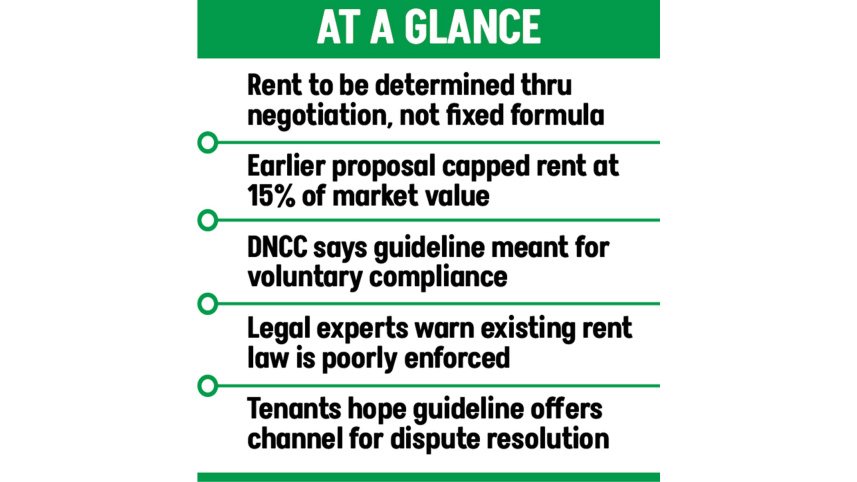
Amid widespread criticism, the Dhaka North City Corporation (DNCC) has revised its recently issued house rent guideline, clarifying that rent determination will be based on negotiation and existing laws.
Earlier, the guideline proposed a standard for fair rent, stating that annual rent should not exceed 15 percent of a house’s market value. The guideline, issued on January 20, drew criticism over its legal basis and implementation.
 For all latest news, follow The Daily Star's Google News channel.
 Contacted, DNCC Administrator Mohammad Azaz said the guideline was revised due to misinformation.
“Newspapers published calculations suggesting how much flat owners should charge. However, government valuation is based on the mouza (official land rate) rates, which are much lower than the actual current market value,” he said.
Regarding legality, Azaz said DNCC has received a large public response.
“This is becoming a matter of voluntary compliance, as landlords want to rent out properties and tenants want to rent them. Many landlords have already said that since there is now a guideline, they will follow it,” he said.
He acknowledged that a formal legal basis would strengthen the process.
“Local government has the authority to issue such directions and can play a role in dispute negotiations. At the ward level, we can help resolve disputes,” he said.
Azaz said the guideline allows landlords or tenants to seek arbitration or mediation from DNCC offices if disputes arise. “If a legal framework becomes necessary, DNCC will be able to play a more supportive role,” he added.
“That would make the process even stronger. So we are waiting positively,” he said.
Supreme Court lawyer Manzill Murshid said the key issue lies in how the 15 percent rent cap under the House Rent Control Act, 1991 is calculated.
“If applied to current market values, rent becomes extremely high,” he said.
He also pointed out that although the law requires written contracts and rent receipts, these are rarely followed in practice. “The law mentions one month’s advance, but landlords often take three to six months,” said Manzill, who is also president of Human Rights and Peace for Bangladesh.
Another problem, he said, is eviction. “Once a two-year contract is signed, tenants cannot be evicted except for renovation or personal use. But landlords often force tenants out early to rent to someone else at a higher rate,” he said.
Manzill said the absence of an effective dispute resolution mechanism is the core problem. Although the law allows for tribunals, cases are delayed and costly, discouraging tenants from seeking legal remedies.
“That is why we opposed this system and said that if the government really wants a tribunal under the law, it should be formed at the ward level, with two or three respectable people in each ward acting as tribunal members,” he added.
“The biggest issue is the lack of a rent fixation system. If rents were fixed, most problems wouldn’t exist. For example, in government housing, rent is fixed. But for private housing, landlords set rent arbitrarily,” he said.
He added that if the government formed a commission to fix area-wise rent based on house quality and other factors, most disputes would be resolved.
Regarding the new guideline, Morshed said DNCC suggested resolving disputes at zonal offices. “But the zonal office has no legal authority. The law does not mandate that disputes must be resolved there. It’s only a suggestion, not legally binding.”
“If one party refuses to comply, there is no punishment. Tribunal decisions, however, are legally binding,” he said.
Noorjahan Begum, a resident of Indira Road, said tenants often feel helpless and are forced to accept rules imposed by landlords.
“If this guideline is followed properly, it may bring some relief. Earlier, we had nowhere to complain,” she said.
According to the 16-point guideline, rent can be increased only after two years, with adjustments during June–July.
Tenants must pay rent by the 10th of each month, and landlords must issue written receipts.
Tenants (with landlord approval) may use rooftops, balconies, and open spaces. For safety reasons, landlords must provide tenants with keys to the roof and the main gate under certain conditions.
If a tenant fails to pay rent on time, the landlord may issue verbal and written warnings. Continued noncompliance may result in a written notice, after which the landlord may terminate the contract.
Section 15 of the House Rent Control Act, 1991 states that standard rent should equal 15 percent of a house’s market value. However, the law has not been effectively enforced, with no rent controllers appointed and few cases taken to court.
In 2010, Human Rights and Peace for Bangladesh filed a writ petition seeking enforcement of rent control, which remains pending.
In 2015, the High Court directed the government to form a commission to set rent limits and appoint rent controllers at the ward level.
Comments