


49% candidates businesspeople
Almost half of the candidates contesting the 13th National Parliamentary Election come from business backgrounds, according to data released by Shushashoner Jonno Nagorik (Shujan).
Of the 2,026 nominees -- both party-backed and independents -- 998 are businesspeople, accounting for 49.26 percent of the total.

Compared with the previous election, where nearly 59 percent of nominees were from business backgrounds, the share of business candidates has declined significantly.
The findings were disclosed yesterday at a press conference organised by Shujan at Jatiya Press Club.
Presented by Shujan Central Coordinator Dilip Kumar Sarkar, the data showed that business remains the most common occupation among candidates, particularly within the BNP.
Of the party’s 290 nominees, 209 are businesspeople -- the highest number in absolute terms.
The Jatiya Party has 129 business candidates among 195 nominees, while Jamaat-e-Islami has 74 businesspeople out of 227 candidates. In the National Citizen Party, 12 of its 32 nominees are from business backgrounds.
Proportionally, business candidates make up 60 percent of Gano Odhikar Parishad nominees, 46 percent of Insaniyat Bangladesh, 44 percent of Khelafat Majlish, 43 percent of Islami Andolon Bangladesh (IAB), and 30 percent of Communist Party of Bangladesh (CPB) candidates.
Outside business, teachers form the next largest professional group, with 240 candidates, followed by lawyers (229) and salaried employees (133).
Thirteen homemakers are also contesting the election.
The data show a high concentration of wealth among candidates.
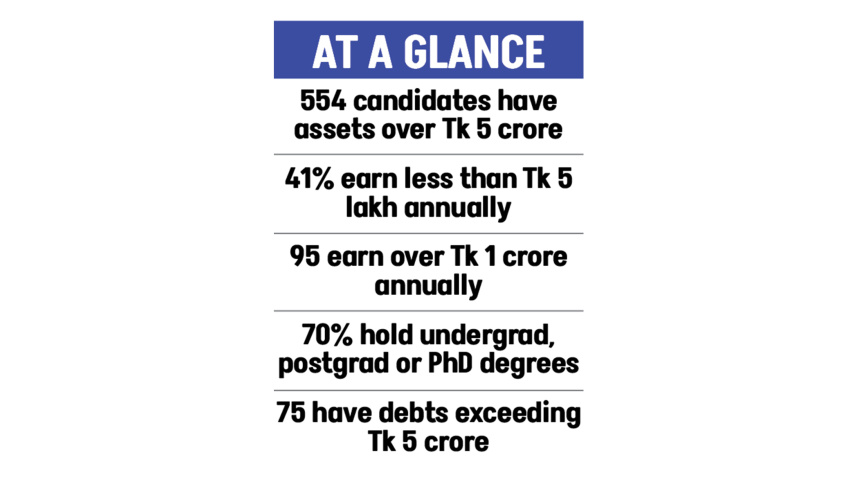
Shujan reported that 554 candidates have assets exceeding Tk 50 million, while 1,127 have declared assets worth more than Tk 10 million.
The BNP leads with 276 millionaire candidates, followed by Jamaat with 178.
Income figures showed that nearly half of all candidates are low earners.
A total of 832 candidates (41 percent) reported annual incomes below Tk 500,000.
Another 741 earn between Tk 500,000 and Tk 2.5 million, 132 between Tk 2.5 million and Tk 5 million, and 71 between Tk 5 million and Tk 10 million.
At the top end, 95 candidates earn more than Tk 10 million annually. BNP candidates dominate this group with 51, followed by 25 independents and five Jatiya Party nominees.
Compared with the previous election, the proportion of candidates earning over Tk 10 million and under Tk 500,000 has declined slightly -- from 8.77 percent and 45 percent to 4.59 percent and 41 percent, respectively.
Addressing the press conference, Shujan Secretary Badiul Alam Majumdar said analyses of winners from the last three national elections and several local government polls show a consistent trend: those who gain power experience sharp rises in income and assets, while those who lose or remain outside power see stagnation or decline.
“Political power functions like a magic wand,” he said, adding that politics has increasingly become a business.
 For all latest news, follow The Daily Star's Google News channel.
 Debt levels among candidates are also notable. Of the 2,026 candidates, 519 have outstanding loans, with 75 owing more than Tk 50 million.
The BNP has the highest number of indebted candidates -- 167 in total, 44 of whom owe over Tk 50 million.
IAB has 40 indebted candidates, three of whom owe over Tk 50 million; Jamaat has 54, including four above that threshold; and the NCP has seven.
Education levels among candidates have risen. This year, 70 percent hold undergraduate, postgraduate, or PhD degrees, up from just over 59 percent in the 12th election.
Highly educated candidates account for 77.58 percent of BNP nominees, 89.43 percent of Jamaat, 71.48 percent of IAB, and 84.39 percent of the NCP.
Age-wise, most candidates fall between 50 and 70 years (45 percent). Those aged 35–50 make up 34.4 percent, under-35s account for 8 percent, and candidates over 70 comprise 7 percent.
Shujan noted that younger candidates are more common in the NCP, Insaniyat Biplob Bangladesh, and Gano Odhikar Parishad, while the BNP and Jamaat tend to nominate older candidates.
Comments