


Farmers’ rights, Pragati’s key focus

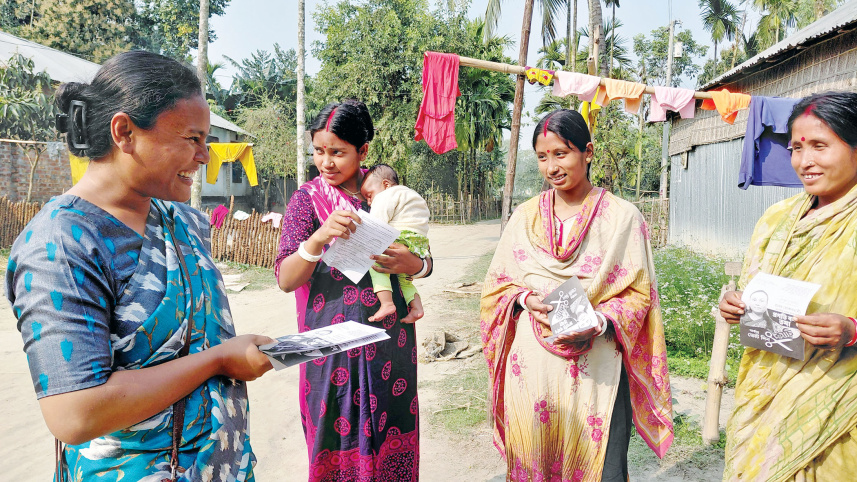
In an election season dominated by blaring loudspeakers and long motorcades, Rangpur-4 candidate Pragati Barman Toma is taking a different approach: a quiet, door-to-door campaign, focused entirely on a manifesto centred on farmers’ rights, women’s dignity and basic public services.
The 33-year-old candidate of Bangladesh Samajtantrik Dal (Marxist) says her constituency -- covering Pirgachha and Kaunia, two major potato-growing areas -- cannot progress unless agriculture survives.

Her pledges reflect that focus.
Pragati’s manifesto includes subsidies for potato farmers, fair prices for all crops including rice and potatoes, government-run cold storage with fees fixed at Tk 100 per sack, lower fertiliser, seed and pesticide costs, and interest-free agricultural loans.
The manifesto further emphasises rights for marginalised communities, including Dalits and Harijans, recovery of khas land and rehabilitation of the landless, establishment of agro-based industries, and measures to prevent the spread of drugs.
“My constituency is agriculture-based. If farmers do not survive, development of this region is impossible,” she said. “That is why agriculture comes first in my manifesto.”
However, without funds to hire workers or organise rallies, Pragati campaigns mostly alone. Each morning she sets out on foot with leaflets bearing her election symbol (scissors) and walks from village to village, stopping in fields and courtyards to speak with voters.
In Hatiram village, 36-year-old Sandhya Rani said she was impressed by Pragati’s clarity. “Pragati Barman Toma clearly highlights women’s problems. If a woman like her goes to parliament, women’s welfare will be ensured,” she said.
Farmers, too, say they value her willingness to listen. Afzal Hossain, 60, recalled her visiting the fields to discuss crop prices and irrigation costs. “She understands our problems. The way she thinks about farmers really appealed to us,” he said.
A former Bangla student at Dhaka University and once general secretary of the Socialist Students’ Front’s campus unit, Pragati now earns a living through private tutoring.
Her father Pijush Kanti Barman, a retired schoolteacher, says he is surprised by her stamina; her mother Molina Roy says women voters respond warmly.
Still, the path is not easy. She is the only female candidate among nine contenders in a constituency with more than half a million voters. She says the election lacks a “level playing field,” arguing that money-driven politics sidelines smaller candidates.
“When politics is dominated by money, inequality is inevitable,” she said. “People should decide based on morality and competence.”
 For all latest news, follow The Daily Star's Google News channel.
Comments