


Voting festive, peaceful
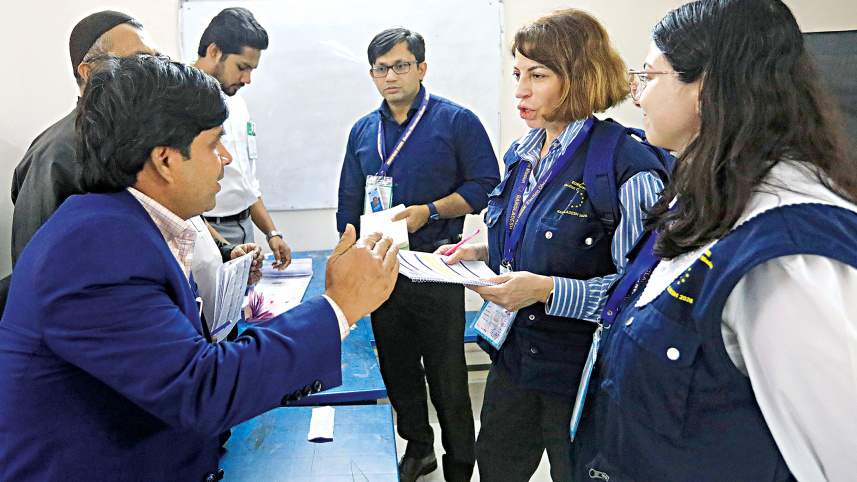
Election monitors from the Asian Network for Free Elections (ANFREL) yesterday said voting in the 13th national polls and referendum was mostly festive, orderly, and peaceful.
After visiting 414 polling booths across all eight divisions -- 169 in rural areas and 234 in urban locations -- covering 71 percent of the country’s 64 districts, ANFREL said nearly 90 percent reports from its observers found no discrepancies in general voting procedures.

However, it noted that most polling stations lacked ramps and wheelchair access, creating mobility barriers for persons with disabilities and elderly voters.
The observers also reported activities, such as political party-operated voter identification desks distributing voter slips in the vicinity of several polling stations, which, they feared, may facilitate vote-buying.
In a post-poll statement, ANFREL said that although most centres opened in an orderly manner, some experienced minor delays that prevented polling agents and observers from entering on time.
“This led to tensions and, in isolated instances, physical confrontations between representatives of competing parties,” it said.
ANFREL said 94 percent of observed polling stations closed on time, with no reported incidents disrupting the process. The counting also proceeded without major disruption, except at two centres where polling agents raised concerns.
More than 50 percent of ANFREL observers reported that presiding officers failed to announce the serial numbers when opening ballot boxes. Nearly one-third said counting centres were not under CCTV surveillance, and 30 percent reported that presiding officers did not ensure separate counting of parliamentary and referendum ballots.
Security arrangements were extensive and highly visible throughout the electoral process, it noted.
Meanwhile, election observers from the European Union and the Commonwealth reported strong voter participation and peaceful proceedings in yesterday’s elections.
The European Union Election Observation Mission said it witnessed a lot of positive enthusiasm among voters till noon.
The mission deployed 200 observers nationwide to monitor the vote, marking the first full-fledged EU mission since the 2008 elections.
Ivars Ijabs, the mission’s chief observer, said EUEOM maintained online contact with its observers stationed across Bangladesh, receiving regular updates on the opening of polling stations, voter turnout and the overall conduct of the election.
The mission will publish preliminary findings tomorrow and a final report within two months.
According to Ijabs, most polling stations opened on time and voting proceeded peacefully.
He described the election as an important opportunity for citizens to exercise their democratic rights.
“I think this is really a wonderful opportunity for Bangladeshi people, this time, to cast their vote in a really free, participatory, and competitive election,” he said.
“This is really a big day for Bangladesh’s democracy.”
Meanwhile, the Commonwealth described the election as the largest democratic exercise of 2026, both within the Commonwealth and globally.
Nana Akufo-Addo, chairperson of the Commonwealth Observer Group, said his team monitored the entire process, from the opening of polling stations to the management of results.
 For all latest news, follow The Daily Star's Google News channel.
 For the first time, diaspora voters participated in the election from 122 countries.
“The inclusion of diaspora voters on this scale, alongside the simultaneous referendum on the constitutional reforms, is noteworthy and reflects a commitment to enhancing democratic processes,” said Akufo-Addo.
The Commonwealth deployed observers to eight divisions two days before the vote to assess preparations and meet with local stakeholders. They will issue a preliminary report tomorrow.
According to the Chief Adviser’s Office, at least 394 international observers and 197 foreign journalists were on the ground to monitor and cover the election and referendum.
Comments