


Policy dialogue: Will repair state, improve lives
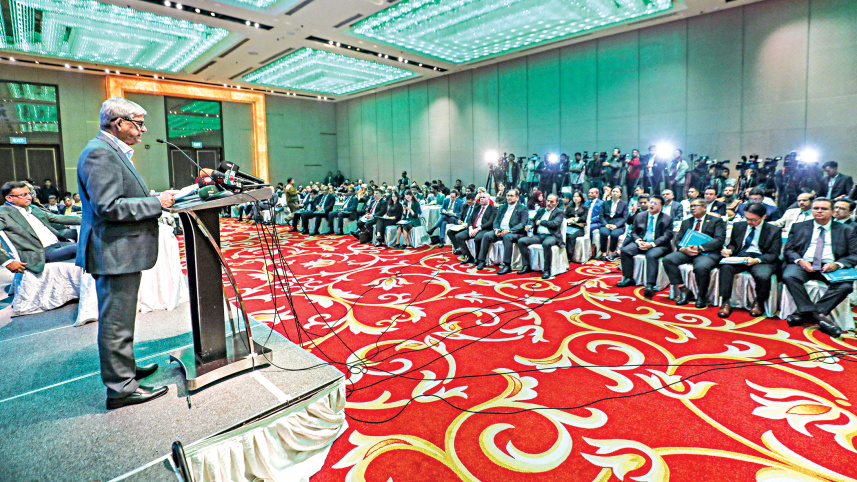
The BNP yesterday presented its eight priority social policies as immediate deliverables under its broader 31-point “state repair” plan, pledging reforms to make governance accountable, services accessible and opportunities equitable.
The key sectors include Family Card, Farmers Card, Health Card, education, employment and skills, environment and climate resilience, welfare for religious leaders and sports.

The party leaders presented policy perspectives on the key social sectors before the foreign diplomats and development partners at an event titled “BNP Policy Dissemination on Priority Social Policies” at Sheraton Dhaka.
The event was attended by a total of 30 representatives, including Chinese Ambassador to Bangladesh Yao Wen, Malaysian High Commissioner Mohd Shuhada Othman and representatives from the US, the UK, India, Pakistan, Russia, the EU, Iran and Bahrain.
“Today, the challenges are multi-faceted -- the BNP has already worked hard to prepare policies, which will enable the shattered economy to grow as a stable one, which will pave the way for sustainable development, which will empower the lower income people to rise and initiate a new era of hopes and aspirations,” said BNP Secretary General Mirza Fakhrul Islam Alamgir.
If voted to power, the party will overcome the financial and political challenges.
“We have challenges. But this has to be overcome with the strength and power of the people. We know the economy is in a critical situation. Political issues are not settled yet. We shall overcome all challenges as we have done in the past.”
Since 2009, the Awami League regime devastated the economy, turned it into a mafia economy and encouraged oligarchy.
“It turned into a haven for looters, plunderers -- the banks were looted, money was taken away from banks to foreign countries where they became owners of huge assets and wealth. It was a country with no significant employment, no investment, an economy of despair.”
The 15 years of Awami rule were marked by lawlessness, lack of accountability and unbridled corruption, all of which led the country to a ‘state of fascism’, Fakhrul said.
The July Uprising, which compelled Sheikh Hasina to flee the country, brought new hope and created new opportunities.
The BNP has always been a forward-looking party, Fakhrul said, adding that his party initiated political as well as economic reforms since its inception.
“With the spirit of liberation war and the spirit of the July movement, the BNP is determined to create a better Bangladesh with new ideas, new technology, new opportunities in this changed world,” Fakhrul added.
EIGHT SECTORS
Under its Family Card programme, the BNP plans to provide Tk 2,000-2,500 monthly assistance or essential food items to 50 lakh women.
The card will be issued in the name of the household’s matriarch. By reducing household food expenditure, the Family Card enables women to save regularly.
The proposed Farmers Card would ensure fair prices for fertilisers, seeds and pesticides, along with incentives, easy-term loans and insurance.
The card will also enable easier access to affordable financing, seasonal credit and crop and livestock insurance to protect farmers from climate shocks, pests and market volatility.
The BNP’s health sector plan promises one lakh new health workers -- 80 percent of them being women -- for door-to-door screening of common diseases.
The party’s health reform agenda places preventive and promotive healthcare at the forefront both in rural and urban areas.
 For all latest news, follow The Daily Star's Google News channel.
 It pledges round-the-clock free medicine through primary health centres, affordable treatment for major illnesses, expanded maternal care at upazila hospitals and year-round mosquito-control initiatives.
In education, the party plans to provide tablet computers to teachers, set up multimedia classrooms, introduce a “Learning with Happiness” curriculum at class VI and make technical education compulsory.
Regarding employment, the party has planned free internet access at educational institutions and short-term training in foreign languages and skills development.
With the view to establishing sports as a profession, the party has planned mandatory sports education from class IV, scholarships for talented students aged 12-14 through ‘Notun Kuri Sports’, construction of Sports Villages with indoor facilities in all 64 districts, appointment of Upazila Sports Officers, BKSP branches in all divisions, playground expansion and establishment of a sports equipment industry.
In the environment sector, excavation or re-excavation of 20,000 km of rivers and canals, development of Teesta and Padma Barrage projects, planting 250 million trees over five years, nationwide integrated waste management and production of fuel and organic fertilisers from waste are in the cards.
For welfare religious leaders, the party has proposed monthly honorarium, festival allowances, skill development training, expansion of mosque-based education programs, strengthening Imam-Muazzin Welfare Trust and similar benefits for heads of places of worship of other religions.
In his keynote speech, Ziauddin Hyder, a member of the BNP Chairperson’s Advisory Council, said: “Bangladesh cannot afford politics that only wins elections -- Bangladesh needs politics that repairs the state and improves lives. Let the promise of the next election be this: not noise, not fear, not division, but a clear plan, a repaired state, and a future where every family can live with dignity.”
Humaiun Kobir, BNP’s joint secretary general (international relations), and Saimum Parvez, special assistant to the BNP chairperson’s foreign affairs advisory committee, also spoke.
Comments