


Zelenskiy leaves White House empty-handed
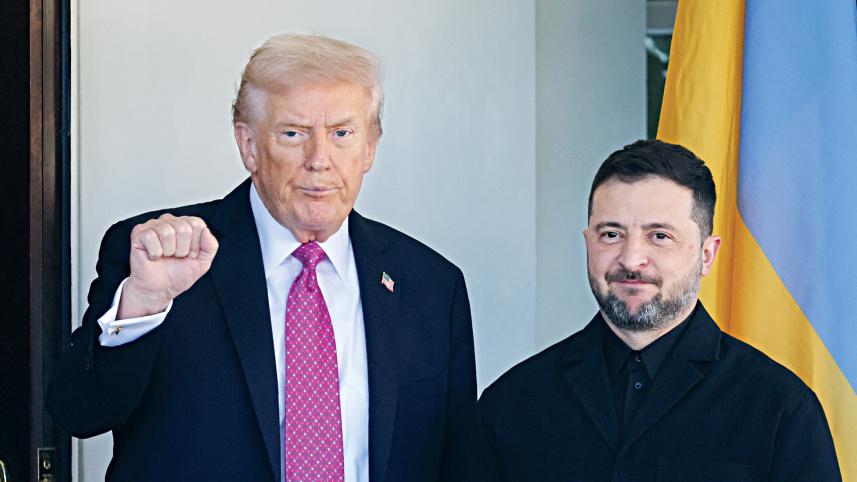
Ukrainian President Volodymyr Zelensky came to the White House on Friday looking for weapons to keep fighting his country's war with Russia, but met an American president who appears more intent on brokering a peace deal than upgrading Ukraine's arsenal.
While US President Donald Trump did not rule out providing the long-range Tomahawk missiles Zelensky seeks, Trump appeared cool to the prospect as he looked ahead to a meeting with Russian President Vladimir Putin in Hungary in the coming weeks.

After speaking with Zelenskiy for more than two hours, Trump implored both Ukraine and Russia to "stop the war immediately," even if it means Ukraine conceding territory.
"You stop at the battle line, and both sides should go home, go to their families," Trump told reporters on his way to his home in West Palm Beach, Florida. "Stop the killing. And that should be it. Stop right now at the battle line. I told that to President Zelensky. I told it to President Putin."
Trump's move to re-engage with Putin, a strategy that has frustrated Zelensky and some European allies in the past, cast a shadow on the US president's otherwise cordial exchange with his Ukrainian counterpart as they spoke with reporters ahead of a private lunch.
The two leaders then went behind closed doors where they also discussed a call the previous day between the Russian president and Trump, who has portrayed himself as a mediator between the warring forces despite the fact that Russia invaded Ukraine in 2022.
"I think President Zelensky wants it done, and I think President Putin wants it done. Now all they have to do is get along a little bit," Trump told reporters.
Zelensky, however, noted how difficult it has been to try to secure a ceasefire. "We want this. Putin doesn't want (it)," he said.
The Ukrainian leader was frank, telling Trump that Ukraine has thousands of drones ready for an offensive against Russian targets, but needs American missiles.
"We don't have Tomahawks, that's why we need Tomahawks," he said.
Trump responded: "We'd much rather have them not need Tomahawks."
Later, Trump reiterated that he wants the United States to hold onto its weaponry. "We want Tomahawks also. We don't want to be giving away things that we need to protect our country," he said.
After the meeting, which Zelensky described as productive, he told reporters he did not want to talk about long-range missiles, saying the US did not want escalation, and that he was "realistic" about his chance of getting them.
The Ukrainian president, who spoke by phone with European leaders after the meeting, said he was counting on Trump to pressure Putin "to stop this war."
When asked about Trump's comments, Zelensky said: "President (Trump) is right, and we have to stop where we are. This is important, to stop where we are, and then to speak."
It was unclear what Putin had told Trump that prompted him to agree to the upcoming meeting. Their August summit in Alaska ended early with no major breakthrough.
The Kremlin said much needed to be decided and that the summit might take place "a little later" than within the two-week period mentioned by Trump.
Trump's conciliatory tone after the call with Putin raised questions over the near-term likelihood of assistance to Ukraine and reignited European fears of a deal that suits Russia. A spokesperson for the European Union said it welcomed the talks if they could help bring peace to Ukraine.
Trump was asked on Friday whether he was concerned Putin might be "playing" him for time by agreeing to talks.
"You know, I've been played all my life by the best of them, and I came out really well, so it's possible," Trump replied.
 For all latest news, follow The Daily Star's Google News channel.
 Trump, who has campaigned for the Nobel Peace Prize, is eager to add to the list of conflicts he says he has been instrumental in ending.
Putin this month said his forces had taken almost 5,000 square kilometres of land in Ukraine in 2025, equivalent to adding 1 percent of Ukraine's territory to the nearly 20% already held.
Both sides have also escalated attacks on each other's energy systems, and Russian drones and jets have strayed into Nato countries.


Comments