


Labour market: Govt looks to Malaysia amid Gulf slowdown


The ongoing war involving the US, Israel, and Iran has slowed Bangladesh’s labour market in the Middle East, particularly in Saudi Arabia, prompting the government to prioritise reopening Malaysia and explore alternative destinations to sustain overseas employment and remittance flows.
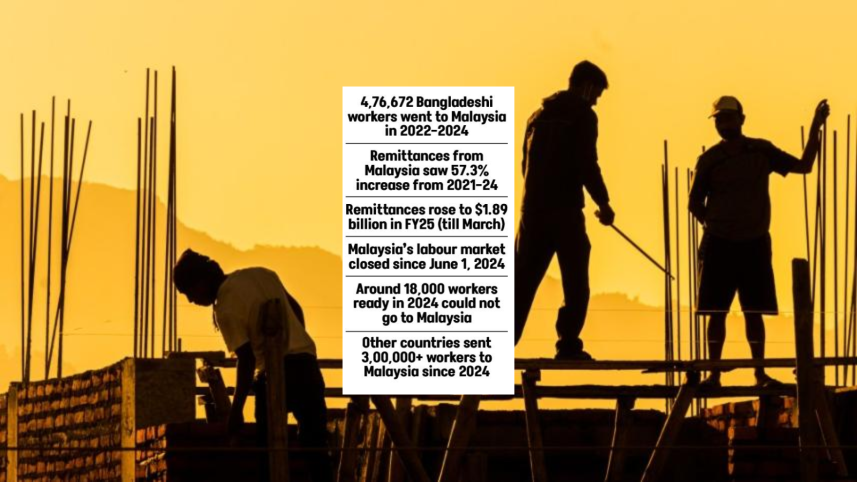
Malaysia, the second-largest destination for Bangladeshi workers after the Middle East, has remained closed to them since June 1, 2024.

Now, with growing uncertainty in Gulf markets, the government is treating reopening the Malaysian labour market as a priority.

As part of the effort, Expatriates’ Welfare and Overseas Employment Minister Ariful Haque Chowdhury and the prime minister’s adviser Mahadi Amin are expected to visit Malaysia on April 8 for discussions, according to ministry sources.
Confirming the development, Ariful told The Daily Star, “We have received an invitation from the Malaysian labour ministry. They want to hold discussions with us, and we are preparing to hold discussions at the government level.
“We are hopeful, but the market is sensitive and has had past complications. We aim to guarantee that individuals do not face any form of harassment. This is particularly important at a time when some of our other labour markets have slowed.”
Under a memorandum of understanding signed between Bangladesh and Malaysia on December 19, 2021, a total of 476,672 workers were sent to Malaysia through 101 recruiting agencies between 2022 and 2024.
The market was suspended in May 2024 over concerns about high migration costs and worker exploitation by recruitment agencies.
Former BAIRA president Ghulam Mostafa, however, said the conflict among recruitment agencies has become a major barrier to reopening the Malaysian labour market and has badly hurt Bangladesh’s labour migration interests.
Ariful said, “We are aware of the longstanding allegations surrounding brokers and the Malaysian labour market. We are looking into them.”
“Since the invitation has come from the Malaysian government, we do not want to miss the opportunity,” he added.
Data from the Bangladesh Bank indicate that remittances from Malaysia have risen steadily, from US $1.02 billion in 2021-22 to US $1.60 billion in 2023-24. In 2024-25, remittances from Malaysia stood at $1.89 billion up to March.
Sources said Malaysia still has significant demand for foreign workers, with estimates suggesting room for around 600,000 more workers, which may rise to 1.2 million or more in the next six years.
Since Bangladesh’s market closed, countries like Nepal, Indonesia, and Myanmar have sent around 300,000 workers to Malaysia, while about 18,000 Bangladeshi workers who were ready in 2024 could not go.
Documents show Malaysia is considering reducing its foreign labour quota to 10 percent by the end of 2026 and to 5 percent by 2035 to boost domestic employment. If Bangladesh cannot resume migration now, future opportunities may narrow sharply, sources warned.
Expatriate ministry officials said Malaysia remains one of the few major destinations for a large number of inexperienced and unskilled workers.
Countries such as Japan and South Korea generally require language skills and technical competence, while Singapore’s market is relatively small.
Officials say the government is also trying to open or expand labour markets in Thailand, Japan, and Singapore as it seeks alternatives to the conflict-hit Middle East.
Md Abul Hasanath Humayun Kabir, director general of the Bureau of Manpower Employment and Training, told The Daily Star that opening new labour markets remained a major challenge.
 For all latest news, follow The Daily Star's Google News channel.
 “We are exploring alternatives, as the Middle East war has slowed down the market in Saudi Arabia. We are prioritising Malaysia, since it is the second-largest labour market for Bangladesh. We are hopeful of reopening it,” he said.
The Malaysian market has been closed three times in the last 16 years, each time amid allegations of syndicates, corruption, and irregularities in recruitment.
THE MIDDLE EAST CRISIS
The conflict has disrupted air travel, with 1,145 flights to and from Dhaka and Chattogram cancelled in the past 33 days since February 28.
Due to the disruptions, migrant workers are facing a crisis in rejoining work.
Boshra Islam, general manager (public relations) of the Biman Bangladesh Airlines, said around 1600 Dammam-bound passengers, most of whom are migrant workers, remained stranded in the country as of April 2 due to the flight cancellation of the national flag carrier.
She said the stranded passengers are gradually returning to their destinations by Biman flight. “Except for Doha and Kuwait, all destinations bound for the Middle East have been resumed.”
Meanwhile, since the start of the war, six Bangladeshi migrants were killed in the Middle East.
Addressing the media on Friday at the airport, State Minister for Foreign Affairs Shama Obaed Islam said the government was working through diplomatic channels to protect Bangladeshi expatriates in the evolving situation and to extend their visas where necessary.
Comments