


Austerity measures are a necessary move
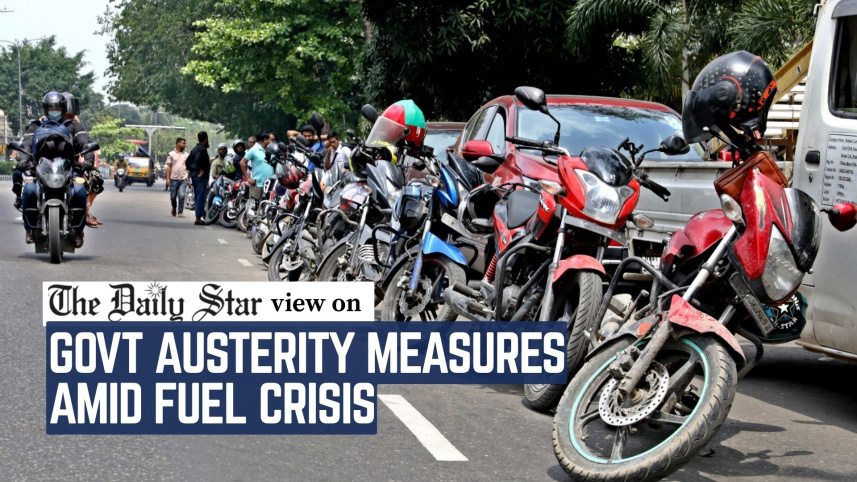
As the US-Israel war against Iran continues to disrupt global energy flows, Bangladesh, like many other countries, faces the economic aftershocks. With the rising oil prices and the resultant pressure on foreign exchange reserves, the government has announced immediate cost-cutting measures to ease the strain on fuel, gas and electricity supplies. Reportedly, all government and private offices will now operate from 9am to 4pm, while banks will close transactions at 3pm and shut fully at 4pm. Shopping malls will close by 6pm, with exceptions for essential services such as pharmacies and food outlets. The austerity measures will also apply to the prime minister, cabinet ministers, and state ministers, whose fuel allocations for official vehicles will be reduced by 30 percent. We welcome these measures.
In addition to reduced working hours, the government expenditure on fuel, power, and gas are to be cut by 30 percent, while foreign training for civil servants has been suspended until further notice. Purchases of government vehicles, vessels, and aircraft have been put on hold. Hospitality budgets for meetings and seminars will be halved, domestic training programmes reduced by 50 percent, and non-essential travel expenditure cut by 30 percent.

The Middle East remains Bangladesh’s key source of fuels and fertilisers, but Gulf suppliers have raised prices or curtailed deliveries. The impact is increasingly visible in our daily economic life. Reduced diesel availability is already affecting irrigation in agriculture, while rising fertiliser and transport costs are putting more burden on farmers. Export-oriented industries are scaling back production due to rising input costs and logistical uncertainty. Concerns are also mounting over potential electricity shortages during peak summer demand, given constrained gas supplies. Recently, the price of cooking gas cylinders has been raised, which will inevitably drive the food costs higher.
Across Asia, governments are responding to the energy shock with a mix of austerity and market interventions. The Philippines has declared a national energy emergency and moved to a four-day work week with consumption caps and subsidies, while Thailand and Vietnam are encouraging remote work and stabilisation funds. India is rationing LPG to prioritise essential use, and Pakistan has introduced compressed workweeks and school closures alongside broader consumption controls. Bangladesh's move towards energy austerity is, therefore, not out of the ordinary. It is necessary.
However, such measures also raise difficult questions about economic resilience in the long run. Shortened working hours may reduce productivity in both public and private sectors, while restrictions on consumption and investment could further slow down an already fragile growth momentum. Reduced business hours may conserve electricity, but they also risk dampening commercial activity, disproportionately affecting small businesses and daily wage earners. Without targeted support, the burden of adjustment risks becoming uneven and unjust. Moreover, the possibility of adjusted school schedules and blended learning raises further concerns about disruptions to education, particularly for students with limited access to digital resources.
The government, therefore, must navigate this crisis with careful balance. Its response must go beyond austerity to ensure that the burden does not fall disproportionately on ordinary citizens. At the same time, it should actively engage with the international community to call for an end to the war and coordinated support for economies bearing its indirect costs.
 For all latest news, follow The Daily Star's Google News channel.
Comments