


Drug addiction is a public health crisis
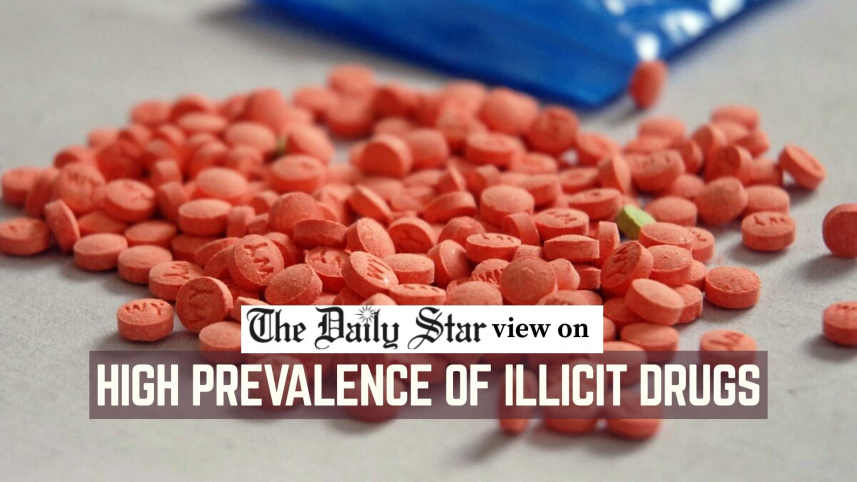
Narcotics numbers tell two stories at once. The Department of Narcotics Control (DNC) seized more than 4.36 crore yaba and other amphetamine-type tablets in 2025—a 91 percent jump from the year before. The other story, revealed by Home Minister Salahuddin Ahmed last week, is even darker: some 82 lakh Bangladeshis, nearly five percent of the population, are addicted to illicit drugs.
Bangladesh's drug problem has a well-understood geography. Yaba and crystal methamphetamine enter mainly through the porous border with Myanmar, where rebel groups have adopted yaba as a narco-currency. Cannabis flows in across the western and northern borders with India. Cox's Bazar, already one of the world's most strained humanitarian zones, is a primary trafficking corridor. The DNC's own report lists two dozen narcotics-prone districts stretching from the Chattogram hills to the northern river plains. Traffickers are inventive: they swallow tablets, conceal them in shoe soles and car tyres, and increasingly conduct their business over encrypted messaging apps and mobile payment platforms.

Against this landscape, Bangladesh has responded with a flurry of announcements. The Narcotics Control Act, 2018 is to be amended. DNC officers will receive modern weapons and updated training. A new legal framework to trace money laundering through anonymous SIM cards and mobile financial services is being drawn up. The government, the home minister says, intends to pursue not just street-level dealers but the "masterminds, financiers and godfathers" of the trade. However, these pledges are often delivered only partially.
Meanwhile, on the treatment side, the home minister has acknowledged the inadequacy of government facilities despite some expansion. The state-run treatment centre in Dhaka's Tejgaon has expanded its bed count. A project is underway to upgrade the Central Drug Addiction Treatment Centre to 250 beds. A Tk 1,413 crore scheme will build 200-bed rehabilitation centres across seven divisional cities: Chattogram, Rajshahi, Khulna, Barishal, Rangpur, Sylhet and Mymensingh. Yet, these projects would not be enough for millions of addicts, especially while the underlying drug supply problem continues to intensify. The emergence of new synthetic and semi-synthetic substances that the minister cited specifically means the demand side is shifting too. Today's addict may not respond to the same interventions as yesterday's. A young population being pulled towards novel stimulants requires a public health response calibrated to the present crisis, not the one from a decade ago.
There is a structural problem that treatment centres and drug busts cannot address. The authorities already know the routes, the carriers, and the dealers. Organised networks with connections to influential quarters continue to operate. Failure to dismantle them is a political one. Until enforcement runs as far up the supply chain, seizure figures will measure effort rather than impact. The government must treat drug addiction as a public health emergency rather than a criminal-justice footnote, insulate enforcement from political interference, and build the prosecutorial muscle to pursue the financial flows that sustain the trade.
 For all latest news, follow The Daily Star's Google News channel.
Comments