


‘The proposed 2+2 dialogue mechanism should not be overinterpreted’

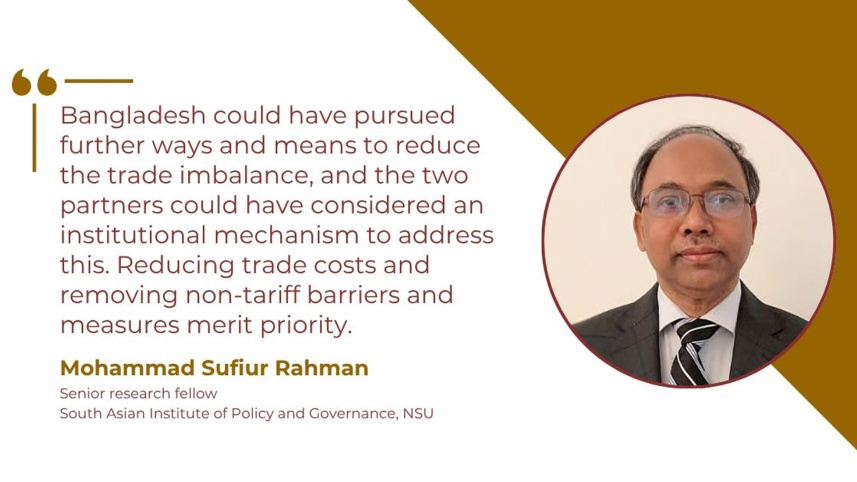
Mohammad Sufiur Rahman, senior research fellow at the South Asian Institute of Policy and Governance in North South University and a former diplomat, speaks with Porimol Palma of The Daily Star about the outcomes of Prime Minister Tarique Rahman’s just-concluded visit to China.
How do you assess Prime Minister Tarique Rahman’s recent visit to China?

The visit should be viewed as part of a broader and continuing process of engagement between Bangladesh and China. Relations between the two countries have steadily deepened over the years; in that context, the visit marks another positive milestone. While there were also important visits in 2024 and 2025, this one appears to have a greater depth. The significance lies not merely in the number of agreements signed but in the quality of understanding and trust as reflected in the discussions and outcomes.
The depth of this visit appears to be reflected in the understanding of the future direction of bilateral relations and implementation. Not everything should be measured by quantity, especially that of investment commitments, business deals and financial aid. Looking at the language and structure of the joint communiqué, I presume that the negotiations were held with greater convergence, the desire to advance interdependence and the spirit of mutuality of interests. Its language indicates that the negotiation was relatively smooth.
Those experienced in drafting such documents can often sense whether difficult negotiations took place. In this case, there are hardly any visible signs of disjointed paragraphs and internal inconsistencies. In the last two outcome documents, there were a few disconnected elements and out-of-place sentences. That suggests good understanding of the priorities and positions of the other side, lesser demands from both sides, a strong desire towards accommodation and collaboration, and close coordination between the sides during the drafting process.
What does the communiqué indicate about the future relationship?
It refers to traditional friendship, (a growing) political trust, and pragmatic cooperation. The emphasis on pragmatic cooperation suggests that both sides are moving away from ideological considerations and instead focusing on practical areas of mutual benefits and complementarities.
The phrase “China-Bangladesh community with a shared future” is also significant. Although China has used similar terminology with other friendly countries such as the Maldives and Sri Lanka, this reflects a broader relationship than a conventional “comprehensive strategic cooperative partnership.” The concept of a “community” goes beyond government-level interaction. It potentially involves political parties, legislatures, and people-to-people exchanges. This indicates utilisation of a broader and more institutionalised engagement framework.
What is the significance of Bangladesh signing an MoU under China’s Global Development Initiative (GDI)?
Although the broader statement expressed support for China’s initiatives, the only specific initiative for which an MOU was signed was the Global Development Initiative (GDI). The exact text of the GDI agreement has not yet been made public, but signing an MoU indicates Bangladesh has moved beyond simply appreciating it or being a “friend of GDI,” which many countries already are. Bangladesh has effectively taken a step forward in relation to the GDI.
The GDI itself does not appear to impose strategic considerations or constraints on Bangladesh. Rather, it can potentially integrate various development initiatives already underway in areas such as education, healthcare, and human resource development. If the GDI serves as an umbrella framework connecting these sectoral efforts on development, their effectiveness may improve while reducing costs and duplication.
In contrast, support for China’s other initiatives appears more general and does not create immediate obligations or commitments. There is no mention of implementation at this stage. Constructive ambiguity has been maintained in those areas, preserving Bangladesh’s strategic space.
How do you view discussions on the Bangladesh-Myanmar-China economic corridor?
Discussions on the proposed Bangladesh-Myanmar-China economic corridor should be understood in the broader context of exploring new regional frameworks for enhanced economic engagement and connectivity options. Traditional connectivity frameworks such as Bangladesh-China-India-Myanmar corridor (BCIM) required India’s participation. With India not showing interest, discussions now seem to focus on alternative routes.
Practically speaking, land connectivity through Myanmar currently remains difficult through Sagaing or the Rakhine state because of the ongoing civil conflict there, as well as in the Shan state. Therefore, the most realistic option at present appears to be maritime connectivity between Chattogram and Myanmar’s Kyaukpyu port. This concept has sometimes been described as a Chinese proposal, but Bangladesh has also actively considered similar ideas. The specific points of transshipment perhaps remain absent from the joint communiqué because Myanmar is the most important stakeholder and decisions cannot be made bilaterally by Bangladesh and China.
There is no reason for external concerns regarding such connectivity arrangements. These routes would not replace existing routes but would simply create additional options for trade, transport and energy security for the participating countries. This could rather increase transparency by involving more actors in areas previously considered exclusive.
Some observers are concerned about the proposed “2+2” dialogue mechanism involving foreign and defence ministries. How do you interpret it?
The proposed “2+2” dialogue mechanism should not be overinterpreted. The communiqué states that both sides agreed to “explore” such a mechanism. This means it remains at an exploratory stage rather than being a finalised arrangement. This has become a common institutional arrangement among countries, and all neighbouring countries have such mechanisms with super powers and major powers. Those are not creating any unease.
Bangladesh can establish similar dialogue frameworks with multiple countries if it wishes to do so. Such arrangements help bring convergences among participating countries and remove irritants. They help preserve strategic flexibility and foreign policy autonomy. The direction itself appears positive because greater engagement can increase Bangladesh’s foreign policy options.
Singapore offers an example of how smaller states use extensive networks and partnerships to improve information-sharing and strengthen security. Security increasingly depends not just on military capability but also on advance information on potential challenges and threats, which contribute to preparedness. This development should, therefore, not be interpreted as Bangladesh moving closer exclusively towards China. Rather than representing a geopolitical tilt, it appears to reflect a desire to follow a balancing strategy.
 For all latest news, follow The Daily Star's Google News channel.
 Bangladesh’s foreign policy should expand options rather than narrow them. Strengthening engagement with China does not require reducing engagement with other countries. In recent months, Bangladesh and the US have considered many mechanisms and instruments in the domain of defence and security. If Bangladesh can simultaneously deepen engagement with China, maintain relations with the US, and eventually improve ties with India, that would reflect its maturity and strengthen its overall position.
What is your assessment of the Mongla port project and the related infrastructure cooperation?
The modernisation of Mongla port should not be viewed through a strategic competition lens only. Mongla, with much less draft, is different from projects such as Matarbari or Sonadia. Comparison with Hambantota is also misplaced. This is not a case of handing over ownership to China. The arrangement involves joint development and management, meaning Bangladesh retains control. The project could improve connectivity for western and northern Bangladesh while having the prospect of creating access for countries such as Nepal and Bhutan and even India. Building infrastructure and using infrastructure are separate issues, and Bangladesh can decide on its usage for various regional stakeholders and negotiate future arrangements independently.
Do you see any areas of inadequacy or shortcomings in the outcome of this visit?
Bangladesh’s firm support to efforts of the Chinese government in “achieving national reunification” may make the resident powers and stakeholders in the Pacific unhappy. This might require some explaining.
Bangladesh could have pursued further ways and means to reduce the trade imbalance, and the two partners could have considered an institutional mechanism to address this. Reducing trade costs and removing non-tariff barriers and measures merit priority.
Bangladesh has not succeeded in generating greater Chinese interests in the stabilisation of Rakhine and in creating a conducive atmosphere in north Rakhine. Merely facilitating the Bangladesh-Myanmar engagement has not produced anything concrete in the last eight years. The protracted situation demands creative engagement of regional countries, in particular China.
Follow The Daily Star Opinion on Facebook for the latest opinions, commentaries, and analyses by experts and professionals. To contribute your article or letter to The Daily Star Opinion, see our guidelines for submission.
Comments